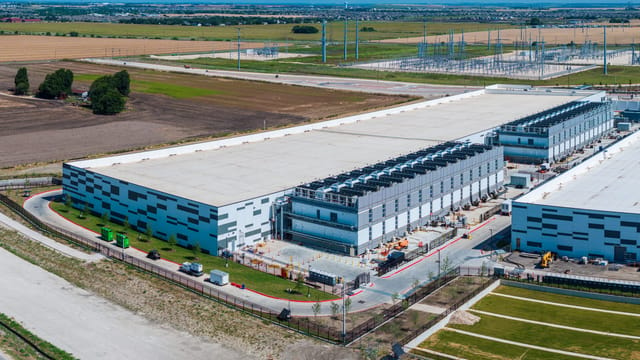
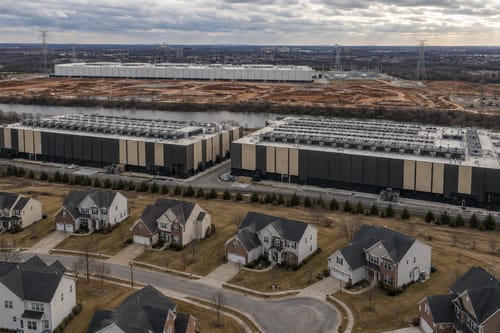

Big tech got the chance to make its case for data centers Thursday before Ohio lawmakers. The so-called hyperscalers — companies responsible for facilities with thousands of servers and footprints measured in football fields — insist they’re good neighbors and a vital part of Ohio’s economy.
Many lawmakers on Ohio’s Select Committee on Data Centers seem willing to hear out Meta, Amazon, Google and Microsoft. But many ordinary Ohioans have had enough. They’re furious about a string of projects shielded from public view by nondisclosure agreements. They worry about the facilities’ impacts on the environment and the power grid. They argue it’s absurd to hand out tax breaks to trillion-dollar companies.
The rising tide of public animosity and mistrust was on full display early last week. Ohio state Rep. Heidi Workman, R-Rootstown, tried to convey that frustration.
“You’re doing a terrible job actually selling your product,” she told the companies’ representatives. “Respectfully, you’re far behind the narrative on this.”
To put the trust deficit in context, Workman described putting a call out to her constituents the night before.
“Over 90% of the responses I received last night are basically telling me we do not want this, no matter what you say,” she said. “They say that they do not believe anything that the data centers are telling them.”
Although the companies readily acknowledged they could do better a job “telling our story,” it seems doubtful their testimony earned many converts.
Conserve Ohio, a group gathering signatures for a constitutional amendment halting new data centers, certainly wasn’t swayed. In a statement, the organization said the testimony “was tone deaf, empty with generalities, and provided no real answers.”
“We see and hear everything and know who they truly are. They do not fool us,” the group wrote. “Big tech is showing yet again that confidentiality, secrecy, and massive tax breaks are still their top priorities, not Ohio.”
Trying to allay concerns
The hyperscalers did their best to tamp down fears about water contamination, air pollution and rising energy costs.
Google’s Liz Schwab explained “our data centers leave watersheds more resilient, and we’re committed to replenishing 120% of the water we consume globally.”
She acknowledged adding chemicals to their internal water systems but compared it to putting chlorine in your pool to avoid algae. Each company insisted they’re not adding so-called forever chemicals to their systems.
Thor Underdahl from Meta explained the company is aiming to be “water positive” by 2030. Craig Sundstrom from Amazon Web Services said they’re pursuing the same target. Already in Ohio, he added, Amazon uses water for cooling their data centers just 3% of the year — their annual water use amounts to less than two car washes.
As for air quality, Sundstrom said that Amazon has upgraded its backup generators to meet “the most stringent EPA emissions requirements available.” He stressed those generators are also only permitted for emergency use.
“So, under federal EPA and then state implementation regulations, we can only run those for a finite period of hours every year.”
Every one of the companies offered some version of the “pay our own way” pitch Daniel Brown made for Microsoft.
“Our goal is that we do not increase electricity rates for other ratepayers,” he said. “We pay utility rates that are high enough to cover our costs, we pay costs associated with generation, transmission, and distribution upgrades, and we make sure that our costs don’t impact other ratepayers.”
Not quite getting there
As lawmakers began asking questions, though, holes began to appear.
Ohio state Sen. Shane Wilkin, R-Hillsboro, pressed the companies to explain what exactly “covering all the costs” or “we’ll pay our own way” meant to them. Microsoft may not want to raise consumer electricity rates, Wilkin said, but how does that square with the law of supply and demand?
“If there’s 100 megawatts and you need 50,” he said, “and there’s no more (power) brought on, you say, ‘Well, I’m paying for the 50 that I’m getting,’ is that fair to the residential consumers? And how does that not drive up the bills?”
“We don’t always control increases in rates as sometimes people assume,” Brown said, “but anything that we can control, we will pay for our fair share.”
The companies expressed support for a statewide version of the data center tariff recently implemented for AEP Ohio. That pricing agreement requires significant financial commitments on the front end to pay for new infrastructure as well as financial penalties if a data center closes before the end of the agreement.
Still, Sundstrom from Amazon, warned “rate-making is different than energy pricing.” Even with the tariff’s consumer protections in place, he said, outside factors like the COVID-19 pandemic or the war in Ukraine can influence prices.
“Those things are going to necessarily be out of, I think, our individual control, certainly out of the control of Amazon,” he said.
In a narrow win for data center skeptics, Brown told the committee Microsoft will no longer use nondisclosure agreements or seek property tax abatements for its development projects. Wilkin asked the other companies if they’d make the same commitment to forgo abatements. He got no takers.
Schwab, from Google, said those agreements are “a great example of how competitive we all are.” The deals are a way for companies to demonstrate their value to local communities, and she said Google has been responsible for some $21.8 billion in economic activity in Ohio.
“The local revenue and jobs are significant, so we’ll continue to push each other, right?” she said. “But at the end of the day, local governments and the local leaders where we operate will make that call.”
Later, Ohio state Sen. Bill Reineke, R-Tiffin, asked about nondisclosure agreements. Sundstrom defended them as “an important economic development tool,” and put the onus on local leaders.
“It’s a tool for local governments to use if they choose to use them or not,” he said, and encouraged the panel to ask local officials about NDAs when they testify.
“From our perspective,” he said, “they see it as a viable tool in order to foster the type of economic development discussions that they’re interested in having.”
The sales tax exemption
The most widely criticized tax break is Ohio’s sales and use tax exemption. Supporters note tax officials award the incentive on a case-by-case basis. But Ohio lawmakers attempted to repeal it as part of the most recent state budget. Gov. Mike DeWine vetoed that provision.
Last month, Signal Ohio reported the exemption cost the state $1.6 billion — or roughly 11 times original projections. Not long after, DeWine paused new exemptions.
Schwab sought to put a positive spin on the ballooning foregone revenue. “It is an indication of how successful Ohio has been at attracting this industry,” she said, and pointed to an Ohio Chamber report suggesting each incentive dollar brings back $2.10 in other tax revenue.
Each companies’ representative acknowledged they take advantage of the same sales tax exemption. Despite DeWine’s pause on new tax agreements, their existing tax breaks will not be affected.
“If Ohio continues to be successful at attracting data centers, or even if Ohio just sees reinvestment in its existing data centers, that dollar amount will go up, right?” Schwab said. “It’s a sign that companies are reinvesting and spending money on chips and servers in the state of Ohio.”
And that dollar amount could keep going up for a while. Sundstrom said Amazon’s exemption runs through 2055.
Follow Ohio Capital Journal Reporter Nick Evans on X or on Bluesky.
This story is republished from the Ohio Capital Journal under a Creative Commons license. View the original article.