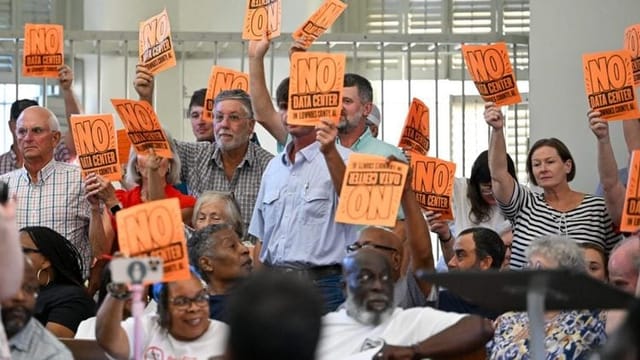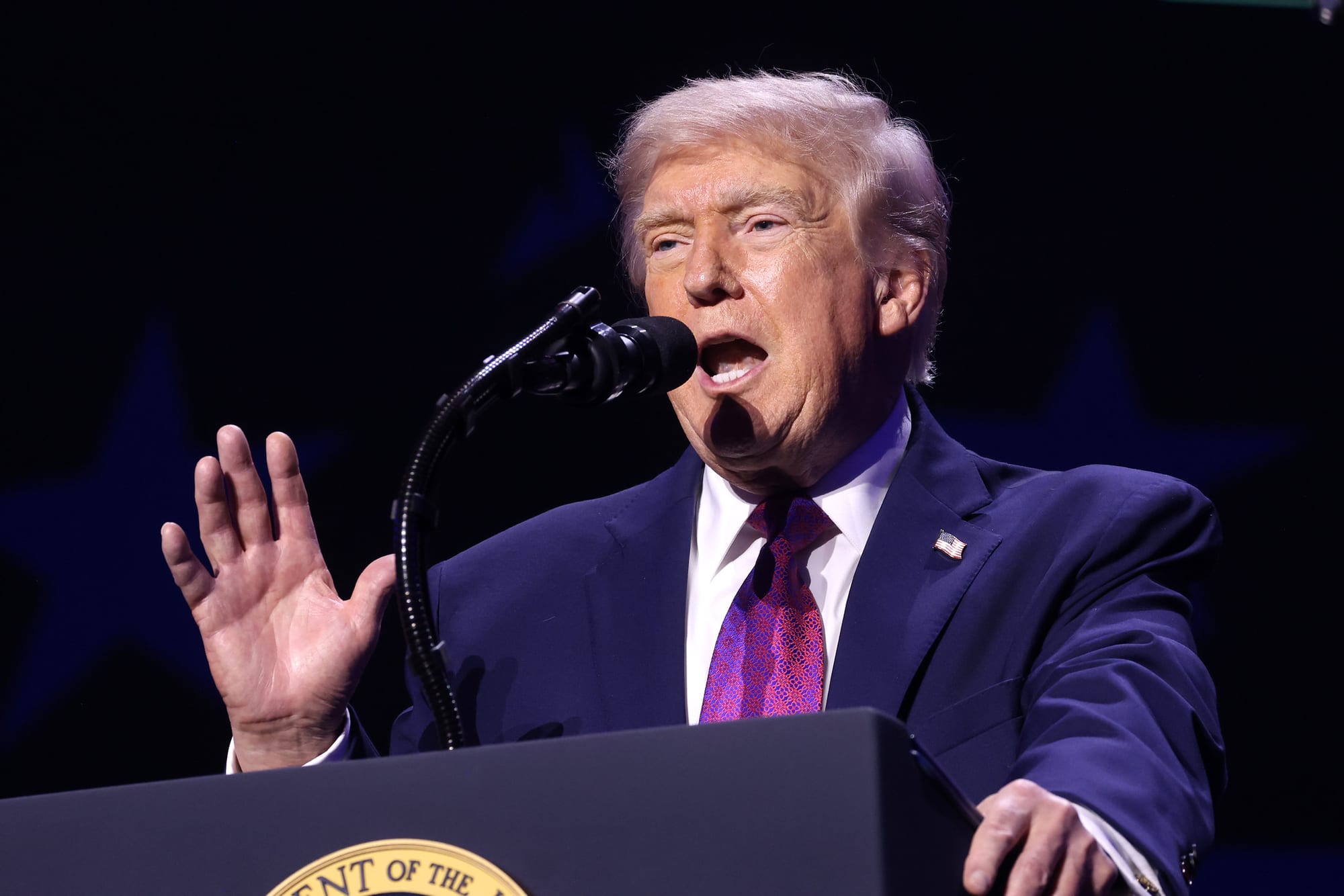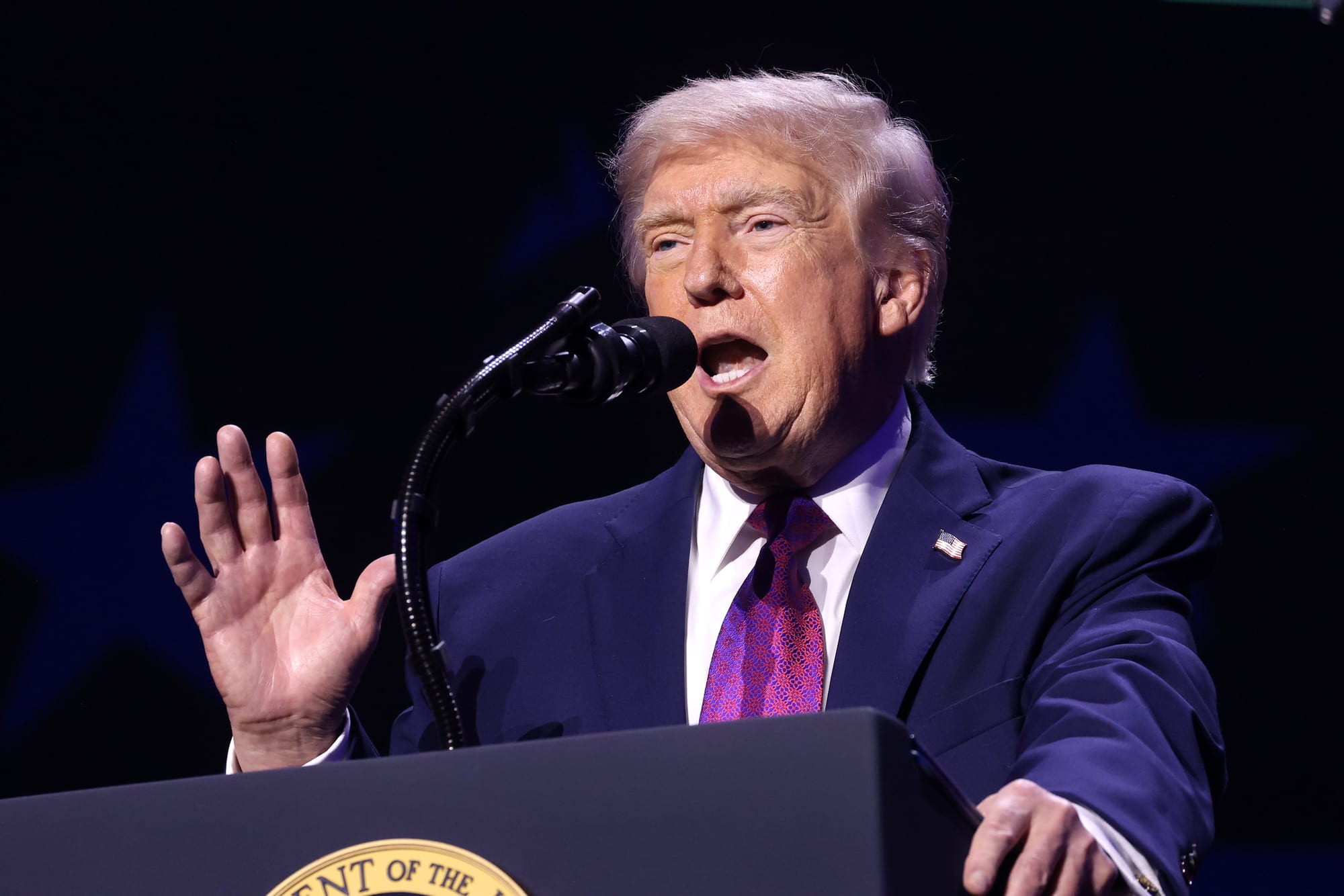
President Donald Trump says American communities that do not want data centers risk becoming “backwards and poor,” delivering one of his most direct attacks yet on the growing grassroots movement pushing back against the massive facilities over electricity costs, water use, farmland and local control.
“The only reason that communities throughout the U.S.A. should not want Data Centers is if they want to end up being backwards and poor,” Trump wrote Monday on Truth Social.
“If they want to be successful and rich, with far lower taxes and jobs all over the place, let Data Reign,” Trump continued. “The good news is that there are plenty of other places that want them. If we kill the Golden Goose, you will only have yourselves to blame.”
Trump then suggested that opposition to the massive computing facilities was benefiting China.
“China could not be happier with this anti Data Center movement,” Trump wrote. “Actually, they can’t believe it is happening!”
The broadside comes as opposition to artificial intelligence data centers has become a growing political problem for an industry racing to build power-hungry computing campuses across the country — including throughout Ohio.
It also lands directly in northwest Ohio, where communities have already begun using local zoning authority to slow the industry’s advance.
Tiffin City Council voted 6-0 in April to impose a 12-month moratorium on data center development while the city considers what zoning rules should govern the facilities.
No data center project had been proposed in Tiffin when council acted. Instead, the city chose to study the issue before a developer arrived, with electricity demand, water consumption, agricultural land and infrastructure among the concerns surrounding the industry’s expansion.
Under Trump’s framing Monday, communities taking that cautious approach risk doing economic damage to themselves.
Trump’s China warning has an Ohio parallel
Trump’s suggestion that American opposition to data centers benefits China also closely resembles a narrative that has already made its way into Ohio legislation.
Embattled state Rep. Gary Click, a Republican ex-pastor and former community theater actor representing Seneca and Sandusky counties, and Rep. Kellie Deeter introduced House Bill 646 earlier this year to establish an Ohio Data Center Study Commission.
The proposal directed the state-created commission to examine environmental impacts, electricity demand, consumer utility rates, water use, noise, farmland and local economic effects.
But the House-passed legislation also ordered the commission to investigate something substantially different: “reports of foreign propaganda intended to create opposition to data centers.”
The language appears in the Ohio Legislative Service Commission’s official analysis of the legislation.
Click’s proposal therefore placed alleged foreign efforts to encourage opposition on the list of subjects Ohio officials would be required to investigate alongside the tangible environmental and infrastructure consequences of the facilities.
That language preceded — and foreshadowed — a broader effort by members of the Trump administration and industry advocates to connect domestic resistance with foreign influence.
Interior Secretary Doug Burgum claimed in May that American communities were being “bombarded” with foreign propaganda designed to stop data center development, according to The Washington Post.
The newspaper reported that Burgum and billionaire investor Kevin O’Leary, who made similar allegations, did not provide conclusive evidence that foreign actors were responsible for the widespread American backlash.
Trump has now taken that argument directly to the public, telling Americans that China “could not be happier” with the anti-data-center movement.
Husted helped make Ohio a data center destination
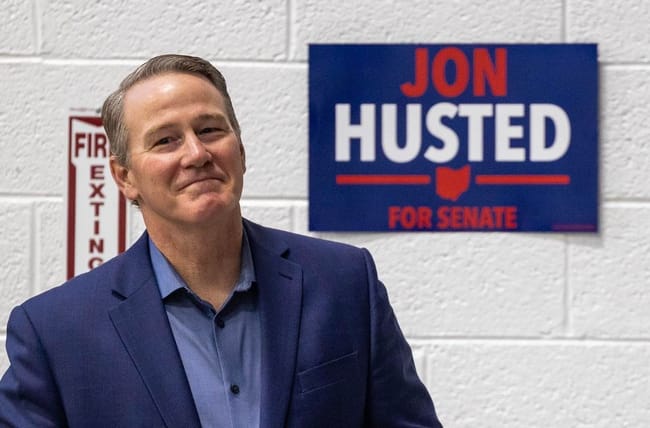
Trump’s declaration also follows years of aggressive data center recruitment by Ohio Republican leaders — perhaps none more visibly than U.S. Sen. Jon Husted.
As lieutenant governor from 2019 until his appointment to the U.S. Senate in 2025, Husted repeatedly promoted Ohio as a destination for some of the world’s largest technology companies and publicly championed billions of dollars in data center investment.
One month after Husted took office as lieutenant governor, Google announced its first major Ohio data center project: a $600 million facility in New Albany.
“Google investing in Ohio to open a new data center is great news for our state,” Husted said at the time. “Ohio is establishing itself as a premier destination for technology investment, and it further strengthens our case that Ohio is becoming the tech capital of the Midwest.”
The project came with a 15-year state sales-tax exemption estimated at $43.5 million, along with a 15-year local property-tax abatement.
When Google broke ground in 2019, Husted explicitly defended those incentives.
“This will fuel the economy for many years in Ohio,” Husted said, arguing that Columbus could become the “tech hub of the Midwest.”
Husted went further, saying that imposing the sales tax would have chased Google out of Ohio.
That is an important distinction in Husted’s record. He did not create Ohio’s original data center sales-tax exemption, which the General Assembly enacted in 2011 before he became lieutenant governor. But once in the DeWine administration, Husted became one of the state’s most visible defenders of using that incentive structure to attract and expand data centers.
The administration continued approving data center tax incentives during his tenure.
In 2023, for example, the Ohio Tax Credit Authority approved a 75%, 15-year data center tax exemption for Aligned Data Centers’ proposed project in Perkins Township in Erie County — a project expected at the time to create 18 full-time jobs and $1.6 million in annual payroll.
Husted and Gov. Mike DeWine’s administration announced the project as part of a package of state-assisted economic development investments.
At the same time, Husted was helping promote vastly larger projects.
In June 2023, Husted joined DeWine and JobsOhio in announcing that Amazon Web Services planned to invest another $7.8 billion expanding its Ohio data center operations.
“This enormous capital investment further solidifies Ohio as the tech center of the Midwest and positions us for a bright future as cloud computing and artificial intelligence are more integrated into the economy and our everyday lives,” Husted said.
The expansion was billed as the second-largest private-sector company investment in Ohio history.
Husted was still promoting the industry’s expansion a year later.
When Google announced another $2.3 billion investment in its Ohio infrastructure in June 2024, Husted said, “Data centers are essential to our digital lives and Google’s additional multibillion dollar investment further establishes central Ohio as an important tech hub in America.”
“We value Google’s continued investment for the jobs and economic impact,” Husted said, adding that Ohio looked forward to further partnerships involving artificial intelligence and energy.
By December 2024, Husted and DeWine were announcing another planned $10 billion expansion by Amazon Web Services.
AWS said the investment could expand its Ohio infrastructure to as many as eight additional sites by 2030 and was intended in part to meet rapidly growing demand for artificial intelligence computing.
The result is an Ohio landscape in which the state’s major data center operators secured extraordinarily valuable long-term tax advantages while investing tens of billions of dollars in new facilities.
The cost of those exemptions eventually exploded far beyond state projections.
As TiffinOhio.net previously reported, Ohio Department of Taxation figures showed the data center sales-tax exemption cost the state nearly $1.57 billion in 2025 alone, compared with an earlier projection of about $136 million.
Separate reporting found that some of Ohio’s largest technology companies secured agreements allowing sales-tax exemptions to continue for decades.
Google, Meta and Amazon all entered statewide agreements offering 100% exemptions that could last as long as 40 years if investment requirements were met.
As public opposition intensified, Husted began recalibrating his position.
He now says Ohio should stop granting the broad sales and use tax exemption to new data center projects — an incentive he once fiercely defended — and has promoted proposals intended to prevent data centers from shifting electricity costs onto residential ratepayers.
But that shift comes after years in which Husted promoted the facilities as central to Ohio’s economic strategy, defended the tax breaks used to attract them and helped announce multibillion-dollar expansions by Google and Amazon.
In a July interview, Husted offered another defense of the industry’s existence.
“If you’re connected to a wire, you’re using the data center,” Husted said. “So, understand that when we look in the mirror, we are the problem.”
The issue has now become politically dangerous enough that Republican strategists themselves are sounding alarms.
A leaked National Republican Senatorial Committee memo reported by Axios in August warned that data center opposition posed a serious threat to Husted’s campaign against former Democratic Sen. Sherrod Brown, describing the issue as an “anchor hanging around Husted’s neck.”
Ramaswamy spent months calling the boom ‘good’
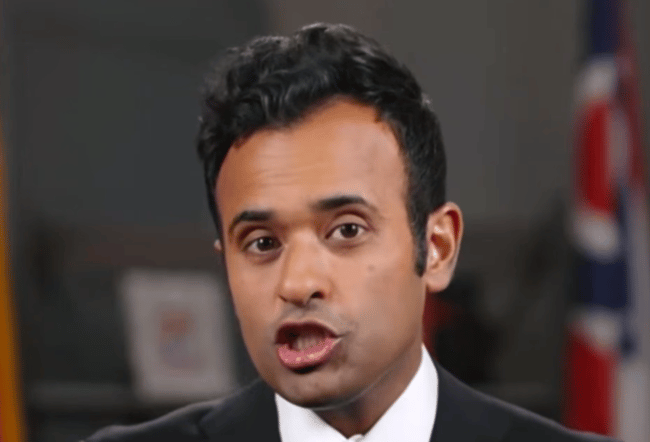
Trump’s aggressive defense of the industry is also much closer to Vivek Ramaswamy’s longstanding position than Ramaswamy’s more recent campaign rhetoric might suggest.
Before data center opposition became a major Ohio political issue, the Republican nominee for governor repeatedly celebrated their arrival.
Speaking at a Republican event in Jefferson County in March 2025, Ramaswamy was explicit.
“It takes two years to build an AI data center or Bitcoin mining firm or whatever — all of which I want in the state, by the way,” Ramaswamy said.
That was not an isolated remark.
As TiffinOhio.net previously documented, Ramaswamy described Ohio’s data center boom as a positive development at least 10 times in recorded appearances and posts during a five-week period in March and April 2025.
“We’ve got AI data centers moving to our state. That’s a good thing. It’s a good thing. I want the sectors of the future to come here,” he said on March 27.
Days later, he was even more explicit.
“We have an AI data center boom in the state of Ohio, which is great,” Ramaswamy said. “I’m all for it, I’m strongly in favor of it.”
His argument throughout that period was not that Ohio should slow data center construction because the facilities consumed too much electricity. It was that Ohio should dramatically expand energy production to accommodate them.
“We’re seeing an AI data center boom (which is good), right at the time when we face supply constraints on baseload power generation,” Ramaswamy wrote in March 2025.
Ramaswamy has since tried to reposition himself as voter opposition intensified.
Earlier this month, his campaign announced an “Ohioans-First” data center proposal that would temporarily halt new approvals until new restrictions are enacted.
But the plan does not propose eliminating the industry. Ramaswamy explicitly rejects a “permanent categorical ban” and says preserving economic growth, investment and jobs from data centers remains an objective.
Under his proposal, data centers would continue being built if they meet his conditions.
That makes his new position a change in the terms under which he would allow the industry’s expansion — not a repudiation of an industry he spent months saying he wanted in Ohio.
Seven in 10 Americans oppose a data center where they live
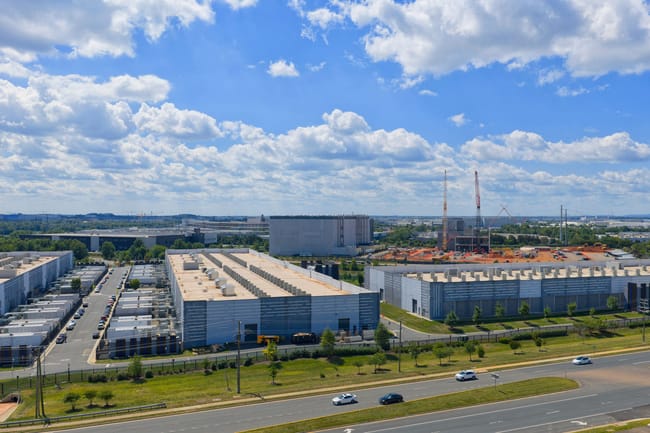
Trump’s characterization of opposition as a road to poverty also runs directly against national public opinion.
A Gallup survey published in May found 71% of Americans opposed construction of an artificial intelligence data center in their local area.
Nearly half of Americans — 48% — said they were strongly opposed. Just 7% strongly favored having one built nearby.
Opposition was even higher in the Midwest, where 76% opposed local construction.
And resistance crossed party lines. Gallup found majorities of Republicans, Democrats and independents opposed having a data center built where they live.
The reasons opponents gave were overwhelmingly domestic and practical.
Half cited excessive resource consumption. Gallup found 18% specifically mentioned water use and another 18% cited electricity consumption. Others pointed to pollution, noise, traffic, quality-of-life changes, higher utility bills, increased costs of living and taxpayer subsidies.
Gallup concluded that the intensity of opposition could fuel significant grassroots activism and make data center development a major issue in state and local elections.
That backlash is already visible in Ohio.
Tiffin has paused new development. Residents elsewhere are organizing around farmland, electricity, water and zoning. Data centers have become a liability in Ohio’s U.S. Senate race. And Republicans are increasingly scrambling to promise that residential customers will not be stuck paying the industry’s power costs.
Yet Ohio did not become one of America’s leading data center destinations accidentally.
For years, state leaders recruited the industry, celebrated its multibillion-dollar investments and used tax incentives to make Ohio more attractive to developers.
Husted argued that taxing Google could have cost Ohio the project. Ramaswamy declared himself “strongly in favor” of the data center boom. Click sponsored legislation instructing state officials to investigate “foreign propaganda intended to create opposition” to the facilities.
Trump has now distilled those arguments into their starkest form.
Communities that embrace data centers, he says, can become “successful and rich.” Communities that resist them risk becoming “backwards and poor.” And the Americans organizing against the projects, according to the president, are making China happy.
For communities asking whether they actually want the data center boom in their backyard, Trump’s message leaves little room for dissent: “let Data Reign” — or risk being left behind.