
This story was originally published by Signal Ohio. Sign up for their free newsletters at SignalOhio.org/subscribe.
When the purple lights turn on, the robots have taken the big rig’s wheel.
Over flat highways and rolling rural hills, a small fleet of passenger vehicles and tractor-trailers have been learning to drive on Ohio’s roads for years now. But for the first time this summer – though on semi-private roads – some don’t have human drivers present.
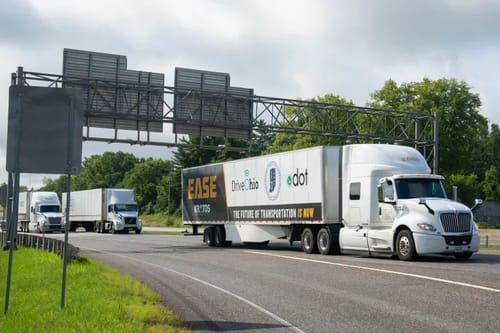
These first deployments of autonomous trucks and cars, backed by artificial intelligence and a suite of lidar (similar to radar, but using light instead of radio waves) and camera technology, are limited in scope. The trucks are festooned with purple lights, which the truck’s operators say will send a clear signal of an autonomous driving mode to law enforcement without advertising their status to anyone looking to stress test it.
Ohioans are unlikely to see them in the wild just yet. But they could be early indications of a significant shift away from human beings controlling our cars.
The state currently only allows fully self-driving cars on the road for testing and research. In most self-driving deployments in Ohio, a human sits behind the wheel ready to take over, especially in more complicated driving environments such as construction zones or during bad weather.
A full rollout of self-driving cars and trucks would require a change in state law. But at least one company trying to build out a self-driving workforce says its products are ready and they’re only waiting on the law and the public to catch up.
Driverless truck technology ‘ready,’ says one Ohio company
Autonomous vehicle testing is led by DriveOhio, an office in the Ohio Department of Transportation. Gov. John Kasich created the office via executive order in 2018, and it has carried on since.
Farthest along in the local automation race is Ease Logistics, a Dublin, Ohio, company that’s mostly an old fashioned freight brokerage that’s dabbling in autonomous trucking. Over the past few years, the company has tested “platooning” mode in its trucks, with the underlying technology coming from Kratos Defense of California. The term refers to one platooned vehicle following another and mimicing its behavior while analyzing its own camera and lidar feeds to maneuver.
In 2022, a fleet of both trucks and cars spanned thousands of miles of rural and windy roads in Vinton and Athens counties with both automated and platooning technologies. A state report of company data noted more success with the trucks than cars, which required more frequent driver engagements and struggled to predict other drivers’ behavior.
More recently, Ease trucks accrued 3,000 miles in platooning mode with a human backup driver present, according to data submitted to DriveOhio this summer, not counting the human-engaged miles on the interstate.
While there were a handful of what are known as “excessive braking events” – the company and DriveOhio haven’t yet analyzed all the data – there were no crashes in platooning mode on I-70, and Chief Administrative Officer Abbi Fallia is bullish on the future.
“The Kratos technology could be ready. It is ready. It could be automated,” she said in an interview. “We could automate that and take the second driver out of the cab. So we’re there. It’s more of a regulation thing than a capability thing.”
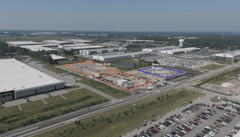
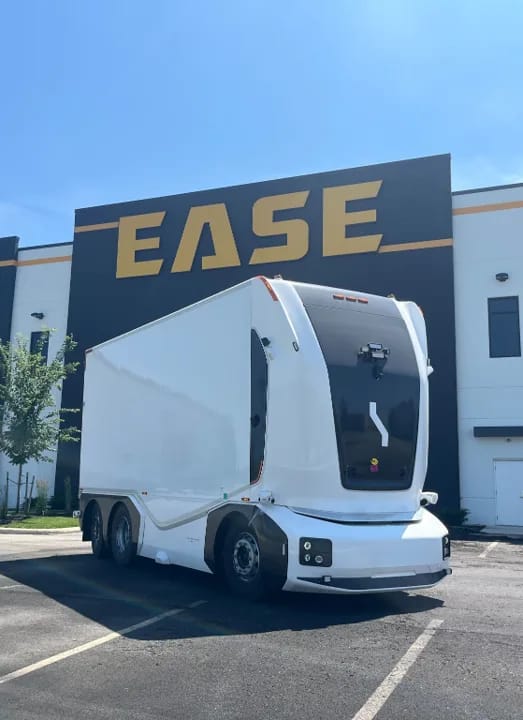
And at the company’s warehouses in Marysville, the trucks drive themselves, by themselves – with tech from Einride, a Swedish company.
Rather than tractor-trailers, Ease’s fully self-driving vehicles look more like shoeboxes than trucks. At modest speeds of 15 mph, the all-electric haulers shuttle a short loop on quasi-private roads within a corporate park. But they carry real cargo. And Falli is eager to expand its testing onto a nearby 45 mph roadway, or even U.S. 33.
Truckers have fought autonomous driving in other states
The self-driving truck industry is most developed in mild weather states in the Southwest. But Ease is hoping its technology can learn the nuances of driving in variable midwestern weather like hail or heavy rain.
Company data indicates the platooning mode is making its trucks more fuel efficient. Down the line, Fallia thinks the trucks could produce “efficiencies” for truckers. For instance, two drivers could tag-team a route hauling two trucks, one leading and the other napping or doing administrative work while platoon mode handles the driving.
There’s also a reasonable risk of eliminating at least some trucking jobs. Self-driving technology doesn’t need sleep, meals or pay and will happily drive at night when the roads are less crowded.
The Teamsters union, which represents truck drivers, last month sued to block a California law allowing self-driving trucks on roadways. The union has fought permissive laws in other states.
“Self-driving trucks are an existential threat to the livelihoods of Teamsters members in California who deliver food and other essentials and are a crucial economic engine for the state,” the union said in a statement announcing the lawsuit.
Hurdles remain, according to Breanna Badanes, a spokeswoman for DriveOhio in an interview. Some systems struggled with work zones, which aren’t always marked in a standardized way with signage positioned for cameras to read. And spotty cell or satellite signals can cause platooning to disengage.
“We’re still a ways off from being able to remove that second driver from the driver’s seat,” she said. “The technology is getting there, but it’s not there yet.”
Other companies are testing in Ohio as well. Kodiak AI, a California company, says it’s planning its “driverless launch” in Texas by the end of the year. And this spring, the company put on a demonstration for DriveOhio with Level 4 autonomy, meaning no driver present.
Scenarios demonstrated included navigating construction zones, merging onto highways, passing slower vehicles, yielding to disabled vehicles, and responding to unexpected pedestrian crossings.
“We do envision our driverless technology scaling broadly in the years ahead,” said Kodiak spokesman Pete Bigelow. “We believe it will bring improved safety to roads across the United States and keep freight moving reliably and efficiently.”
There are no autonomous passenger vehicles currently on the road, but Waymo, which has robotaxis on the streets in several Southwestern states, recently told Cincinnati news outlets that it has begun high definition mapping of some of the roadways there.
Are driverless vehicles safe?
No crashes have been reported in any DriveOhio deployments, according to Badanes.
A final report on Ease’s Southeast Ohio deployments notes six “excess braking” events. And Fallia estimated a similar amount for the I-70 deployment.
Companies are hoping computers will mitigate human errors in driving like distraction or dozing off.
It’s unclear for now whether the automated trucks are any safer than the human-driven ones, according to David Kidd, a Vice President for Vehicle Research at the Insurance Institute for Highway Safety, a nonprofit funded by insurers that evaluates vehicle and roadway policy.
Preliminary research is starting to show that robo-taxis are crashing less than human drivers in the same area, he said. For instance, using self-reported data from Waymo of its self-driving, IIHS analysis found they crashed at a 68% lower rate.
That said, it’s too soon to tell with trucks. And just because autonomous cars are safer doesn’t mean trucks are. Truck drivers’ working hours are limited and must undergo higher training requirements than regular drivers. And large trucks can do far more damage than much lighter cars at the same speeds.
Kidd pointed out there’s an important check in the system. Widespread deployment of autonomous vehicles requires both political and public support. The industry, he said, will need to prove itself to succeed.
“It may feel like the wild, wild west when it comes to regulation, the types of information these companies have to report, or the extent to which they have to prove themselves,” he said. “But you have to remember that these companies, if they don’t earn the trust of the public or demonstrate safe driving behavior or a safety-first attitude, then they’re not going to survive.”
Signal Ohio is a nonprofit news organization covering government, education, health, economy and public safety.