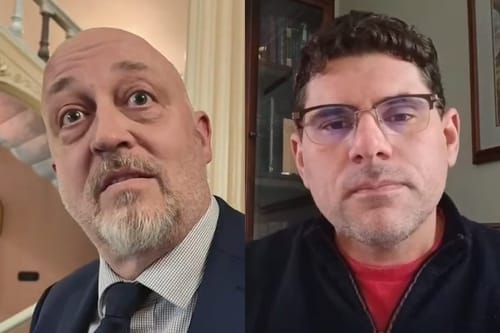

Republican primary challenger Eric Watson accused State Rep. Gary Click of having a “surveillance state fetish” in a video deleted hours after it was posted to Facebook on Monday, tying together three bills Click cosponsors that Watson said would build out a government surveillance infrastructure in Ohio.
“My opponent Representative Gary Click has a Surveillance State System fetish!” Watson wrote in the post. “He is supporting multi legislation that is going to infringe on constituents’ constitutional rights!”
In the accompanying video, filmed from his vehicle, Watson named three bills: House Bill 78, which would authorize the use of a digital driver’s license or state ID card; House Bill 116, the Ohio Blockchain Basics Act; and House Bill 649, the Child Care Fraud Prevention Act.
Click (R-Vickery) is a cosponsor of all three bills, according to Ohio legislative records.
Watson also said Click told him directly that he had not read HB 649 before signing on as a cosponsor. Watson said the exchange took place “about two Thursdays ago” with a witness present.
“I did ask Gary … if he actually read the legislation for House Bill 649,” Watson said in the since-deleted video. “And he said that he did not have time to do it. He took advice from a colleague that he thought he could trust … I said, well, you should have read it. He said, ‘Eric, that’s not how it works.’ And I said, well, that’s exactly what’s wrong. And I said, that’s what makes me and you different. I will actually read the legislation before I ever put my name on anything.”
Click has not publicly responded to the video. TiffinOhio.net could not independently verify the conversation Watson described.
What the bills actually do
HB 78, sponsored by Reps. Thomas Hall (R-Madison Twp.) and Joe Miller (D-Amherst), would authorize Ohioans to use a digital driver’s license or digital state ID on a cell phone, tablet, or other wireless device in lieu of a physical card. The bipartisan bill remains in the House Technology and Innovation Committee.
HB 116, sponsored by Rep. Steve Demetriou (R-Bainbridge Twp.), passed the Ohio House 68-26 in June 2025 with bipartisan support. The bill would bar local governments from imposing certain taxes or fees on digital asset transactions, protect self-custody of cryptocurrency wallets, and allow residential and industrial crypto mining subject to local zoning. The measure is under consideration in the Ohio Senate.
Watson’s video linked HB 116 to “data centers” and a “cashless society.” HB 116 itself does not address data centers; it is limited to blockchain and digital asset regulation. The data center legislation Click co-authored is a separate measure — House Bill 646, which would establish a 13-member state study commission on data center impacts. Watson previously criticized HB 646 in a separate video in March.
HB 649, sponsored by Reps. Josh Williams (R-Sylvania Township) and D.J. Swearingen (R-Huron), would require every licensed child care center in Ohio to install video surveillance cameras at all entrances, exits, and general non-private areas. Footage would be retained for 60 days and made available to the Ohio Department of Children and Youth for compliance reviews. Within 12 months of enactment, the department would gain live, remote access to the camera feeds.
A substitute version of the bill, analyzed by Policy Matters Ohio, would have required daily facial recognition scans of children for attendance verification. At a March 24 committee hearing, an amendment was added prohibiting the storage of photos or videos of children themselves, though the camera mandate and attendance tracking features remain part of the bill.
HB 649 carries 28 cosponsors, all Republicans, and remains in the House Children and Human Services Committee. A companion measure, House Bill 647, would give the Ohio Attorney General direct authority to investigate and prosecute child care providers and strip providers of appeal rights on state funding decisions.
Context heading into May 5
Watson’s video comes just over two weeks before the May 5 Republican primary for the 88th Ohio House District, which covers Seneca and Sandusky counties. Early in-person voting began April 7.
Click has declined to debate Watson throughout the primary and skipped the League of Women Voters’ District 88 candidates forum in Tiffin earlier this spring. Watson has made Click’s legislative record — particularly on digital ID, data centers, and campaign finance — the central focus of his insurgent challenge.
The winner of the May 5 primary will face Democratic nominee Aaron Jones, a Tiffin City Councilman and U.S. Army veteran, in the November general election.