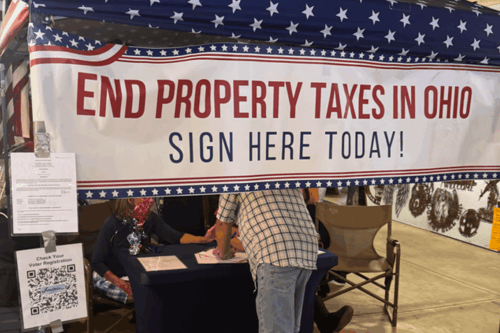
LAKE COUNTY, Ohio — A grassroots effort to put a constitutional amendment eliminating property taxes on the November ballot in Ohio has come up short. Now organizers say they’re refocusing their efforts on 2027.
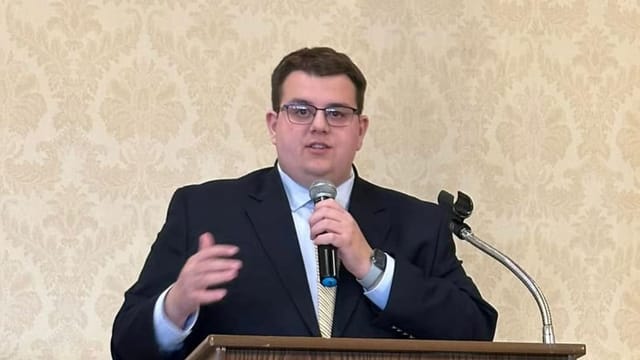
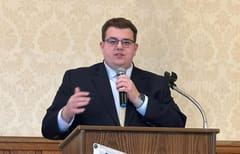
Brian Massie, a campaign leader and the co-founder of AxOHTax, announced early Friday that the group hasn’t reached its goal of collecting 620,000 signatures.
Facing a July 1 deadline to submit petitions to the Ohio Secretary of State, he and fellow volunteers have decided to hold off — for now.
To qualify for the ballot, organizers needed to turn in 413,488 valid voter signatures. They’ve been trying to collect plenty of extras, since thousands of signatures routinely get thrown out during the state’s verification process.
“We thought that we would need quite a buffer,” Massie said during an interview with WEWS.
During a news conference in late April, Massie said the campaign had amassed 305,000 signatures. On Friday, he refused to provide an updated total.
“We’re declaring war on the legislators,” he said, describing some members of the General Assembly as callous and slow to act. “And when you’re at war, you never give the enemy any intel. Giving them information — specifically how many signatures — that’s like giving them intel.”
Massie and his fellow organizers say they’ve lost confidence in politicians in Columbus. They’re reflecting the outrage of elderly taxpayers, in particular, who feel overburdened and ignored.
The proposed constitutional amendment would scrap property taxes entirely — on housing, commercial, and industrial real estate and land.
There’s a growing anti-tax movement across the country, as cash-strapped homeowners feel the pain of post-pandemic house-price spikes, broader inflation and tax levies. But no state has jettisoned real estate taxes entirely.
Opponents say eliminating property taxes is a drastic move. Ohio governments would have to make deep cuts, sharply raise other types of taxes or do a combination of both things to have any chance at making up the difference.
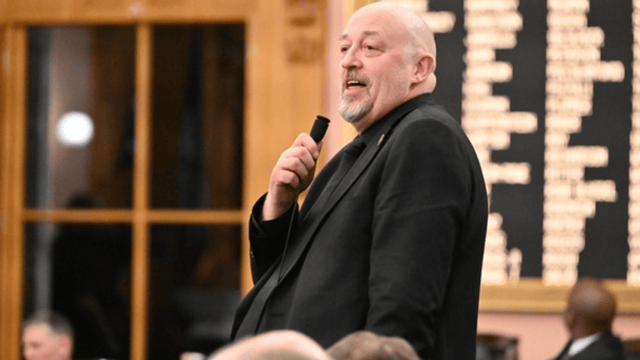
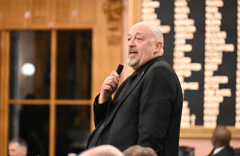
“What it ends up being is a tax shell game, the biggest tax shell game you could imagine,” state Sen. Jerry Cirino, a Kirtland Republican, said during an interview Friday. “Because, yeah, we can get rid of property taxes. But then sales tax will have to be tripled. … Homeowners, individuals will end up, I think, paying more in tax. Just different types of taxes. And that doesn’t really solve the problem.”
A coalition called Ohioans to Protect Public Services, which includes firefighters, police, teachers, and librarians, issued a statement Friday morning calling the push to abolish all property taxes “reckless” and pledging to continue fighting the effort.
“Local property taxes pay for services Ohioans count on every day, including police, fire and EMS, 911, public schools, senior services, supports for children and people with disabilities, to name just a few,” Jen Detwiler, a representative for the coalition, said in a written statement.
“Eliminating two-thirds of local tax revenue overnight does not make those needs disappear — it forces our state into impossible choices: severe cuts to local services, massive increases in sales and income taxes, or both.”
Massie said lawmakers in Columbus now have another year to prove they can make meaningful reforms, while the signature-gathering continues.
“We’re saying okay, let’s give the legislators more time. And let’s see what they do,” he said, challenging lawmakers to cut spending and bureaucracy.
The General Assembly approved a handful of tax-relief measures late last year, but homeowners aren’t feeling the effects of those changes yet.
The reforms included some property-tax credits and rollbacks, changes to the math around school levies, adjustments to the state review process for county reappraisals and increases in oversight powers for county budget commissions.
Lawmakers expect those updates to yield $2.4 billion to $3 billion worth of savings for homeowners over the next few years.
“Next month, with the tax bills coming out, people will start to see it,” Cirino said of the impact. “Particularly if you write a check twice a year to pay your property taxes, it will be very visible to you. If you pay through your mortgage, you’re going to have to look for it a bit harder than people who are paying taxes directly.”
He said lawmakers are still discussing additional reforms. “We have a number of bills in both the House and Senate,” he said.
Cirino said he’s sympathetic to homeowners who are struggling.
But he’s clearly fed up with the anti-tax campaign — which faces long odds, as a volunteer-led effort that’s been gathering signatures for just over a year. As signatures age, they’re more likely to get tossed because voters move or die.
“I’m not sure whether these people are delusional or not,” Cirino said, “but they haven’t done their homework. I don’t think they’ve put the intellectual rigor behind evaluating this problem and what the right solution is.”
So far, Massie isn’t impressed with the legislature’s actions. And he views the campaign’s shortfall as a delay — not a defeat.
“We will continue to collect these signatures. And we’re going to prove Jerry Cirino wrong,” Massie said.
As for whether that will happen next year? “My response is, it’s in God’s hands,” he said.
Michelle Jarboe is the business growth and development reporter at News 5 Cleveland. Follow her on X @MJarboe or email her at Michelle.Jarboe@wews.com.
This article was originally published on News5Cleveland.com and is published in the Ohio Capital Journal under a content-sharing agreement. Unlike other OCJ articles, it is not available for free republication by other news outlets as it is owned by WEWS in Cleveland.
This story is republished from the Ohio Capital Journal under a Creative Commons license. View the original article.