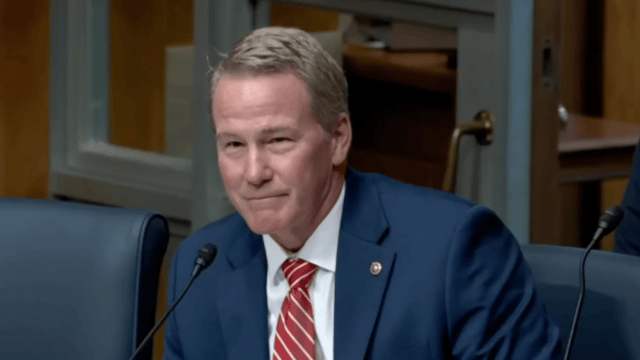


Ohio Republican U.S. Sen. Bernie Moreno and Democratic U.S. Sen. Elizabeth Warren have proposed a fix to Social Security. Observers praised it, but said more needs to be done.
The Ohio and Massachusetts senators made an unlikely team when they co-authored an op-ed last Tuesday that proposed a fix to Social Security.
An outside group praised the proposal as a vital first step, but called for additional action to be taken.
Warren D-Mass., is a leading progressive and one of the favorite targets of President Donald Trump’s racially tinged name calling. Moreno won office in 2024 partly on the power of Trump’s endorsement and his embrace of the MAGA movement.
But the two teamed up to advocate a solution to the looming insolvency of Social Security.
“We don’t agree on everything, but here’s one thing we do agree on: Congress must act now to save Social Security for generations of Americans to come,” the pair wrote in the New York Times. “Social Security is a core component of our nation’s promise — a covenant between the federal government and Americans who pay into it throughout their working years so they can retire with dignity.”
They explained that the retirement benefit for older Americans is again under threat.
“That promise is at risk of unraveling,” Moreno and Warren wrote. “For years, seniors in Ohio and Massachusetts have told us how concerned they are about the future of Social Security.”
They were referring to a report earlier this month by the Social Security Board of Trustees saying that Social Security will be insolvent by 2032 and Medicare — the health program for older Americans — will become so six months later.
If that happens, the average Ohio beneficiary will have to live on $487 less a month.
There are 2.2 million Social Security recipients in Ohio and their average benefit is just $1,900 a month, so insolvency would mean they would lose a quarter of an already-small income.
“That’s just six years away. Instead of cutting benefits for the retirees who count on Social Security, we need to take bipartisan action to protect those benefits, reward work and restore fairness,” Warren and Moreno wrote.
“That starts with a common-sense solution: lifting the Social Security payroll tax cap.”
Social Security is funded by a 6.2% tax paid by employees that is matched by their employers. But it is only paid on the first $184,500 of payroll income.
That means the vast majority of workers pay Social Security tax on all of their incomes, but some wealthier Americans don’t — and the richest only pay on a tiny portion of their incomes.
Moreno and Warren said this is unfair.
“Why should a middle-class nurse pay a larger share of her paycheck than a wealthy corporate lawyer?” they asked. “This is doubly unfair in an economy in which top earners’ wages, over time, have pulled far ahead of those of the average worker.”
They added that removing the cap would make Social Security solvent for a generation.
Marc Goldwein, senior vice president of the Committee for a Responsible Federal Budget, said there’s a double hazard if elected leaders think only in terms of a single fix and a single generation.
“Good for Sen. Warren and Sen. Moreno for saying we need to do something about this,” Goldwein said in an interview in which he called the senators’ proposal “a perfectly reasonable idea.”
“But saying that this is the whole solution, that’s wrong,” he said. “Politicians need to keep talking about this because time is running out.”
He called the Warren-Moreno proposal “raising the tax max” and called it “the most popular, most commonly discussed plan out there for raising revenue.”
And, Goldwein said, it would put a real dent in the solvency problem.
His group estimates that getting rid of the cap would close the solvency gap by 50% and delay insolvency by 22 years if benefit rules stay the same.
However, “it can’t be a full fix,” Goldwein said. “There’s not enough money there. As a starting point, I think it’s a given that any Social Security reform plan is going to need more revenue.”
Goldwein, who has worked on Social Security and related issues for the executive branch and for congressional committees, added, “Regardless of your ideological point of view, we’re out of time to do this on the benefits side alone. We have only six years to insolvency, and you just can’t get benefit savings fast enough.”
So he advocates coming up with a package of reforms that will make Social Security solvent for the next 50 to 75 years.
“We don’t want to have a kick-the-can thing that’s going to make us feel really good but bring us right back here in a couple decades,” Goldwein said.
That approach is especially hazardous because when lawmakers face the next crisis, the most palatable options will be off the table, he said.
The Committee for a Responsible Federal Budget has already proposed several reforms and Goldwein said many more are in the pipeline.
One would be to rein in spending by capping the amount a couple can collect from Social Security at $100,000 a year.
Another would reduce the rate of cost-of-living increases for the richest recipients so that their dollar-amounts match those of the next-lowest income group.
Goldwein proposes another reform that would replace Moreno and Warren’s “raising the tax max” proposal.
He would have employers pay tax on all compensation.
“This would raise a similar amount of money to the tax max, but it does it in a much more efficient way,” Goldwein said. It would be a tax on all wages above the $184,500 cap, “but it also includes all fringe benefits. Right now employers are getting tax breaks for paying people in the form of health care or stock options or transportation benefits.”
When insolvency loomed in 1981, Congress appointed a commission that proposed a package of reforms, many of which were amended into the Social Security Act two years later.
Goldwein said a similar commission could be appointed now and work along a tighter timeline because many viable proposals are already out there.
As for Medicare, Goldwein said Congress would be wise to approach that piecemeal.
“With Social Security, you really want to solve this all at once,” he said. “With Medicare, you can work on it incrementally because so much of Medicare is how do we get the payment structure right. How do we direct people to the best kind of care at the lowest cost. We can do that little by little as we learn more.”
This story is republished from the Ohio Capital Journal under a Creative Commons license. View the original article.