Ask a MAGA voter what a sexual assault accusation would cost a Republican candidate, and the answer, for two out of three of them, is nothing.
A national survey released July 30 by Politico and the polling firm Public First put voters in a hypothetical U.S. House race and told them a former partner had accused the Republican of sexual assault. Among self-identified MAGA voters who backed President Donald Trump in 2024, 66% said they would vote for that Republican anyway. Another 25% said they would sit the race out. Nine percent said they would vote for the Democrat.
That is the finding in full: an accusation of sexual assault moved fewer than one in 10 of Trump’s most committed supporters to the other party.
The loyalty gap widens the closer you get to Trump
The MAGA number is not the Republican number. Among Trump’s 2024 voters as a whole, including those who do not describe themselves as MAGA, support for the accused Republican dropped to 53%. Among Republican-leaning respondents generally, it fell to 42%, with 11% choosing the Democrat and 47% choosing neither.
The same pattern held on domestic violence. Seventy-two percent of MAGA voters said they would stay with a Republican accused of it, against 61% of Trump 2024 voters overall.
Democratic voters were more willing to walk. Forty percent of Kamala Harris’s 2024 voters said they would keep backing a Democrat accused of sexual assault, and 39% said the same about a Democrat accused of domestic violence. On those scenarios, more Harris voters said they would stay home or cross over than said they would stick with their own nominee.
The same accusation, judged twice
The survey then asked whether a candidate facing a given scandal ought to leave the race, and varied the candidate’s party.
Seventy-one percent of Republicans said a Democrat accused of sexual assault should drop out. Asked about a Republican accused of the identical thing, that figure fell to 52%. The accusation did not change. The party did, and 19 points of moral urgency went with it.
Democratic respondents showed a gap in the same direction, judging Republicans more harshly than Democrats, but a much smaller one — roughly 5 points.
Twelve scandals, no floor
Pollsters tested a dozen scenarios in all, running from the survivable to the disqualifying: exploiting tax loopholes, a DUI conviction, taking gifts from lobbyists, exaggerating a military record, concealing a terminal illness, posting antisemitic content, passing classified information to a foreign government, domestic violence, sexual assault.
Majorities of MAGA voters stayed with the Republican in every single one. Trump’s wider 2024 coalition also leaned toward staying in most scenarios, breaking only on antisemitic comments.
Republican strategist Ford O’Connell told Politico the rules of the game have changed and Republican voters know it, describing modern politics as closer to “more UFC than civics class” than to a debate over conduct.
Brandon Rottinghaus, a University of Houston political scientist who studies political scandal, framed the shift as a change in what scandal is for. It has stopped functioning as a verdict, he told Politico, and become one input among many in a partisan calculation.
What the poll can and cannot tell you
The survey measured stated intent in a hypothetical race with no name attached, which is a cleaner test of partisan reflex than of real-world behavior. Voters answering an abstraction are not weighing a specific candidate’s record, a specific opponent, or the specific facts of a specific allegation.
It also surveyed adults nationally rather than voters in any one district, and Politico noted that smaller subgroups, including the MAGA bloc that produced the headline number, carry higher margins of error than the sample as a whole.
What it does establish is a rank order, and the rank order is consistent across all 12 scenarios: the closer a voter sits to Trump, the less a scandal costs.
Ohio is running the live version
The poll was in the field July 12 to 15. Within three weeks, Ohio produced a real race that asks the same question.
U.S. Rep. Max Miller, R-Ohio, whose 7th Congressional District covers Cleveland’s western suburbs plus Medina, Wayne and Ashland counties, has spent August refusing calls from his own party to leave the ballot. His ex-wife, Emily Moreno, has alleged in court filings that he threw hot water on her, shoved her against a wall and held a gun to her head, and has raised concerns about their 2-year-old daughter’s fractured collarbone. Miller denies all of it and has sued Moreno for defamation. He has not been criminally charged; prosecutors declined to take the matter to a grand jury, citing insufficient admissible evidence, and a county child-welfare inquiry did not substantiate abuse.
Moreno is the daughter of U.S. Sen. Bernie Moreno, R-Ohio, who broke months of public silence on August 2 to say his former son-in-law fails any basic standard of character for office. Miller then asked the House Ethics Committee to investigate him, and the panel opened a review on August 4 into whether he “may have engaged in domestic violence and abuse or illegal drug use,” noting that opening a review does not itself indicate a violation occurred.
Asked that day on CNN whether he would resign or withdraw, Miller told Jake Tapper: “My answer to you, Jake, is no.” He let the withdrawal deadline pass and stayed on the November 3 ballot.
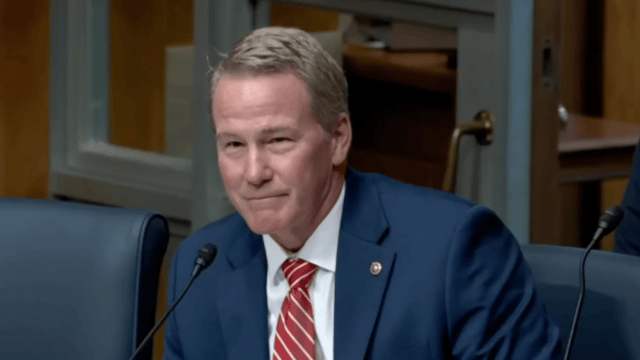
Two days later, Ohio’s other senator, Jon Husted, who is on the ballot himself this fall, called for Miller to resign. “Anyone who commits domestic violence is not fit to serve in Congress,” Husted wrote on X.
The contrast with the other party is a matter of record. When an ex-girlfriend accused Maine Senate nominee Graham Platner of sexual assault, an allegation he denies, Senate Minority Leader Chuck Schumer and Sen. Bernie Sanders pushed him to withdraw, the Democratic Senatorial Campaign Committee pulled its money, and Platner left the race.
Ohio Republicans, facing the same category of allegation, are testing whether 66% is enough.
About the survey
The Politico poll was conducted online by Public First from July 12 to July 15, 2026, among 2,061 U.S. adults. The overall margin of error is plus or minus 2.16 percentage points. Subgroups carry higher margins of error. Figures may not total 100% because of rounding. The Hill reported the sexual assault findings on July 30.