
This story was originally published by Signal Ohio. Sign up for their free newsletters at SignalOhio.org/subscribe.
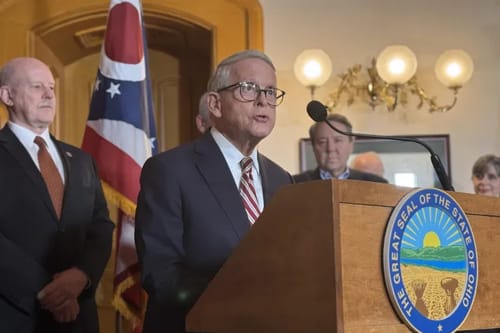
Republican Gov. Mike DeWine vetoed legislation Wednesday evening that would have rolled back newly enacted legal protections for Ohio renters’ electric bills in “submetered” units.
House Bill 173 would have reversed an Ohio Supreme Court opinion that said submetering companies were public utilities and therefore subject to state regulation. This would entail new scrutiny from a previously unregulated industry.
But according to DeWine, the submetering industry is “fundamentally flawed” because it leaves its customers lacking several legal protections and perks given to ratepayers of traditional gas and electric utilities.
“If this bill became law, Ohio, for the first time, would be legitimizing and legalizing this flawed submetering model,” he said in a statement. “Therefore, this veto is in the public interest.”
DeWine specified three disadvantages for submetered customers: They can’t shop around for cheaper sources of gas and electricity like all other customers; they can’t enroll in a utility-funded state program that allows low-income earners to pay only a percentage of their income for electricity; and they can be charged for electricity costs in common areas, which he said effectively make rent costs less transparent.
“As a consumer protection principle, tenants should only be individually billed for the electric service usage for which they are individually responsible,” he said.
His comments align with the Ohio Consumers’ Counsel, a state agency that advocates for residential ratepayers and opposed the legislation. Its director, Maureen Willis, said in a statement late Wednesday praising the veto and adding that “Ohio consumers should not have different utility rights simply because of where they live.”
Rep. Dave Thomas, the Ashtabula Republican who sponsored HB 173, said the utilities, which have lobbied against submeterers and fought them in court, won while renters lost.
“This veto does not give renters anything except more legal gray area and no actual law protecting them,” he said in a text Wednesday night. “Governing by [a] vague Supreme Court ruling with guaranteed lawsuits coming is no way to regulate an industry. I look forward to working with Ohio’s next Governor to protect these customers.”
The bill passed roughly on partisan lines, with Republicans in support and Democrats opposed. Any veto override must begin in the state House. A spokesperson for House Speaker Matt Huffman couldn’t be reached for comment. Several House Democrats praised the veto Thursday.
Submetering companies operate by paying landlords to take over electric distribution to tenants, the end users, from a building’s master meter. From there, they bill customers like a traditional utility would. The companies say they buy electricity at a wholesale price before selling it at the same price as the local utility’s standard service offer.
The two largest known industry players in Ohio – Nationwide Energy Partners and American Power & Light – are regularly accused of price gouging their self-professed 55,000 customers. Over the past five years, the PUCO has received more than 300 complaints about each, according to a spokesperson. Customers have also taken to the statehouse, media and online reviews, insisting they’re being unfairly charged by a de facto monopoly.
Utility companies, led by American Electric Power, have tussled with the submeters in the Ohio Supreme Court, claiming the company has improperly acted as an unregulated utility company. As that case proceeded, some Democrats voted for early iterations of HB 173, deeming it better than the status quo and safer than the whims of a pro-business court.
But Justice Pat DeWine, the governor’s son, in April wrote a unanimous opinion for the Ohio Supreme Court siding with AEP and against Nationwide Energy Partners.
Republicans passed the legislation handily among themselves. Supporters, including property developers and a manufactured home trade association, note that the bill codifies several legal protections for submetered customers that didn’t previously exist in law. It requires them to charge a 3% discount to customers compared to the local utility’s standard service offer price. And it requires the PUCO to set up a complaint system for customers.
The Ohio Environmental Council lobbied for DeWine to veto the bill. Nolan Rutschilling, managing director of energy policy for the organization’s action fund, said it would “advantage utility reselling companies over hard-working Ohioans who are struggling to pay their utility bills.”
Signal Ohio is a nonprofit news organization covering government, education, health, economy and public safety.