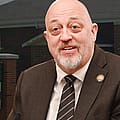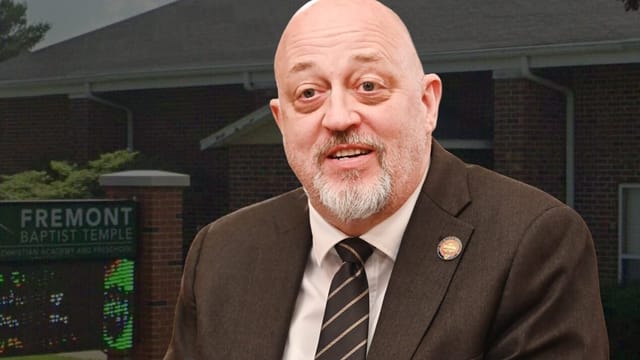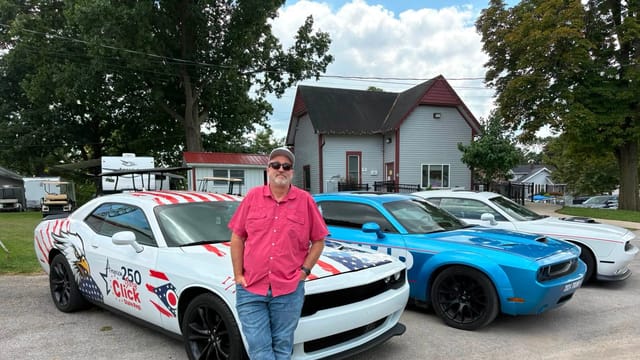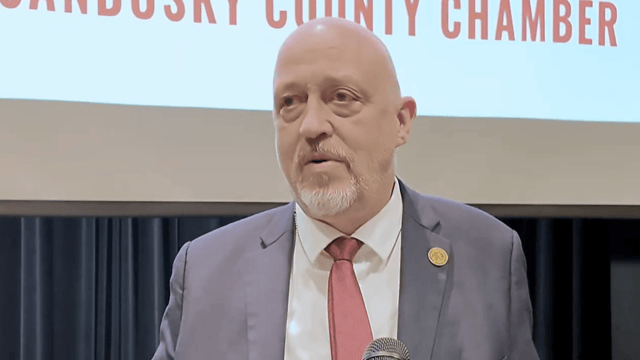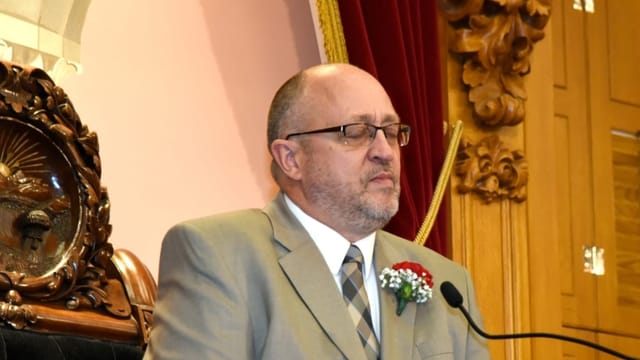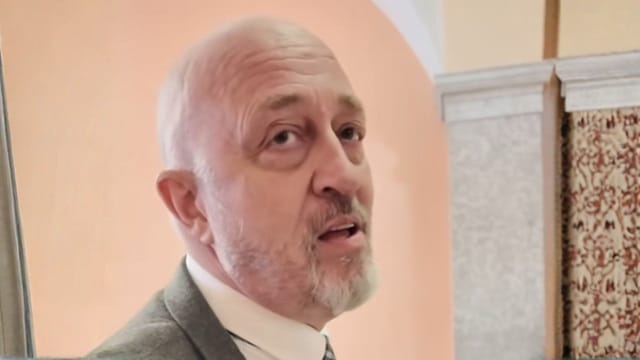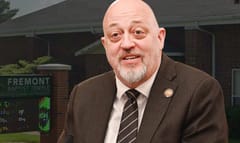
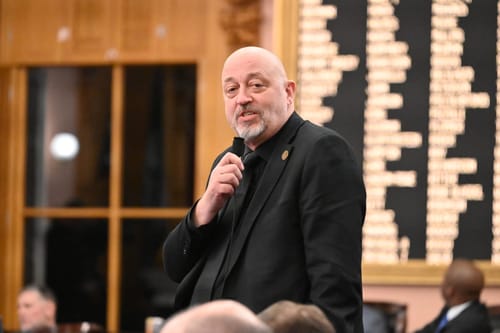
Before Gary Click won a seat in the Ohio House, his campaign committee spent money to publicly defend the nuclear bailout law that would later become the centerpiece of the largest public corruption case in state history.
According to Meta’s Ad Library, a sponsored Facebook ad paid for by The Committee to Elect Gary Click, treasurer Jerri Miller, ran from Sept. 20 to Sept. 22, 2019, delivering an estimated 3,000 to 4,000 impressions. In it, Click — then a first-time candidate for Ohio’s 88th House District — shared a U.S. Department of Energy Office of Nuclear Energy post about the shutdown of Three Mile Island Unit 1 in Pennsylvania and added a personal endorsement of House Bill 6, Ohio’s then-new utility subsidy law.
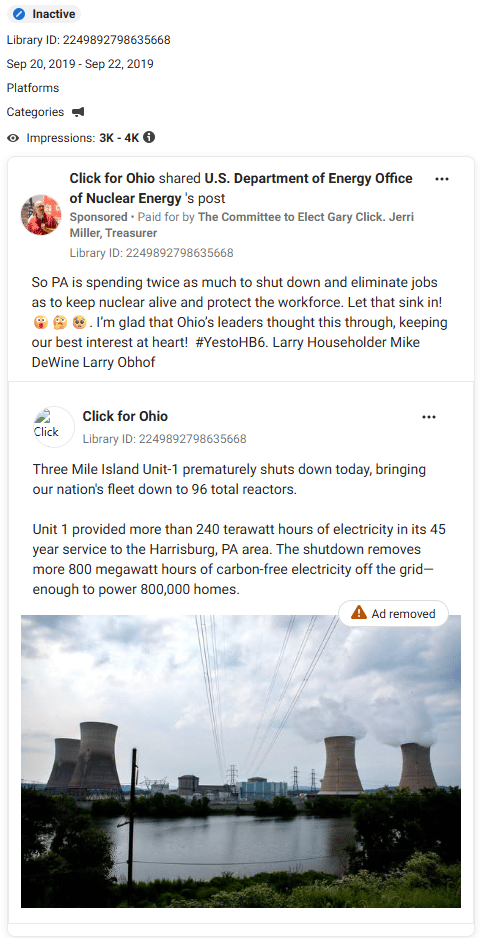
“I’m glad that Ohio’s leaders thought this through, keeping our best interest at heart!” Click wrote, adding the hashtag “#YestoHB6” and tagging three Republican state leaders: then-Ohio House Speaker Larry Householder, Gov. Mike DeWine, and then-Senate President Larry Obhof.
Running during the referendum window
The timing matters. DeWine had signed House Bill 6 into law on July 23, 2019. That signature triggered a 90-day constitutional window in which opponents could circulate petitions to put a referendum on the 2020 ballot and repeal the law. After the Ohio Attorney General’s Office certified revised petition language on Aug. 29, 2019, Ohioans Against Corporate Bailouts had roughly 52 days to gather the 265,774 valid signatures needed to qualify for the ballot.
Click’s ad ran in the closing stretch of that signature drive. It began the same day Three Mile Island Unit 1 stopped producing electricity — a moment pro-HB 6 messaging used to argue that without subsidies, Ohio’s Davis-Besse and Perry nuclear plants would follow. By the Oct. 21, 2019, deadline, opponents had collected 221,092 signatures and fell short, allowing HB 6 to take effect. A separate pro-HB 6 dark money group, Ohioans for Energy Security, spent an estimated $16.56 million on television and radio advertising during the same period, including ads falsely suggesting Chinese interests were behind the referendum effort.
Click was not a member of the Ohio General Assembly in September 2019 and did not vote on HB 6. What the ad documents is a public political communication paid for out of his campaign account, in defense of a law already passed, during the window in which Ohio voters were being asked to repeal it.
Who Click tagged
The three officials tagged in the ad were the Republican leaders most directly associated with HB 6’s passage.
Householder, who had returned to the speakership in January 2019 after a decade out of office, was identified by federal prosecutors a year later as the leader of a $60 million bribery scheme funded by FirstEnergy and routed through the dark-money nonprofit Generation Now. A federal jury convicted Householder on racketeering charges in March 2023, and he is serving a 20-year prison sentence. Matt Borges, a former chair of the Ohio Republican Party, was convicted alongside him.
Obhof, a Medina Republican, served as Senate President from 2017 to 2020 and presided over the chamber as HB 6 passed the Senate on June 18, 2019. He has not been charged with any wrongdoing in the scandal.
DeWine signed the bill into law and has repeatedly said he believed it was sound policy. Text messages and calendars produced in subsequent state and federal proceedings have shown extensive contact between DeWine’s office — and then-Lt. Gov. Jon Husted, now a U.S. senator — and FirstEnergy executives during the period HB 6 was drafted, passed, and defended. Neither DeWine nor Husted has been charged with any wrongdoing.
What the ad meant for Click’s primary
At the time the ad ran, Click held one elected position: member of the Ohio Republican Party State Central Committee for the 26th Senate District, a post he has held since 2017. His campaign for the 88th House District faced two other Republicans — Seneca County Commissioner Shayne Thomas of Tiffin and Fremont environmental engineer Ed Ollom — for a seat being vacated by term-limited Rep. Bill Reineke.
The Ohio Republican Party endorsed Click. On April 28, 2020, in a mail-only primary delayed from March 17 by the COVID-19 pandemic, Click won with 5,385 votes to Thomas’s 4,702 and Ollom’s 3,057. He took office in January 2021 — five months after Householder’s arrest.
HB 6 authorized $1 billion in nuclear plant subsidies, extended subsidies for two Ohio Valley Electric Corporation coal plants, and gutted Ohio’s renewable energy and energy-efficiency standards. The nuclear subsidies were repealed in 2021. The coal subsidies remained law until August 2025, by which point Ohio ratepayers had paid more than $500 million to prop up the plants.
Click is now serving his third term and is seeking a fourth and final term in the May 5, 2026, Republican primary against Tiffin businessman Eric Watson. Democrat Aaron Jones of Tiffin, a U.S. Army veteran and city council member, is unopposed for his party’s nomination. The 88th District covers Sandusky and Seneca counties and includes Tiffin, Fremont, Clyde, Green Springs, and surrounding communities.