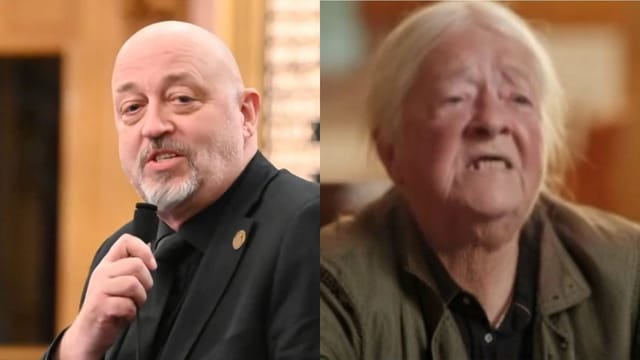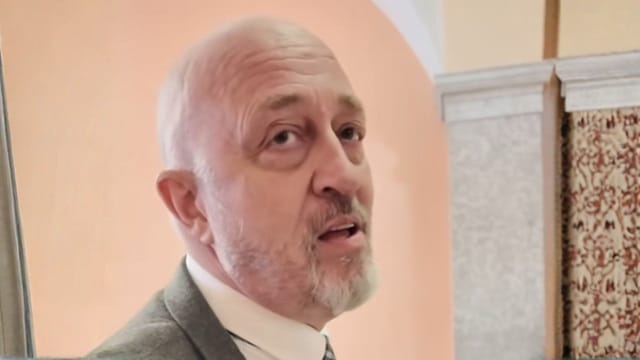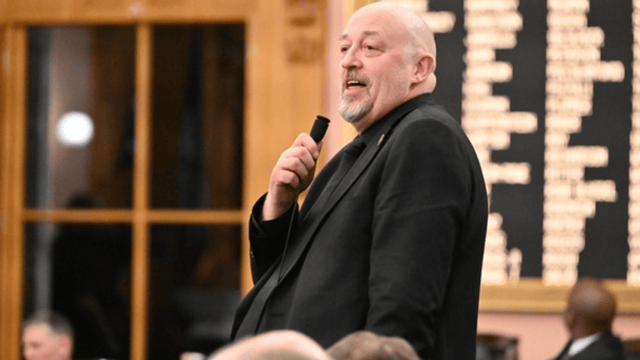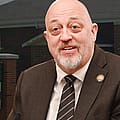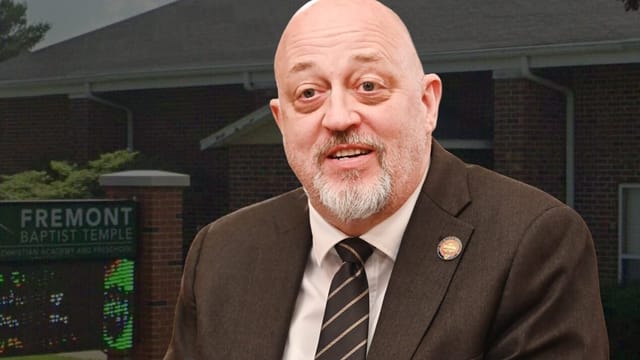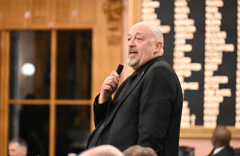
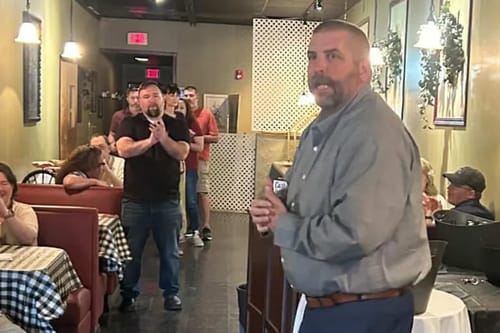
TIFFIN, Ohio — Democratic state House candidate Aaron Jones is calling for new limits on government use of Flock cameras and other AI-powered surveillance, pledging to pursue bipartisan legislation if elected to represent Seneca and Sandusky counties.
“I’ve got a pretty simple view on this: if you haven’t done anything wrong, the government shouldn’t be keeping tabs on everywhere you go,” Jones said Thursday.
“Flock is one example, but AI-powered surveillance is spreading fast, and the law needs to catch up,” he said.
Jones said he would work with members of both parties to introduce legislation protecting Ohioans from mass surveillance if he defeats Republican state Rep. Gary Click in November.
“Big tech doesn’t get to own our privacy, and government doesn’t get a blank check to take it away,” Jones said.
Click, a three-term Republican from Vickery, has not publicly taken a position on Flock cameras or the growing push at the Ohio Statehouse to restrict automated license plate surveillance. A review by TiffinOhio.net of Click’s public statements, legislative news releases and newsletters found no statement addressing Flock or the proposals now being advanced by other Ohio lawmakers.
Jones’ position puts the issue directly into the race for House District 88 at a time when opposition to mass vehicle surveillance is increasingly crossing party lines.
Flock cameras are already operating in the district
The debate is not an abstract one for voters in House District 88.
The Fremont Police Department uses Flock Safety automated license plate readers. According to the department’s public Flock transparency portal, Fremont had 10 cameras and retained data for 30 days as of the portal’s July 25 update.
Those cameras recorded 248,593 vehicle detections and were searched 84 times during the 30-day period reflected on the portal.
The Sandusky County Sheriff’s Office also operates Flock cameras. The Electronic Frontier Foundation’s Atlas of Surveillance lists six Flock automated license plate readers operated by the sheriff’s office as of September 2025.
Flock cameras capture passing vehicles and make information about them searchable by law enforcement. The technology can identify license plates and other characteristics of a vehicle and associate those observations with a location and time.
Police agencies have used the systems to find stolen vehicles, locate wanted suspects and develop leads in criminal investigations. But the ability to build a searchable record of where vehicles have been seen has also fueled concerns about what happens when police use the technology to track people who are not suspected of a crime.
Bipartisan backlash reaches Ohio Statehouse
Jones is taking his position as lawmakers on both sides of the aisle begin pushing for restrictions in Columbus.
Democratic state Reps. Tristan Rader and Darnell Brewer and Republican Reps. Levi Dean and Justin Pizzulli called on the Ohio Department of Transportation this month to stop approving automated license plate readers in state highway rights-of-way and review permits already granted for the cameras.
The lawmakers argued that Ohio lacks comprehensive statewide rules governing how license plate information is retained, searched, shared and used.
“The government should not be able to track everyone, everywhere, all the time just in case someone might someday become the subject of an investigation,” Rader said.
Dean, a Republican from Xenia, has gone further. He announced plans Sept. 3 to introduce the Ohio Freedom from Mass Surveillance Act.
Dean’s proposal would prohibit government entities from deploying mass-surveillance technology such as Flock cameras and would require a search warrant before the government could access surveillance footage. It would also prohibit the sale of surveillance data.
“A tool that can track the movements of innocent Americans can also be abused in the wrong hands,” Dean said.
Republican state Sen. Al Cutrona of Canfield is pursuing a different approach. Cutrona submitted legislation Wednesday that would allow automated license plate readers to remain in use while placing new restrictions on the data they collect.
His proposal would require data to be deleted after 10 days, prohibit the sale of collected information, require law enforcement agencies and local governments using the cameras to adopt access policies and require annual reporting to the Ohio Attorney General.
Jones has not yet released bill language spelling out whether his proposal would resemble Dean’s broader prohibition, Cutrona’s regulatory approach or another model. His campaign statement instead committed him to working across party lines on legislation aimed at mass surveillance generally.
Cases of alleged misuse fuel concerns
The push for restrictions has accelerated following reports that law enforcement personnel have used Flock systems for purposes unrelated to legitimate investigations.
Columbus Mayor Andrew Ginther suspended the city’s use of Flock cameras Sept. 3 after officials began investigating a police officer’s use of the system.
A national database reviewed by USA Today found that the officer searched for the location of a single vehicle more than 200 times. Columbus Police Chief Elaine Bryant said the department did not believe the searches were connected to an investigation. The officer was relieved of duty while the matter was investigated.
“What I have learned has shaken my trust,” Ginther said while announcing the suspension.
Flock has also become an issue in political races across the country as lawmakers and candidates from both parties question whether existing laws have kept pace with the rapid expansion of automated surveillance technology. An Associated Press report published this month found candidates in several states campaigning on proposals to restrict or ban the systems.
Click backed separate government camera proposal
Although Click has not publicly weighed in on Flock cameras, he has previously backed legislation involving government access to surveillance cameras.
Click is listed as a cosponsor of House Bill 649, a Republican-backed child care fraud proposal that, as introduced in January, would have required cameras at every entrance and exit of child care centers and in general areas where children receive care.
The original bill required cameras to record whenever a center operated, required recordings to be stored for 60 days and required centers to provide the Ohio Department of Children and Youth access to stored footage. Within 12 months, the bill would also have required live state access to the cameras.
The proposal generated opposition from child care providers and privacy advocates and was substantially changed during committee hearings.
Ohio Capital Journal reported that lawmakers later moved to prohibit storage of certain photos or videos and faced opposition over proposals involving photographs or technological identification of children.
Click himself acknowledged during a March committee hearing that support was lacking for part of the proposal.
“I think there’s not a broad amount of support for [child photo or video capture] staying in the bill,” Click said.
Click remains listed as a cosponsor of HB 649. The legislation remains in the House Children and Human Services Committee and has not passed the Ohio House.
TiffinOhio.net previously reported on Click’s support for the legislation and the surveillance provisions contained in its original version.
Jones is challenging Click in the November general election for House District 88, which includes all of Seneca and Sandusky counties.
For Jones, the broader question is where Ohio draws the line as technology gives government agencies increasingly powerful tools for tracking people.
“When I get to the Statehouse, I’ll work with Republicans and Democrats to introduce legislation protecting Ohioans from mass surveillance,” Jones said.