FOSTORIA, Ohio — Seneca County health officials halted a planned soil-testing operation at WIN Waste Innovations’ landfill November 5 after receiving a letter from the company’s attorney warning of legal action for trespass and other alleged offenses, according to correspondence obtained by TiffinOhio.net and statements from both parties.
The health district’s sampling contractors had already entered the landfill and begun preparing to collect soil samples when officials received the warning and withdrew the team pending legal advice, Ajith Singh, the Seneca County General Health District’s director of environmental science and landfill compliance, confirmed Tuesday.
WIN Waste acknowledges that the sampling team entered the property and departed without collecting samples. The company denies obstructing the operation, maintaining that its attorney’s warning concerned testing it considered unlawful. The health district says the warning intimidated officials into suspending an inspection authorized by state law.
The confrontation interrupted a sampling program with a budget of up to $200,000, approved by the county Board of Health to determine whether hazardous chemicals remain in soil beneath an older, unlined section of the landfill being excavated for expansion. No samples have been collected, and the district plans to return November 18.
Legal warning preceded halted testing
In a November 4 letter sent to the health district’s attorney, Jack Van Kley, Dale Papajcik of the Cleveland-based law firm Squire Patton Boggs challenged the district’s authority to conduct additional soil testing at the landfill, formerly known as Sunny Farms.
Papajcik argued that the health district had failed to identify the specific regulatory purpose and necessity of its inspection. He also cited Ohio EPA’s determination that laboratory analysis was unnecessary under the approved waste-relocation plan.
The letter said WIN Waste would permit lawful inspections but warned that the company would pursue remedies if the district proceeded with testing that its attorneys considered unauthorized.
“Should SCGHD proceed to take samples and not follow Ohio Revised Code 3734.07(C), WIN Waste will be compelled to remedy the trespass and other offenses committed during and after such sampling event.”
The correspondence was sent by email and overnight mail, with copies to senior Ohio EPA officials. According to the health district, the warning reached officials the following morning, after its sampling personnel had arrived at the landfill.
Singh said the district withdrew its contractors until legal advice could be obtained. The district subsequently accused WIN Waste of interfering with its inspection authority through intimidation, announcing the confrontation in a November 6 press release.
WIN Waste’s account confirms that the contractors were on-site and preparing to collect samples. Ben Nutter, the company’s community engagement and government affairs representative, said WIN Waste had arranged for its own laboratory team to collect split samples for independent analysis. The health district confirmed that the company’s sampling team was present.
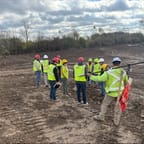
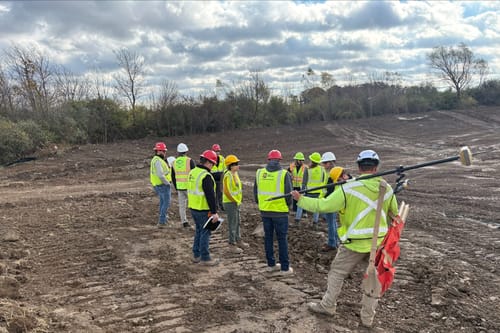
Nutter said approximately 20 people from multiple organizations attended a safety and preparation meeting before the district halted sampling. WIN Waste provided TiffinOhio.net with a photograph of personnel gathered at the excavation site, which the company said was taken shortly before the contractors departed.
In a November 9 letter to Health Commissioner Julie Richards, WIN Waste Vice President Brian Ezyk asserted that health district personnel stopped the sampling after receiving instructions from their attorney. Ezyk rejected the district’s characterization of the company’s warning as a threat to sue and demanded a retraction of its allegations.
The dispute centers on the effect of that warning. Both parties acknowledge that the health district entered the facility and suspended sampling before collecting its first sample. The district says its withdrawal resulted from WIN Waste’s legal threat; the company maintains that it cooperated and did nothing to prevent the inspection.
WIN Waste challenges health district’s inspection authority
Ohio Revised Code 3734.07(C) authorizes boards of health and their representatives to enter public or private property at reasonable times to inspect, investigate and obtain samples for determining compliance with Ohio’s solid-waste laws. Inspectors must properly identify themselves and state the purpose and necessity of the inspection.
The statute permits licensing action when authorized inspections are refused or obstructed. Subsection (D) specifically addresses inspections hindered or thwarted through intimidation and provides for recovery of certain costs when authorities obtain and execute a search warrant.
WIN Waste argues that the health district’s proposed sampling exceeds its authority because Ohio EPA has already approved a verification process that does not require additional laboratory analysis. The health district maintains that its October 29 notification satisfied the statutory inspection requirements and that it has authority to obtain samples to investigate potential environmental violations.
Papajcik’s November 4 letter also asserted that the proposed testing would violate Ohio Administrative Code 3745-37-08(C)(11). That provision concerns health districts obtaining legal assistance from appropriate state and local agencies to carry out their responsibilities. It contains no prohibition against soil sampling.
The health district maintains that WIN Waste’s conduct violated the inspection statute and has warned the company that interference could provide grounds for legal action or license-related enforcement. WIN Waste disputes that its warning constituted obstruction and has expressly agreed to permit inspections authorized under the statute.
Ohio EPA defends inspections without laboratory soil testing
The disputed sampling concerns an approximately 25-acre unlined disposal area where WIN Waste is relocating roughly 2 million cubic yards of historically buried waste into a newly constructed, lined landfill cell. Ohio EPA approved the waste-relocation plan through a September 11, 2024 permit-to-install.
Under the approved plan, waste and visibly affected soil are excavated before five-foot-deep test pits are dug at 100-foot intervals to confirm that the bottom of the buried waste has been reached. Inspectors examine the exposed soil for staining, discoloration and other visible indications of contamination.
The health district contends that visual inspections cannot establish whether chemical residues remain beneath the excavated waste. In an October 29 announcement, Richards cited historical Ohio EPA records documenting the disposal of benzene and cyanide at the landfill during the 1980s.
“Right now, the EPA is relying solely on a visual inspection of the excavation bottom, and that’s just not an adequate testing method to ensure our residents are safe,” Richards said.
In an October 14 letter, the health district asked Ohio EPA to require laboratory testing before excavation areas were backfilled. The district argued that contamination could remain undetected beneath the new protective infrastructure, particularly given the site’s unlined disposal history and underlying geology.
Ohio EPA declined that request and defended its position in a statement Tuesday to TiffinOhio.net.
Agency press secretary Bryant Somerville said regulators considered the site’s geology, natural clay deposits, existing environmental safeguards and groundwater-monitoring requirements when approving the relocation plan. Ohio EPA personnel have also been present during excavation work.
Somerville said the landfill undergoes groundwater monitoring twice annually under federal Resource Conservation and Recovery Act requirements and that benzene and cyanide have never been detected during that monitoring.
Ohio EPA maintains that the available environmental data, protective clay deposits and continued monitoring provide adequate protection of human health and the environment. The agency says it will continue overseeing the relocation project and evaluating new information.
Those groundwater results do not establish the chemical composition of soil left beneath the excavation. The health district’s proposed laboratory testing would examine that soil directly before it is covered by backfill and new landfill infrastructure.
WIN Waste maintains that moving the historic waste into a modern, engineered disposal cell provides substantial environmental protection and that additional testing would not alter the remediation already underway. Nutter said health district representatives participated in visual inspections of more than 40 test pits on November 5 that found no remaining waste or visible staining.
Health district plans to resume sampling November 18
The Seneca County Board of Health unanimously approved the independent testing program at an October 29 special meeting, authorizing expenditures not to exceed $200,000 from construction and demolition debris funds.
The district retained engineering firm Burgess & Niple to conduct sampling, with ALS Global designated to perform laboratory analysis. The plan calls for samples from approximately 95 remaining test pits, along with 15 duplicate samples for quality assurance.
Testing will examine soil for organic chemicals, heavy metals, cyanide, petroleum-related substances and selected PFAS compounds. Samples are to be collected from the bottoms of test pits, approximately five feet beneath the excavated landfill floor or side slopes, to assess soil conditions directly below the removed waste.
WIN Waste has criticized the proposed expense, arguing that the money could provide greater public-health benefits elsewhere. Health officials maintain that laboratory testing is necessary while the underlying soil remains accessible, before excavation and backfilling work progresses.
Singh confirmed Tuesday that no samples have been collected. The health district is planning another sampling operation for November 18, subject to contractor availability.