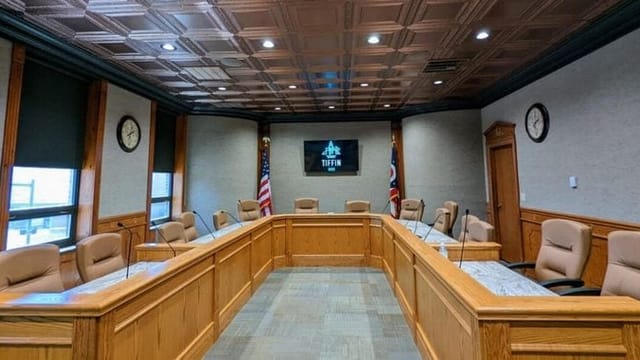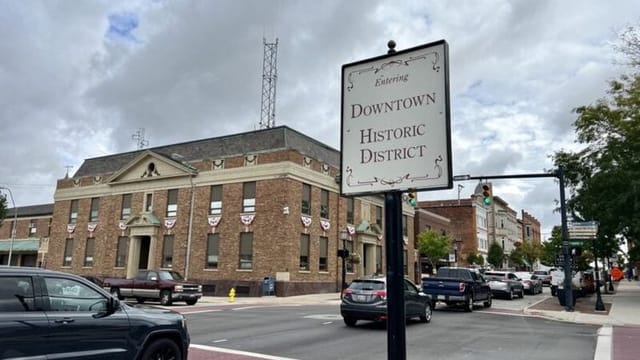
Tiffin City Council voted 5-1 Monday to extend a proposed sewer-backup grant program to property owners who installed protective devices earlier this year, potentially providing up to $2,000 in reimbursement for work already completed.
The November 2 vote amended Ordinance 2026-61 to include eligible installations dating back to January 1, 2026. Council postponed final passage while Law Director Zachary Fowler prepares the revised legislation, leaving the reimbursement program awaiting approval after weeks of debate over its costs and effectiveness.
The amendment followed testimony from a downtown property owner who described extensive basement flooding and explained why retroactive assistance matters to residents who have already paid to protect their buildings.
Downtown property owner describes severe flooding
Yolanda Gonzalez, who said she and her husband own the building at 190 S. Washington St., told council that flooding earlier this year covered approximately 80 feet of the property’s 100-foot basement. Water entered so quickly that her husband recorded the flooding, she said, and the couple subsequently installed a backflow-prevention device.
The basement has not flooded since the installation, according to Gonzalez, although she reported noticing moisture elsewhere and wondered whether the device had redirected water toward another portion of the building.
“If you don’t backdate it, then it’s useless to me,” Gonzalez told council.
Councilmember John Hays moved to allow reimbursement applications for installations completed before the ordinance takes effect. Councilmember Aaron Jones, who introduced the original grant legislation, seconded the amendment.
After discussing eligibility requirements with Fowler, council agreed to make work completed since January 1, 2026, eligible for consideration. Applicants would have to provide work orders, paid invoices and documentation sufficient for city inspection and review. Applications for previously completed 2026 installations would have to be submitted by December 31.
Fowler emphasized that retroactive reimbursements require a different review process because the city’s existing grant procedures generally involve applications and inspections before work begins. Council also retained the requirement that applicants comply with restrictions on connecting downspouts to the sanitary sewer system.
The amendment passed 5-1, with Councilmember Kevin Roessner casting the lone dissenting vote.
Public works superintendent defends program
The proposal has faced sustained scrutiny since its introduction in September. As TiffinOhio.net previously reported, council deadlocked 3-3 on a motion to table the legislation, requiring Council President Bridget Boyle to cast the deciding vote to delay consideration.
Mayor Lee Wilkinson invited Public Works Superintendent Brandon Burner to Monday’s meeting to address concerns about the devices, which are installed on private sewer connections and designed to prevent wastewater from flowing backward into buildings when the municipal system becomes overloaded.
Burner said the city previously provided assistance for backflow-prevention installations and had seen favorable results among residents experiencing repeated backups. His department generally stopped receiving complaints from those properties after installation, freeing public works employees to respond to other sewer problems during heavy rainfall.
He also addressed concerns that preventing sewage from entering one property could cause it to back up elsewhere. Burner acknowledged that wastewater can seek other outlets within an overloaded sewer system but said his department had not experienced a pattern of new complaints from neighboring properties following installations.
The devices are already permitted in Tiffin. Burner estimated that a typical installation could cost approximately $5,000, with excavation accounting for much of the expense. Property owners are responsible for their sewer laterals all the way to the municipal sewer main, including portions extending beyond their property lines into the street.
Councilmembers Ashlee Decker and Roessner questioned maintenance requirements, possible liability and whether less expensive measures such as drain plugs or standpipes could adequately protect certain properties. Burner said those alternatives depend on each building’s plumbing configuration and the owner’s ability to respond when heavy rainfall occurs.
Roessner’s proposal to cut grants to $300 fails
Ordinance 2026-61 would expand Tiffin’s existing clean-water-removal grant program to reimburse property owners for 50% of eligible backflow-prevention installation costs, including labor, up to $2,000 per installation.
Roessner sought to reduce that maximum reimbursement to $300, approximately the cost of some backflow-prevention devices. His proposal would have limited the city’s contribution to the equipment itself, leaving property owners responsible for excavation and installation expenses.
The amendment received no second and died without a vote.
Funding for the proposed program would come from sewer utility revenue. The city currently budgets $50,000 annually for its existing downspout-disconnection grant program, which officials said has experienced limited demand in recent years. The proposed ordinance maintains a $100,000 annual program ceiling, although only $50,000 has been appropriated for 2026.
City Administrator Nick Dutro told council that financial models incorporating an additional $50,000 in annual grant spending showed the sewer fund remaining solvent through 2040. He noted that the existing program’s spending had not exceeded approximately $12,000 in any of the past three years, leaving capacity within the current allocation.
Fowler explained that sewer revenue is restricted to expenses connected with the system’s construction, operation, maintenance and repair. The discussion centered on how assistance for devices installed on privately owned sewer lines serves the municipal system, including whether preventing recurring backups can reduce demands on public works employees.
The grant proposal emerged after heavy rainfall caused sewer backups affecting Tiffin homes and businesses. City officials have described the assistance as a way to help individual property owners while larger sewer infrastructure improvements proceed over several years.
Final approval postponed
Following the 5-1 amendment vote, Fowler recommended allowing council to review the revised ordinance in writing before deciding on passage. The changes require specific provisions governing retroactive applications, documentation, inspections and eligibility deadlines.
Council agreed to defer final action. Fowler will prepare the amended legislation for another review, with the proposed December 31 application deadline creating a limited window for property owners who paid for installations earlier this year.