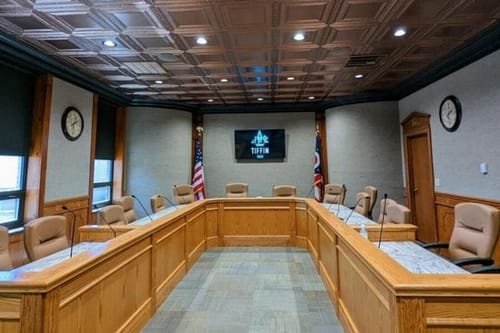
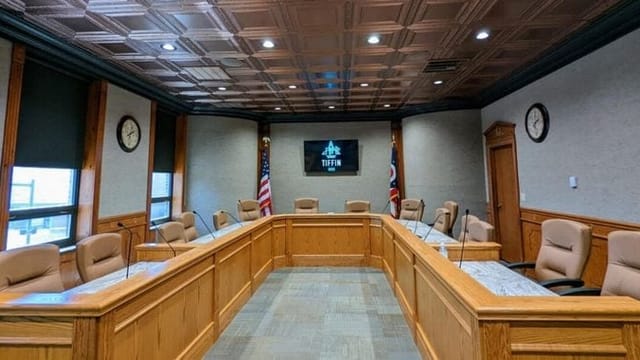
TIFFIN, Ohio — A proposal to help property owners pay for sewer backflow-prevention devices stalled Monday after Tiffin City Council deadlocked 3-3 over whether to put the program on hold.
Council President Bridget Boyle cast the deciding vote to table Ordinance 2026-61, delaying a proposal that would reimburse property owners for 50% of the cost of installing a backflow-prevention device, including labor, up to $2,000.
The ordinance was scheduled for its second reading Monday after first coming before council Sept. 8. Councilmember Kevin Roessner instead moved to table it and laid out a lengthy list of financial and technical concerns. Councilmember John Hays later raised a separate question about potential city liability.
Roessner, who chairs council’s Finance Committee, said he was particularly concerned about using sewer utility revenue for the program while the city remains committed to years of major sewer-system work.
“I’m very suspicious of any program that’s gonna take away from the sewer’s bottom line,” Roessner said.
The proposed assistance would expand an existing city grant program that helps property owners remove downspouts, sump pumps and other clean-water connections from the sanitary sewer system.
As TiffinOhio.net previously reported, the proposal emerged after recent heavy rainfall generated reports of sewage backing up into residential and commercial properties. City officials described the grants as an interim way to help individual property owners while Tiffin continues implementing its broader long-term sewer improvements.
Questions over what happens when a valve closes
Roessner questioned whether installing a backflow-prevention device at one property could affect another property during a sewer surcharge.
He argued that when a valve closes and prevents sewage from backing into one building, the sewage remains in the sewer system and could instead seek another unprotected opening.
“Blocking one outlet redirects surcharging sewage to the lowest unsealed opening in the system,” Roessner told council. “That is your neighboring property.”
That potential effect was not established by an engineer during Monday’s meeting. Federal Emergency Management Agency guidance recognizes backwater valves as a method of protecting buildings from sewer backups, while also warning that the devices require maintenance and that water used inside a building may be unable to drain while a valve is closed.
Roessner also raised concerns about maintenance, debris interfering with valves and the possibility of internal flooding if water continues to be used while a valve is closed.
He contrasted the proposed backflow grants with the city’s existing program for disconnecting clean-water sources from the sanitary sewer. Removing a downspout or similar connection reduces the amount of water entering the sewer system, he said, while a backflow valve does not.
“This would not remove a single gallon of water from the system,” Roessner said.
Potential city liability questioned
Hays raised another question: whether the city could face legal action if it helps pay for a backflow device and a neighboring property owner later claims that installation contributed to a sewer backup at their property.
Law Director Zachary Fowler said he had not researched that specific liability question.
Fowler distinguished the proposal from the city’s existing clean-water grant program, which helps property owners comply with requirements to disconnect sources of clean water from the sanitary sewer. A backflow-prevention device, by contrast, is intended primarily to protect the individual property where it is installed.
“It’s always possible somebody sues,” Fowler told council. If city money funded part of the project, he said, the city could be named in litigation, although “whether they prevail is a different story.”
Councilmember Scott Hoernemann said the funding source was the issue that stood out most to him.
“With the sewer fund … it’s being tapped to its absolute limit right now,” Hoernemann said, supporting additional review before council moves forward.
3-3 vote forces tie-breaker
Roessner made clear that without information changing his view, he was prepared to oppose the ordinance outright.
“I seldom vote no on anything, but this is gonna be a no from me,” Roessner said. “Everything I’m seeing is risky with it.”
When council voted on Roessner’s motion to table the ordinance, members split evenly.
Roessner, Hoernemann and Dennis Snay voted to table the proposal. Hays, Aaron Jones and Kyle Daugherty voted against delaying it. Councilmember Ashlee Decker was absent.
That left the decision to Boyle.
Boyle voted to table the ordinance, saying council members should have an opportunity to receive and review the information Roessner discussed before taking up the proposal again.
The vote did not defeat Ordinance 2026-61. It remains tabled and would require further council action before it could advance.
There is currently no $2,000 backflow grant available to property owners because the proposal has not been enacted.
Also at Monday’s meeting
Council unanimously approved Resolution 2026-49, authorizing Mayor Lee Wilkinson to apply for an Ohio Public Works Commission infrastructure loan for the State Route 101 Borer Influent Sewer Lining Project. Hays said immediate passage was necessary because the application needs to go before the county at an Oct. 1 meeting.
Council also voted 6-0 to approve Wilkinson’s appointment of Stephen P. Miller to fill an unexpired term on the city’s Park and Recreation Board through Dec. 31.
A separate request authorizing the city to accept real estate transferred from the Seneca Industrial and Economic Development Corp. was referred to the Recreation and Public Property Committee. The committee scheduled a meeting for Sept. 28 at 5:15 p.m. to consider the transfer.
Ordinance 2026-60, authorizing the sale and conveyance of city-owned property at the corner of Jackson and Noble streets, received its second reading without final action. Ordinance 2026-62, which would update portions of Tiffin’s codified ordinances, received its first reading.
Sheetz is also moving forward with a liquor permit for its Tiffin project. Law Director Zachary Fowler told council that Tiffin has reached its quota for the type of carry-out permits Sheetz is seeking, requiring the company to use Ohio’s economic-development transfer process, known as TREX, to transfer a permit from a Columbus location to Tiffin.
Fowler said Sheetz is investing more than $8 million in the Tiffin project and estimates it will create 36 new jobs. Council unanimously authorized Fowler to complete and return the city’s portion of the TREX application, finding the project qualifies as an economic-development project for purposes of the permit transfer.
TIFFIN, Ohio — A proposal to help property owners pay for sewer backflow prevention devices stalled Monday after Tiffin City Council deadlocked 3 3 over whether to put the program on hold. Council President Bridget Boyle cast the deciding vote to table Ordinance 2026 61, delaying a proposal that would reimburse property owners for 50% of the cost of installing a backflow prevention device, including labor, up to $2,000. The ordinance was scheduled for its second reading Monday after first coming before council Sept. 8. Councilmember Kevin Roessner instead moved to table it and laid out a lengthy list of financial and technical concerns. Councilmember John Hays later raised a separate question about potential city liability. Roessner, who chairs council's Finance Committee, said he was particularly concerned about using sewer utility revenue for the program while the city remains committed to years of major sewer system work. "I'm very suspicious of any program that's gonna take away from the sewer's bottom line," Roessner said. The proposed assistance would expand an existing city grant program that helps property owners remove downspouts, sump pumps and other clean water connections from the sanitary sewer system. As TiffinOhio.net previously reported, the proposal emerged after recent heavy rainfall generated reports of sewage backing up into residential and commercial properties. City officials described the grants as an interim way to help individual property owners while Tiffin continues implementing its broader long term sewer improvements. Questions over what happens when a valve closes Roessner questioned whether installing a backflow prevention device at one property could affect another property during a sewer surcharge. He argued that when a valve closes and prevents sewage from backing into one building, the sewage remains in the sewer system and could instead seek another unprotected opening. "Blocking one outlet redirects surcharging sewage to the lowest unsealed opening in the system," Roessner told council. "That is your neighboring property." That potential effect was not established by an engineer during Monday's meeting. Federal Emergency Management Agency guidance recognizes backwater valves as a method of protecting buildings from sewer backups, while also warning that the devices require maintenance and that water used inside a building may be unable to drain while a valve is closed. Roessner also raised concerns about maintenance, debris interfering with valves and the possibility of internal flooding if water continues to be used while a valve is closed. He contrasted the proposed backflow grants with the city's existing program for disconnecting clean water sources from the sanitary sewer. Removing a downspout or similar connection reduces the amount of water entering the sewer system, he said, while a backflow valve does not. "This would not remove a single gallon of water from the system," Roessner said. Potential city liability questioned Hays raised another question: whether the city could face legal action if it helps pay for a backflow device and a neighboring property owner later claims that installation contributed to a sewer backup at their property. Law Director Zachary Fowler said he had not researched that specific liability question. Fowler distinguished the proposal from the city's existing clean water grant program, which helps property owners comply with requirements to disconnect sources of clean water from the sanitary sewer. A backflow prevention device, by contrast, is intended primarily to protect the individual property where it is installed. "It's always possible somebody sues," Fowler told council. If city money funded part of the project, he said, the city could be named in litigation, although "whether they prevail is a different story." Councilmember Scott Hoernemann said the funding source was the issue that stood out most to him. "With the sewer fund ... it's being tapped to its absolute limit right now," Hoernemann said, supporting additional review before council moves forward. 3 3 vote forces tie breaker Roessner made clear that without information changing his view, he was prepared to oppose the ordinance outright. "I seldom vote no on anything, but this is gonna be a no from me," Roessner said. "Everything I'm seeing is risky with it." When council voted on Roessner's motion to table the ordinance, members split evenly. Roessner, Hoernemann and Dennis Snay voted to table the proposal. Hays, Aaron Jones and Kyle Daugherty voted against delaying it. Councilmember Ashlee Decker was absent. That left the decision to Boyle. Boyle voted to table the ordinance, saying council members should have an opportunity to receive and review the information Roessner discussed before taking up the proposal again. The vote did not defeat Ordinance 2026 61. It remains tabled and would require further council action before it could advance. There is currently no $2,000 backflow grant available to property owners because the proposal has not been enacted. Also at Monday's meeting Council unanimously approved Resolution 2026 49, authorizing Mayor Lee Wilkinson to apply for an Ohio Public Works Commission infrastructure loan for the State Route 101 Borer Influent Sewer Lining Project. Hays said immediate passage was necessary because the application needs to go before the county at an Oct. 1 meeting. Council also voted 6 0 to approve Wilkinson's appointment of Stephen P. Miller to fill an unexpired term on the city's Park and Recreation Board through Dec. 31. A separate request authorizing the city to accept real estate transferred from the Seneca Industrial and Economic Development Corp. was referred to the Recreation and Public Property Committee. The committee scheduled a meeting for Sept. 28 at 5:15 p.m. to consider the transfer. Ordinance 2026 60, authorizing the sale and conveyance of city owned property at the corner of Jackson and Noble streets, received its second reading without final action. Ordinance 2026 62, which would update portions of Tiffin's codified ordinances, received its first reading. Sheetz is also moving forward with a liquor permit for its Tiffin project. Law Director Zachary Fowler told council that Tiffin has reached its quota for the type of carry out permits Sheetz is seeking, requiring the company to use Ohio's economic development transfer process, known as TREX, to transfer a permit from a Columbus location to Tiffin. Fowler said Sheetz is investing more than $8 million in the Tiffin project and estimates it will create 36 new jobs. Council unanimously authorized Fowler to complete and return the city's portion of the TREX application, finding the project qualifies as an economic development project for purposes of the permit transfer.
Continue reading for free.
Sign up for TiffinOhio.net's free newsletter to continue. No spam. Unsubscribe anytime.