TIFFIN, Ohio — Tiffin’s fire and EMS call volume has climbed about 25% since 2018 while the number of firefighters on duty each day has stayed close to where it sat two decades ago, Fire Chief Rob Chappell told City Council on Monday in the division’s annual report.
Chappell said the Tiffin Fire/Rescue Division responded to 3,085 emergency incidents in 2018 and 3,872 in 2025, growth of roughly 25.5% over seven years that he said is a sustained trend rather than one unusual year. The city’s population has not grown at anything close to that rate.
He pointed to an aging population, patients living longer with more complex conditions, growth in assisted living and health care facilities, two universities and significant daytime employment. A planned assisted living development on the city’s north end expected to house more than 200 residents could add more than 100 emergency responses a year in that part of the city, he said.
Nearly 80 times in 2025, Chappell said, the division called personnel back in to supplement daily staffing because of overlapping or large incidents.
Schedule change draws recruits, trims daily staffing
The division’s most visible change over the past year was a move to a 24-hour-on, 72-hour-off schedule, which required reorganizing from three crews of 12 into four crews of 10 and promoting additional officers.
Chappell said the previous schedule had firefighters working 2,704 hours a year against a starting salary of less than $56,500 — the equivalent of under $21 an hour. The division’s most recent hiring campaign drew 41 applicants, which he said is the most in more than 15 years, including seven lateral hires with full-time experience elsewhere. The budgeted roster of 40 firefighters is now filled, with 15 of those 40 hired since January 2025.
Asked by a councilmember what the schedule’s downsides have been, Chappell said the crew restructuring temporarily reduced minimum on-duty staffing from nine to eight.
“It really is kind of an integral part of our operations to have nine people as a minimum on duty,” he said, adding that he is confident the division will return to nine in the near future. He also flagged the challenge of bringing on that many new firefighters at once in a service that depends on knowing every corner of its response district.
Council has approved legislation that would eventually allow the division to build back to crews of 11.
Two stations, neither adequate
Chappell said facilities remain the division’s largest long-term problem, and that discussion of a west-end station has been going on since shortly after Station 2 was rebuilt in the 1960s.
“We need to develop a plan before the plan is made for us,” he said.
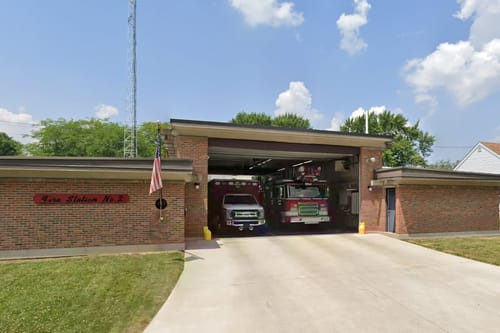
Apparatus have grown larger and heavier and required equipment has multiplied, he said, while modern stations need space for contamination control, turnout gear, secure medication storage, fitness and training areas and separate sleeping accommodations for a diverse workforce. Neither Tiffin station was designed for any of that.
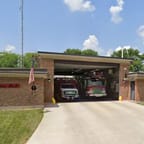
At Station 2, built in 1965 and now 60 years old, apparatus are parked tight against the bay doors front and back. Personnel crossing the station must squeeze between the front bumper of an ambulance and a bay door, or between the rear bumpers of the ambulance and an engine.
“Football may be a game of inches, but it has nothing on us,” Chappell said.
The tight fit has knock-on costs. Chappell said Engine 1, now 10 years old, would normally rotate to Station 2 as a reserve, but its wheelbase is too large for the space Engine 2 occupies. Engine 2, which he described as 21 years old and due to be sold, instead took $55,000 in repairs last year.
Chappell said he has been working with a local architectural firm on a 16-foot addition to the rear of Station 2, estimated at roughly $250,000, which would relieve the immediate crowding without solving the long-term problem. A new station, he said, would cost approximately $12 million based on current construction costs.
EMS revenue tops $1 million
Emergency medical service remains the bulk of the division’s work, accounting for nearly 90% of activity, Chappell said. Over the past 12 months the division transported 2,293 patients, 1,096 of whom required advanced life support. Thirty-two of the 40 firefighters are certified paramedics.
EMS revenue passed $1 million in 2025 for the first time in the division’s history, a figure that includes contracted service to Clinton Township and northern Eden Township along with medical coverage for university sports and community events. Chappell said participation in the Ohio ambulance provider assessment program is projected to bring in more than $173,000 in additional annual revenue by recovering federal Medicaid dollars.
On the fire side, the division has responded to 47 fires since May 2025, including 21 building fires, along with 155 motor vehicle crashes and 387 false alarms. Average response time to fire incidents was 4 minutes, 42 seconds. Chappell said a majority of false alarms occur on the college campuses and that the division worked with Tiffin University over the past year on materials aimed at reducing preventable activations.
Deputy Chief Mike Homan told council the division used a Tiffin Community Foundation grant of a little over $1,600, accepted by council in March, to buy 30 LifeVac airway clearance devices. The devices were distributed across fire apparatus, roughly 10 to the police department and about half a dozen to city parks, with training provided to police and parks staff.
Residents challenge annexation
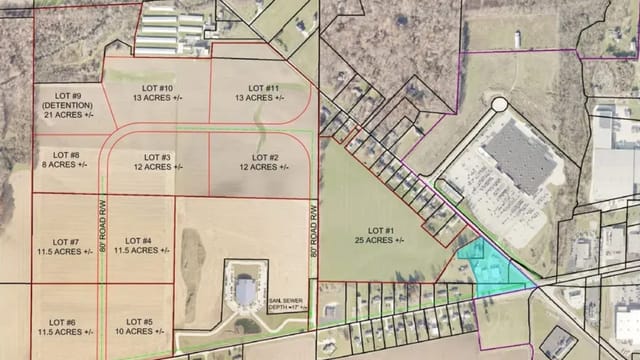
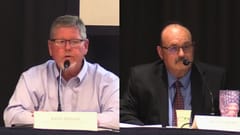
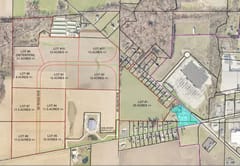
Three residents used the public comment period to press council over a private developer’s bid to annex roughly 149 acres of Hopewell Township into the city. Anna Flechtner told council her family was warned it could lose sewer service if it did not sign the annexation petition, and was later given one day to sign a replacement petition or face legal action.
Mayor Lee Wilkinson said the developer approached the city, that Tiffin is nearly out of developable industrial land and that no particular industry is driving the request. Council President Bridget Boyle said no annexation measure is pending before the body.
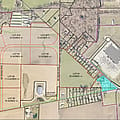
TiffinOhio.net has reviewed City of Tiffin Engineering Department maps that divide the same acreage into an 11-lot industrial park and propose light and heavy industrial zoning across it.
Sewer transfer and stormwater easements pass 6-0
Council suspended its three-reading rule and passed two ordinances unanimously. Councilmember Kyle Daugherty was absent.
Ordinance 2026-50, introduced by Kevin Roessner, transfers and appropriates $138,000 from the Sewer Revenue Fund into the Combined Sewer Separation Fund for additional flow monitoring and data analysis in the Schonhardt and Main Street areas. It was passed as an emergency and took effect immediately.
Ordinance 2026-49, introduced by John Hays, authorizes the mayor to negotiate and accept permanent stormwater easements from TH Plastics, Inc. at 680 Tyber Road and from the Diocese of Toledo Properties Trust for a new parking lot on Jefferson Street. City code requires property owners who operate a stormwater facility to grant the city a permanent easement to inspect, maintain and repair it.
“It just passes the maintenance responsibility onto the property owner,” Hays said of the post-construction maintenance agreements.
Council also tabled Ordinance 2026-43, a tax increment financing measure that had reached its third reading. Hays, who moved to table, said a required notice went out the previous Thursday and that 14 days must pass before the ordinance can be adopted. Council is expected to take it up at its next meeting.
Ordinance 2026-46, which would repeal the Fire/Rescue Division residency requirement, received its second reading. Resolution 2026-47, adopting federal funds policies for the city, received its first reading.
Also before council
Three new requests for legislation were referred to committee: authorization to acquire and accept sewer easements, to the Streets, Sidewalks and Sewers Committee; establishment of an All Patriots Memorial Committee and an option agreement with AFLP, LLC for the purchase of Lot 4 in the Eagle Rock North Subdivision, both to the Recreation and Public Property Committee.
Both committees will meet Monday, July 27, in council chambers — Recreation and Public Property at 5:15 p.m., with Streets, Sidewalks and Sewers immediately following.
Finance Director Jill Lindhorst reported total receipts of $4,810,545.57 and total expenses of $6,231,450.01 for the month ending June 30, with a general fund unencumbered balance of $5,556,232.08. June income tax receipts were $1,389,795.74, up $60,810.68 from June 2025, though year-to-date income tax receipts are down 1.74%. The unexpended balance across all funds was $44,401,384.34. Council accepted the report and bank reconciliation on a voice vote.
Wilkinson said 2026 street paving is nearly complete, with East Market Street, Circular Street and final striping remaining, and said the work should take place in August if the contractor’s schedule holds. Construction on North Sandusky Street has moved to rebuilding the stretch from Sixes Corners to Tome Street one lane at a time, with the northbound lane currently open. Wilkinson pointed residents to the street closures and delays page on the city’s website rather than its Facebook page.
The mayor also said three qualifying applications for the CDBG downtown revitalization grant have been forwarded for initial screening ahead of a second round, and noted the Seneca County Fair’s opening ceremony at 8 a.m. Monday, July 27. The fair runs through Aug. 2.
The city administrator reported that Rumpke collected 2,981.51 tons of municipal solid waste and 428 tons of recyclables in Tiffin from January through June, compared with 2,809.04 tons of trash and 462.5 tons of recyclables over the same period last year — more garbage and less recycling year over year. June’s bulk cleanup week brought in 137.13 tons, down from 162.64 tons in 2025. For all of 2025, Rumpke collected 5,770.24 tons of trash and 878.29 tons of recyclables.
Councilmember John Hays also reported that the Streets, Sidewalks and Sewers Committee, meeting July 13, discussed properties within the city that are in disarray, resident complaints about them and how the city is addressing the problem. Administration is exploring its legal options and will bring findings and recommendations back to council at a later date.