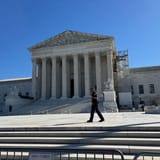
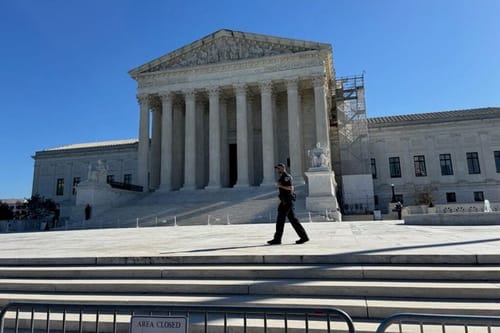

State courts cannot find liability for labeling shortcomings in pesticides and related products because such products are covered by federal law, the U.S. Supreme Court said Thursday in a decision backing agricultural giant Monsanto.
The justices, in a 7-2 decision, threw out a $1.25 million verdict a Missouri court awarded to a man who said long-term use of the weedkiller Roundup caused him to develop non-Hodgkin lymphoma, a type of blood cancer.
The herbicide, produced by Monsanto, does not include any warning of carcinogenic material and Monsanto and parent company Bayer deny there is any link.
The decision created an unusual split for the conservative-dominated court, with Justice Brett Kavanaugh writing the majority opinion and his fellow conservative Justice Neil Gorsuch joining a dissent written by liberal Justice Ketanji Brown Jackson.
The majority ruled that the Federal Insecticide, Fungicide, and Rodenticide Act, or FIFRA, which governs herbicide use, preempts state claims like the one awarded to John Durnell of St. Louis.
Roundup’s label complied with U.S. Environmental Protection Agency regulations, to which states cannot add requirements, Kavanaugh wrote.
“In sum, federal law requires Monsanto to sell Roundup with the label that EPA approved at the initial registration and that EPA has subsequently re-approved on multiple occasions—that is, the label without a cancer warning,” he wrote.
“Durnell’s state tort claim, by contrast, would require Monsanto to add a cancer warning to its labels. That Missouri-law requirement is ‘in addition to’ and ‘different from’ Monsanto’s federal-law labeling obligations.”
In her dissent, Jackson wrote that the majority’s decision improperly prioritized national uniformity over consumer protection.
“In accepting Monsanto’s argument and holding that Durnell’s failure-to-warn claim is preempted, the Court misunderstands FIFRA’s requirements, misinterprets the scope of FIFRA’s preemption, and ultimately leaves Durnell without a remedy for the significant harms he has suffered,” she wrote.
Durnell sued Monsanto and parent company Bayer in 2019, claiming that exposure to Roundup over two decades led to his cancer diagnosis. A Missouri trial court awarded him $1.25 million, and a state appeals courts affirmed the ruling.
The Supreme Court was the first federal court to hear the case.
Federal law typically trumps state law, which Monsanto and the Justice Department emphasized during April oral arguments. Industry groups across the economy tend to support federal supremacy because it saves companies from complying with 50 separate regulatory schemes across states.
The EPA, which regulates labeling requirements for herbicides, does not require the kind of warning the Missouri jury said was appropriate.
T_his is a breaking news story and will be updated._
This story is republished from the Ohio Capital Journal under a Creative Commons license. View the original article.