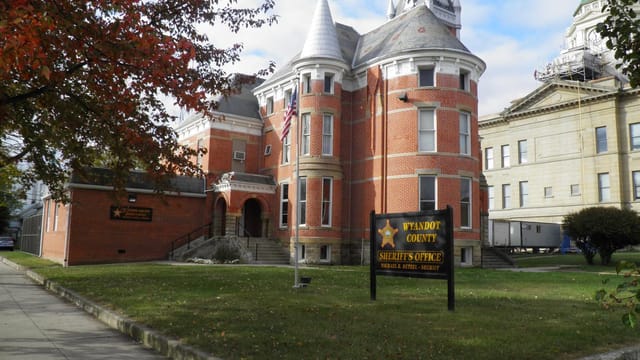
Six days after Seneca County deputies fatally shot a Bloomville man, Sheriff Fredrick W. Stevens released a body camera clip, four still images and a second written statement that argues his deputies fired only because their lives were at risk.
Stevens issued the release Monday, July 13. He wrote that a second statement was necessary “to address misinformation circulating in our community” about the July 7 shooting of Jeffrey R. Sergent, 43, at Township Road 8 and State Route 67.
The release does not say what the misinformation is, who spread it, or where it appeared.
It arrives while the criminal investigation into the shooting is still open. The Ohio Bureau of Criminal Investigation is the lead agency, and it has released no findings. The Sheriff’s Office previously told TiffinOhio.net it could not provide records from the shooting because BCI had taken over the case, and the Ohio Attorney General’s Office has withheld the entire investigative file, citing the exemption in state public records law for material assembled for a pending case.
The deputies who fired have not been named. The Sheriff’s Office says they are crime victims whose identities are protected. In the new release, Stevens wrote that the deputies and a Bloomville officer “were, by law, victims of crime in the incident,” and that personal information had to be manually redacted from the footage under Marsy’s Law before any of it could be viewed.
What the Sheriff’s Office says the video shows
Viewer discretion is advised for the bodycam video below.
“The video evidence establishes many facts,” Stevens wrote. The release makes four points.
First, it says deputies did not have their guns drawn while they spoke with Sergent, and drew them only after he put the truck in reverse, struck a guardrail and then drove toward deputies.
Second, it addresses the weapons question. Sergent said he had only knives, according to the release, but deputies could not assess whether other weapons were in the truck because he rolled his windows up. The release says deputies assumed there could be more weapons because they knew his record.
Third, it addresses sound. The release says “popping sounds” audible on the clip came from a window punch tool, then an asp breaking the window, then the truck striking the guardrail. Gunfire comes after those sounds, according to the release, followed by the engine backfiring after the truck hit a cruiser.
Fourth, it addresses where deputies were standing. The release says deputies were on both sides of the truck during the arrest attempt and “never in front of it,” and that when Sergent put the truck in motion, deputies were forced to move to avoid being hit — which placed some of them in front of the vehicle.
The Sheriff’s Office account issued on the day of the shooting said deputies were positioned in front of and beside the truck when they fired into it. Both releases place deputies in front of the vehicle at the moment shots were fired. The new one describes how they got there.
“The Deputies drew their weapons and fired only when their lives and the lives of their fellow officers were in danger, as the video clip clearly shows,” Stevens wrote.
The stills
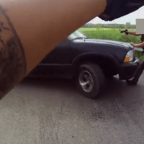
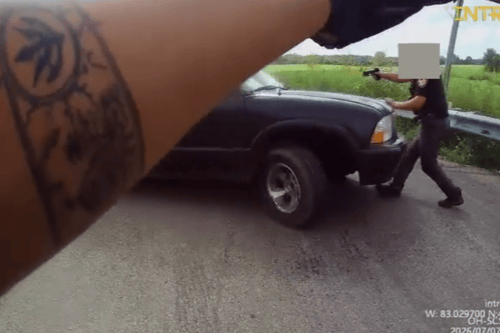
The four released images are watermarked and carry redactions applied by the agency. Two, timestamped 10:26:03 a.m., show an officer with a handgun raised toward the front of a dark pickup truck stopped along a guardrail. A third, timestamped one second later, shows the truck from the driver’s side. A fourth, at 10:26:13 a.m., shows the truck’s front end against the push bar of a cruiser, its windows shattered.
The Sheriff’s Office said in its first release that the traffic stop began at about 10:17 a.m. and that deputies negotiated with Sergent for roughly 10 minutes. The timestamps on the stills are consistent with that timeline.
The Sheriff’s Office also posted a partial body camera clip to Facebook. It has not released the full footage, and it has not said how many deputies fired, how many shots were fired, or how much of the recorded video the clip represents.
The record the Sheriff’s Office cites
Much of the new release is devoted to Sergent’s criminal history, which the Sheriff’s Office says shaped how deputies approached him. Stevens wrote that Sergent is “a known violent felony offender with our office.”
According to the release, Sergent had convictions in Ohio and Tennessee and faced charges in Georgia. His Ohio charges included resisting arrest, failure to comply, vandalism, being a fugitive from justice and assault of a police officer, the release says, and he was convicted in Ohio of escape and assault.
Those convictions stem from a 2018 case in which Sergent assaulted a Seneca County deputy and tried to take the deputy’s gun during a domestic violence arrest, according to the release, and resulted in a prison sentence.
The release also says deputies had spoken with Sergent about the felony domestic violence charges before the July 7 arrest attempt. Sergent denied the allegation and said he had evidence disproving it, according to the release, but never produced it, and the charges were filed.
The legal argument
The release closes with a legal case for the shooting. Stevens quoted Ohio’s statutory definition of a deadly weapon — any instrument, device or thing capable of inflicting death that is designed, adapted, possessed, carried or used as a weapon — and wrote that a second section of Ohio law “further clarifies a motor vehicle as a ‘deadly weapon.’”
The definition Stevens quoted matches the statute word for word. His description of the second section does not.
That section is Ohio’s felonious assault law. It nowhere classifies motor vehicles as deadly weapons. It borrows the same definition, and it mentions a motor vehicle in a single place: a sentencing provision requiring a license suspension when a vehicle turns out to have been the deadly weapon used in an assault.
Under Ohio law, almost nothing is a deadly weapon by default. Courts have held that knives, BB guns and pocket knives are not deadly weapons on their own, and that the question turns on how an object was actually used. Vehicles are treated the same way. Ohio appeals courts have held that a vehicle qualifies only when used in a manner likely to produce death or great bodily harm, and that the driver’s intent, manner of use and actions must all be examined. One Ohio appellate decision put it directly: a car can be a deadly weapon if used as one, but the state must prove the driver intended to use it as a weapon and was not merely attempting to flee the scene.
Stevens wrote in the same release that Sergent “put their lives at risk by attempting to escape instead of simply complying.”
None of this establishes that the deputies acted unlawfully. Whether an officer’s use of deadly force is justified is judged by a different standard entirely — whether the force was objectively reasonable from the perspective of an officer at the scene — and an officer may lawfully fire at a vehicle he reasonably perceives as a threat even if the driver could not be convicted of assault. Those are separate questions, and BCI is examining the first one, not the second.
What the Sheriff’s Office has done is tell the public that the law already answers a question the law does not answer, while the investigation that will answer it remains open.
What is still not public
The state’s investigation has produced no public findings. The full body camera and cruiser footage has not been released. The deputies have not been identified.
In November, the Ohio Supreme Court ruled that police officers attacked in the line of duty are crime victims under Marsy’s Law and that their names may be redacted from public records. Agencies across the state have relied on that ruling to withhold the identities of officers involved in shootings. The Sheriff’s Office is invoking the same protection here.
The Seneca County Coroner’s Office has said Sergent suffered a gunshot wound to the head and a gunshot wound to the arm. Final cause and manner of death and a toxicology report remain pending.
WTOL-11 reported last week that Jacob Kendrick, a friend of Sergent’s, was on a video call with him during the encounter and described what he saw. The Sheriff’s Office release does not reference that account.
TiffinOhio.net previously reported the shooting and the coroner’s findings.
Questions about the investigation are being directed to the Ohio Attorney General’s Office, according to the Sheriff’s Office. This is a developing story.