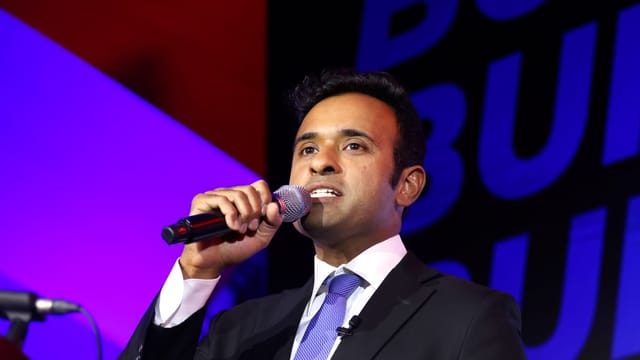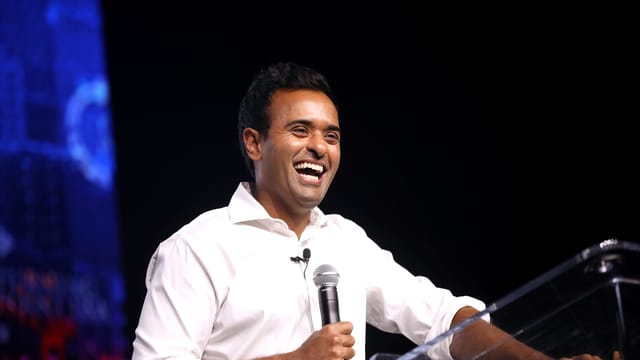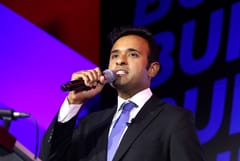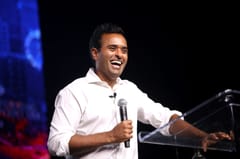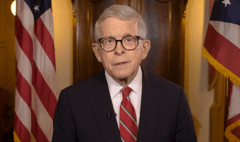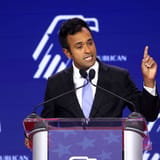
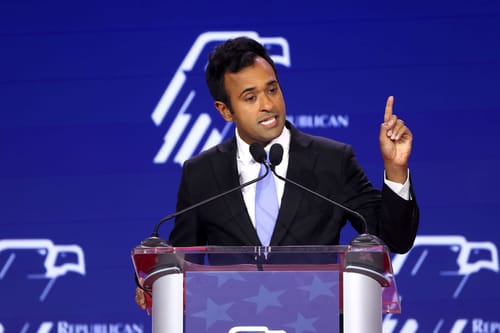
Vivek Ramaswamy says Ohio needs a “fresh approach.” He says his campaign represents a “demand for change” and a movement “beyond the status quo.”
Ohio’s political status quo is Republican government.
Republicans have controlled the governor’s office, Ohio House and Ohio Senate continuously since January 2011. The party also controlled all three from 1995 through 2006.
The Republican hold on the legislature stretches even further. Statehouse News Bureau records show Republicans have controlled the Ohio House since 1995 except for the 2009-10 legislative session. Democrats have not controlled the Ohio Senate since 1985.
Republicans George Voinovich, Nancy Hollister and Bob Taft held the governor’s office from 1991 through 2006. Democrat Ted Strickland served one term from 2007 through 2010. Republicans John Kasich and Mike DeWine have held the office ever since.
Ramaswamy is campaigning to change a state government his party has controlled for almost all of the past three decades.
His campaign platform promises to slash property taxes, phase out the state income tax, cut electric bills, reduce government spending and bureaucracy, improve schools, reform Medicaid and rewrite Ohio’s approach to data centers.
Some of those promises amount to a direct repudiation of decisions made under Republican governors and Republican legislative majorities.
Ramaswamy was asked about that directly in May.
After he declared Medicaid fraud his “absolute top priority,” The Associated Press asked how much responsibility Ohio’s Republican establishment should bear after controlling state government for more than 15 years.
“I’m not playing that game, OK?” Ramaswamy responded.
He instead said his candidacy represented “a bottom-up movement and a demand for change, positive change in the state” and “a movement beyond the status quo.”
Republicans have been the status quo for decades
Ramaswamy is not running against a divided state government where responsibility has regularly shifted between the parties.
Republicans have won 83% of Ohio’s statewide elections since 1994, according to the Statehouse News Bureau.
The party regained complete control of state government after the 2010 election. Since Kasich took office in January 2011, every Ohio governor has been Republican, every General Assembly has had Republican majorities in both chambers and every state operating budget has moved through a Republican-controlled legislature to a Republican governor.
Ramaswamy’s own ticket comes directly from that government.
His running mate, Rob McColley, is not simply a Republican lawmaker. He is president of the Ohio Senate. He has served in the General Assembly since 2015 and in the Senate since 2017.
When Ramaswamy selected McColley as his running mate in January, he said McColley would be his “governing partner” and help advance his legislative agenda.
Fifteen Republican senators had already endorsed Ramaswamy in March 2025, including every member of the Senate Republican leadership team.
The campaign’s own endorsement announcement captured the two messages Ramaswamy is running on.
“For years, Republican leadership has turned Ohio into a Midwest success story,” McColley said.
The campaign then said Ramaswamy’s leadership “isn’t about maintaining the status quo.”
Ramaswamy added: “Ohio is already great — but great isn’t good enough.”
He attacks Ohio’s COVID response. DeWine says the decisions were his.
Ramaswamy’s attacks on Ohio’s COVID-19 response put him in direct conflict with the Republican governor who made those decisions — and who has endorsed him.
Former Ohio Department of Health Director Amy Acton’s role in the pandemic has become a major Republican line of attack in the 2026 governor’s race.
Ramaswamy has accused Acton of promoting dangerous “COVID ideology” and has attacked her over shutdowns, restrictions and the postponement of Ohio’s March 2020 primary election.
Acton signed major public-health orders as DeWine’s health director. But AP reported that those orders were issued at the urging of DeWine, who was governor throughout the pandemic.
DeWine publicly rebuked one Ramaswamy campaign ad that blamed Acton for suspending the March 2020 election.
“I told her to issue the health order,” DeWine said. “The decision was mine.”
DeWine has made the same point about Ohio’s broader pandemic response.
“The decisions that were made during COVID, they were my decisions,” DeWine told PolitiFact. “The buck stops with me.”
Jon Husted, DeWine’s Republican lieutenant governor during the pandemic and now a U.S. senator, also told PolitiFact that DeWine ultimately made the decisions.
Ramaswamy himself had a connection to the administration’s pandemic response.
AP reported that Ramaswamy wrote in a 2021 op-ed that, while leading biotechnology company Roivant Sciences, he “worked with the lieutenant governor as an adviser on COVID-19” in 2020.
Ramaswamy told AP his work with Husted focused on reopening the economy. He supported vaccination and advocated wearing masks while opposing government mandates.
Six years later, Ramaswamy is campaigning against pandemic decisions made by the Republican administration he advised.
His running mate’s campaign biography says McColley helped ensure Ohio never repeats what it calls “the overreach of the COVID-era shutdowns led by Democrat Amy Acton.”
DeWine has said he was the one making those decisions.
DeWine nevertheless endorsed Ramaswamy and McColley in January.
“Ohio is winning new business projects from the coasts, and Vivek will keep the momentum going,” DeWine said.
He promises to fix Medicaid. His running mate helped eliminate its oversight committee.
Medicaid puts Ramaswamy’s change message even closer to the Republican leadership supporting his campaign.
On May 19, Ramaswamy announced a plan to “crush” Medicaid waste, fraud and abuse.
His campaign said approximately $47 billion would flow through as many as 10 state entities by fiscal year 2027, creating bureaucracy and “leaving an opening for bad actors to exploit a broken system.”
Standing with Ramaswamy at the announcement were McColley, Republican House Speaker Matt Huffman and Republican Auditor Keith Faber.
All three already hold power in the state government Ramaswamy says needs a new approach.
McColley also held key decision-making authority over the 2025 state budget that eliminated Ohio’s Joint Medicaid Oversight Committee.
The Ohio Legislative Service Commission confirms that the committee was abolished by House Bill 96, the two-year state operating budget enacted in 2025.
State law had authorized the committee to oversee Medicaid and investigate state and local Medicaid agencies.
AP reported the committee was investigating contracts involving Gainwell, the nation’s largest Medicaid claims processor, when lawmakers eliminated it.
Republican state Rep. Jennifer Gross, who served on the committee, told AP it could have helped carry out the fraud-fighting agenda Ramaswamy is now proposing.
“I believe that if we had kept JMOC it always could have been something that we kept in place that could have morphed into a DOGE Ohio, an Ohio Medicaid DOGE,” Gross said.
DeWine’s administration has pushed back against claims that Ohio failed to pursue Medicaid fraud.
DeWine spokesman Dan Tierney told AP that the suggestion Ohio had not been combating Medicaid fraud was “just not true.” He cited about 2,300 indictments, 2,200 convictions and $644 million recovered since 2011.
Republican Auditor Keith Faber also said the fraud concerns being highlighted by Ramaswamy were not new to state officials.
Ramaswamy is therefore promising a new crackdown while members of his own ticket and political coalition have spent years overseeing the program, writing its budgets and restructuring its legislative oversight.
He wants to overhaul Ohio’s universities. DeWine says no.
Ramaswamy is also campaigning against the current Republican administration’s approach to Ohio’s public universities.
He has argued that Ohio’s university system is too fragmented and has called for consolidation or elimination of some state universities as enrollment declines.
In a March column published by his campaign, Ramaswamy called for major changes to the public higher-education system.
DeWine wants no part of eliminating state universities.
Speaking to college and university trustees Sept. 9, DeWine rejected the proposal.
“I don’t think that’s a good idea,” DeWine said. “First of all, it’s not going to happen. Can’t happen. Too much opposition.”
DeWine said eliminating state universities would work against efforts to broaden access to higher education. He also said he doubted lawmakers would even introduce such a proposal.
The governor saying that is not Ramaswamy’s Democratic opponent.
It is the Republican who has governed Ohio since 2019 and endorsed Ramaswamy to succeed him.
He says he’ll fix data centers after Republican government helped build the boom
Ramaswamy’s August data-center plan offers another direct example.
Ohio spent years competing for data centers through tax incentives and economic-development policies under Republican governors and legislatures.
That strategy helped turn Ohio into a major data-center destination.
It also became far more expensive than the state had projected.
Ohio estimated in 2024 that its data-center sales-tax exemption would cost about $136 million in fiscal year 2025. The actual cost reached nearly $1.6 billion, according to state figures reported by AP.
DeWine paused new awards of the tax incentive this summer while lawmakers study data centers’ economic, environmental and energy effects.
He still supports the industry. DeWine told AP that roughly $37 billion in Ohio data-center investment during 2024 and 2025 had been worthwhile.
Ramaswamy is now campaigning on restrictions that go far beyond the policy Ohio used to attract those projects.
His “Ohioans-First Data Center Pledge” would require future projects to provide free electricity or compensation to nearby residents, pay full property taxes and meet environmental and farmland protections.
Ramaswamy says he would halt approvals for new projects until legislation imposing those conditions takes effect.
His own description of the problem is direct.
“The data center industry has badly failed to earn the trust of millions of everyday Ohioans,” Ramaswamy wrote.
He then separated himself from the state’s existing policy.
“While I had no part in these past projects, I am committed to ensuring our policies catch up to current realities,” he wrote. “I’m pro-Ohio, and I have a plan to fix the problem.”
Ramaswamy is correct that he did not hold state office when those projects and incentives were approved.
Republicans did.
Property taxes and electric bills are also central to his campaign
Ramaswamy’s broader affordability campaign follows the same pattern.
His campaign says property taxes have “surged” since the pandemic and says Ohio families have been “asked to pay more and accept less.”
He promises to roll property taxes back to pre-pandemic levels.
His statewide platform also promises to “reduce electric bills,” “cut government bloat” and improve educational performance.
Property taxes are not set exclusively by the governor or General Assembly. Local levies, school districts and county property valuations determine much of what homeowners pay. Electric bills are also shaped by utilities, power generation, transmission costs and the regional PJM market.
State government still controls major pieces of both systems.
Ohio lawmakers write state property-tax law and school-funding policy. Governors sign those laws and appoint members of the Public Utilities Commission of Ohio. The General Assembly writes utility law, authorizes state energy policy and determines how state money flows to schools and local governments.
Republicans have controlled those state decisions without interruption since 2011.
The Republican establishment is not opposing him. It is backing him.
Ramaswamy can credibly separate himself personally from decisions made before he entered state politics. He has never served in Ohio government.
The same cannot be said for the political coalition surrounding his campaign.
His running mate runs the Ohio Senate.
House Speaker Matt Huffman has spent years in legislative leadership, including four years as Senate president before becoming House speaker in 2025.
DeWine has been governor since 2019 and served as attorney general for eight years before that.
Faber has served as state auditor since 2019 after years in the legislature, including as Senate president.
The Ohio Republican Party endorsed Ramaswamy in 2025.
DeWine endorsed him.
Republican Senate leaders endorsed him.
Ramaswamy is not leading a revolt against the politicians who have controlled Columbus. Many of them are part of his campaign coalition.
Changing direction without changing the party in power
Ramaswamy’s campaign does not argue that Republican control of Ohio has been a failure.
Quite the opposite.
McColley says Republican leadership turned Ohio into a “Midwest success story.” DeWine says the state is winning business projects and wants Ramaswamy to “keep the momentum going.” Ramaswamy says “Ohio is already great.”
At the same time, Ramaswamy is running on a long list of policies he says need to be changed: COVID-era government overreach, high property taxes, high electric bills, Medicaid bureaucracy and fraud, an inadequate education system, a fragmented university system and data-center policies that he says failed to protect Ohio families.
Those conditions did not develop while Democrats controlled Ohio’s state government.
By the time the next governor takes office in January 2027, Republicans will have controlled the governor’s office, Ohio House and Ohio Senate continuously for 16 years.
Ramaswamy is asking voters to keep the same party in power while giving him authority to change the government that party has been running.