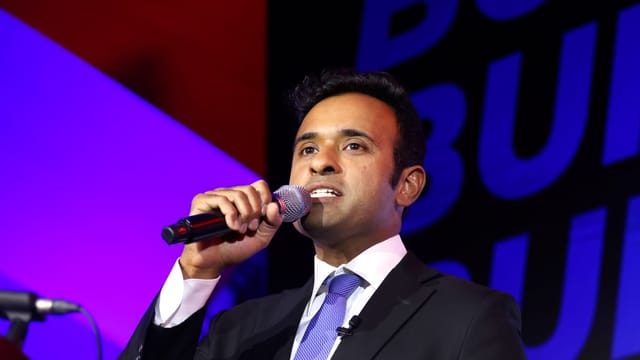
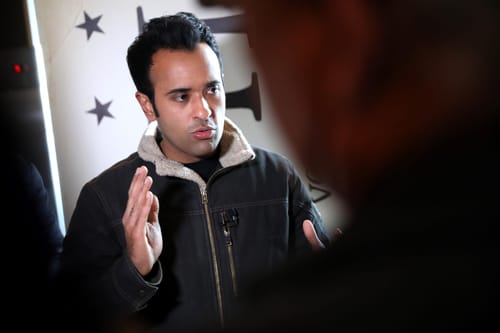

Vivek Ramaswamy launched his campaign for Ohio governor with one of the most sweeping tax promises in the race: bring property taxes down immediately and, ultimately, eliminate them.
“We need to bring down property taxes in this state immediately — eventually down to zero,” Ramaswamy told supporters during his February 2025 campaign launch. “If you own land, it should not feel like it’s a lease from the government.”
But Ramaswamy, now the Republican nominee for governor, has since quietly abandoned that promise.
By early 2026, Statehouse News Bureau reporting noted that Ramaswamy had backed away from eliminating property taxes and was instead promising the “biggest property tax rollback in the history of our state.” By July, Ohio Capital Journal reported that Ramaswamy acknowledged eliminating property taxes was no longer feasible.
His current campaign plan now calls for rolling property taxes back to levels before the end of the COVID-19 pandemic and limiting future growth.
The shift came as state fiscal officials, tax researchers, local governments and municipal bond attorneys were putting numbers behind what eliminating Ohio property taxes would actually mean.
The most detailed analyses were prepared in response to a separate citizen-led constitutional amendment seeking to abolish real property taxes statewide — not Ramaswamy’s current rollback proposal. But those analyses examined essentially the same endpoint Ramaswamy promised voters at the beginning of his campaign: eliminating taxes on real property.
More than $20 billion would have to come from somewhere
Ohio does not collect a state property tax. The money is collected locally and pays for schools, police and fire departments, emergency medical services, libraries, developmental disability programs, senior services, roads and other local government operations.
In a February 2026 memorandum to Gov. Mike DeWine, Ohio Office of Budget and Management Director Kimberly Murnieks said property taxes generate roughly $24 billion annually for local governments — approximately as much as Ohio collects from its state income and sales taxes combined.
Because the proposed abolition amendment applied to real property but did not eliminate public-utility personal-property taxes, the amount that would actually need to be replaced would be more than $20 billion annually.
OBM concluded that replacing that revenue through other taxes would be “fiscally impractical and economically harmful.”
If Ohio tried to replace the lost revenue through income taxes, OBM said rates could need to rise to roughly 11% to 15% statewide.
A separate Tax Foundation analysis calculated that replacing Ohio property taxes through income taxes would result in an average all-in state and local income-tax rate of about 12.6%, with enormous differences among counties. In some counties, the combined rate required to replace property taxes could approach 27%.
That 27% figure is not a proposed statewide Ohio income-tax rate. It represents the upper end of the Tax Foundation’s county-by-county estimates if income taxes were used to replace the property-tax revenue currently collected in each county.
The alternative would not necessarily be cheaper.
OBM estimated that replacing the lost revenue through Ohio’s sales tax could require increasing the state rate from 5.75% to somewhere around 15% to 18%. DeWine went even further, warning that the rate could approach 20%.
For comparison, Tax Foundation data from July 2026 show Louisiana currently has the highest average combined state and local sales-tax rate in the country, at just over 10%.
Schools are particularly dependent on the tax
The consequences would be especially significant for Ohio public schools.
A study by Butler County Auditor Nancy Nix estimated that roughly $13 billion in annual property-tax revenue goes to school districts.
The Ohio Legislative Service Commission likewise found that property taxes account for approximately 95% of school districts’ local operating revenue, excluding property taxes paid by the state through existing rollback and homestead-exemption programs.
That does not necessarily mean schools would simply lose every dollar. A Legislative Budget Office analysis noted that eliminating real-property taxes could dramatically reduce districts’ calculated local capacity under Ohio’s school-funding formula, potentially requiring the state to provide considerably more money.
But the proposed abolition amendment contained no mechanism requiring the state to replace the lost revenue, and doing so would transfer an enormous new financial obligation to Columbus.
An anti-abolition coalition, Ohioans to Protect Public Services, has estimated that eliminating property taxes without replacement could result in more than 50,000 teacher layoffs. WOSU reported the coalition’s estimate in April.
That figure is an advocacy coalition’s estimate rather than an official state layoff projection. But the scale is notable: the Ohio Department of Education and Workforce reported 111,646 full-time-equivalent teachers in Ohio public schools during the 2023-24 school year. A loss of 50,000 positions would represent roughly 45% of that workforce.
Police, fire and EMS funding would also be exposed
Public safety agencies are another major recipient of voter-approved property-tax levies.
Ohioans to Protect Public Services estimates that eliminating property taxes without a replacement could jeopardize more than 32,000 positions among police officers, firefighters, paramedics, dispatchers and other first responders.
Again, that is a coalition estimate, not an official state forecast. But local governments’ reliance on property-tax revenue for public safety is well documented.
The Ohio Legislative Service Commission reported that Ohio had 944 law-enforcement agencies employing 26,004 full-time officers as of January 2024, including municipal police, sheriff’s deputies, township officers and state law-enforcement personnel.
Some communities are overwhelmingly dependent on property taxes for police services. The research compiled on the abolition proposal found, for example, that Washington Township said property taxes represented approximately 95% of its police funding.
“The total elimination of property taxes without a secured, guaranteed replacement creates a public safety crisis,” Independence Police Chief Robert Butler, president of the Ohio Association of Chiefs of Police, said during the debate over abolition.
Bond attorneys warned of another problem: Ohio’s local debt
Eliminating property taxes would not eliminate the debts Ohio communities have already incurred.
That created another warning from some of the state’s largest municipal bond-law firms.
In a February memorandum, attorneys from Bricker Graydon Wyatt, Calfee Halter & Griswold, Dinsmore & Shohl, FBT Gibbons and Squire Patton Boggs examined the impact of the proposed constitutional amendment.
They said Ohio local governments had nearly $22.3 billion in outstanding general-obligation bonds, many of which are secured directly or indirectly by property-tax revenue.
Abolishing that underlying security, the attorneys warned, would likely trigger immediate credit downgrades to “junk” status for affected Ohio general-obligation debt and could freeze the municipal credit market for local governments seeking to finance schools, roads, water systems and other infrastructure.
The memo also warned that replacing property taxes with income- or sales-tax revenue could make future borrowing more expensive because those revenue streams are more economically volatile.
The warning was directed at the full abolition amendment, not Ramaswamy’s current rollback proposal. But it underscored another complication with his original zero-property-tax promise: existing debts do not disappear when the tax securing them does.
Ramaswamy’s new plan still leaves billion-dollar questions
Ramaswamy is no longer proposing to eliminate the tax entirely.
His campaign now says he would roll property-tax collections back to levels “before the end of the Covid pandemic.” The campaign says new construction would not be affected, existing debt obligations would be honored and local governments would continue operating “with greater discipline.”
But the campaign has not publicly specified the exact tax year it would use as its rollback baseline.
The Statehouse News Bureau reported in July that Ramaswamy has said savings from reducing the size of government and economic growth — including a goal of increasing Ohio’s population to 15 million — would help finance his proposal.
Fifteen million residents would represent roughly a 36% increase in Ohio’s population. The campaign has not detailed a timetable under which that population growth would occur or provided a dollar-for-dollar replacement mechanism for local governments affected by the rollback.
Innovation Ohio, a progressive policy organization, attempted to quantify the proposal by assuming Ramaswamy meant rolling property taxes back to approximately 2021 levels.
Its analysis estimated that such a rollback would initially reduce local property-tax collections by roughly $4 billion annually, with the gap reaching approximately $6.6 billion a year by the time the policy was fully implemented.
The organization estimated that approximately $4 billion of the eventual reduction would fall on school districts.
TiffinOhio.net previously reported on that analysis in April.
The $6.6 billion estimate depends on Innovation Ohio’s assumed 2021 baseline. Ramaswamy’s campaign has not committed to that year, meaning the exact fiscal impact of his current proposal cannot yet be calculated.
The abolition effort is now targeting 2027
Meanwhile, the separate citizen effort to abolish Ohio property taxes has not disappeared.
Organizers failed to collect enough signatures to place their constitutional amendment before voters in November 2026 and announced in June that they would instead continue collecting signatures in hopes of making the November 2027 ballot.
That means Ohio voters will not decide on complete property-tax abolition this fall.
They will, however, decide between candidates offering sharply different approaches to the property-tax problem — including Ramaswamy, who began his campaign promising to take the tax to zero and is now asking voters to support a historic rollback instead.
The promise has changed.
The unanswered question is how much the replacement promise would cost — and who would ultimately pay for it.