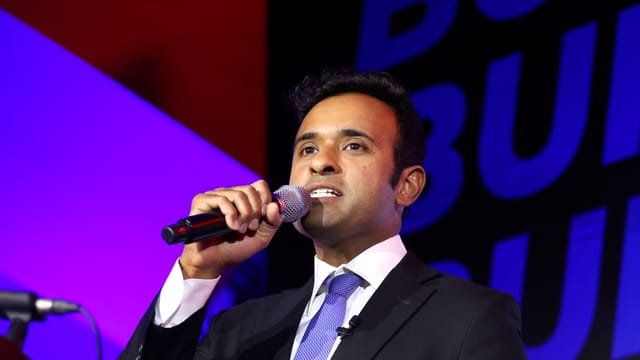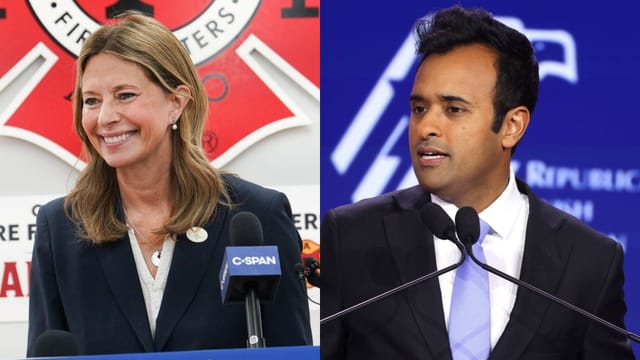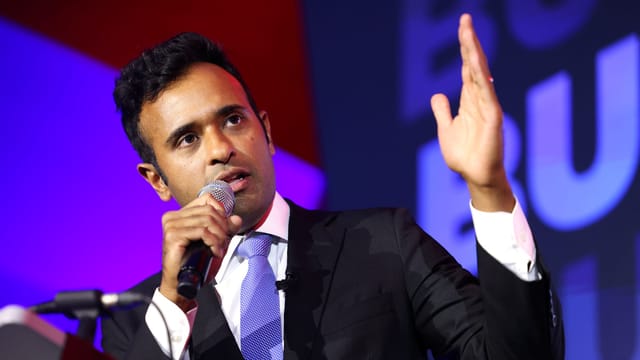


Republican gubernatorial nominee Vivek Ramaswamy is facing allegations of possible violations of New York attorney-registration rules or Ohio voter-registration law after a newly reported filing showed him identifying a West Chester residence as his home, despite moving his family to the Columbus area five years earlier.
In a report published Monday, MeidasTouch revealed that Ramaswamy listed West Chester, Ohio, as his home address in a July 2026 New York attorney registration. Ohio voter records, meanwhile, place his registration in the Columbus area, where he and his family relocated in 2021.
The discrepancy raises two separate legal questions: whether Ramaswamy failed to maintain accurate residential information with New York’s attorney registration authorities, and whether his Ohio voter registration accurately reflects his legal residence.
New York requires attorneys to report their home addresses and update them within 30 days of a change. Ohio separately makes it a fifth-degree felony to knowingly register to vote in a precinct where a person is not qualified.
Ramaswamy’s own gubernatorial campaign identifies greater Columbus as his family’s home, while an October 2 Forbes investigation independently documented his move from West Chester to central Ohio in mid-2021. That relocation occurred approximately five years before the attorney registration now under scrutiny.
The allegations come just two weeks before Ohio’s November 3 gubernatorial election, in which Ramaswamy faces Democrat Amy Acton, and involve a candidate who has made stricter election identification requirements a prominent part of his political agenda.
New York requires attorneys to report address changes within 30 days
Under Section 118.1 of New York’s attorney registration rules, attorneys admitted to practice in the state must provide their home addresses as part of their registration statements.
Subsection (e)(8) specifically requires disclosure of a home address, while subsection (f) requires an amended registration statement within 30 days whenever that address changes. Subsection (h) directs that attorneys who fail to comply with the registration requirements be referred for disciplinary action.
New York’s Judiciary Law Section 468-a goes further, classifying noncompliance with attorney registration requirements as conduct prejudicial to the administration of justice and requiring referral to the appropriate appellate division for disciplinary proceedings.
Those obligations apply regardless of whether an attorney resides in New York. Ramaswamy was admitted to the state’s bar in 2014 and remains listed as currently registered.
According to MeidasTouch, Ramaswamy signed an affirmation certifying the accuracy of the information in his 2026 attorney registration, including the West Chester home address. The reported affirmation stated that the information was true to the best of his knowledge and belief.
If West Chester was no longer his home address when he submitted the July 2026 registration, the filing would raise a direct compliance issue under New York’s requirement that attorneys keep that information current.
The original July registration statement was not reproduced in the MeidasTouch article and has not been independently obtained by TiffinOhio.net. The publicly available New York attorney database confirms registration status but does not independently resolve the reported home-address discrepancy.
Records show Ramaswamy moved from West Chester to Columbus five years ago
The reported July filing conflicts with a residential timeline documented through property records, voter registration reporting and Ramaswamy’s own campaign biography.
In a detailed October 2 investigation, Forbes reported that Ramaswamy relocated from New York City to West Chester Township outside Cincinnati in December 2019, purchasing a newly built home for approximately $420,000.
About 18 months later, in mid-2021, Ramaswamy and his family moved to a larger home outside Columbus valued at approximately $2 million, according to Forbes.
His voter registration followed the same timeline. In August 2023, NBC News reported that Ramaswamy had registered to vote in Franklin County in November 2021.
His 2026 gubernatorial campaign continues to identify central Ohio as his home. The campaign’s official biography states that Ramaswamy and his wife, Dr. Apoorva Ramaswamy, are raising their family in greater Columbus.
That account is consistent with Forbes’ documentation of the 2021 move and his subsequent Franklin County voter registration. It also makes the reported July 2026 New York filing significant: after five years in the Columbus area, Ramaswamy allegedly continued identifying his former West Chester residence as his home for professional registration purposes.
The question is whether that address accurately represented his home in July or whether he failed to update information New York law requires attorneys to keep current.
Ohio law makes knowingly registering in the wrong precinct a fifth-degree felony
The conflicting addresses also raise a separate question about Ohio’s voter-residency requirements.
Under Ohio Revised Code Section 3503.02, a person’s voting residence is generally the location where the person’s habitation is fixed and where that person intends to return when absent. The statute also identifies the residence of a married person’s family as the person’s place of residence, subject to specified exceptions.
Ohio does not permit voters to select an arbitrary precinct simply because they own property or maintain an address there. Registration must reflect the voter’s qualifying residence.
Under Ohio Revised Code Section 3599.11, knowingly registering or attempting to register in a precinct where a person is not a qualified voter constitutes a fifth-degree felony. The statute also prohibits knowingly making false statements on voter registration documents.
If Ramaswamy’s actual voting residence remained in West Chester rather than the Columbus area, his Franklin County registration would warrant examination under those requirements. Conversely, if his established residence was in Columbus, as his campaign biography and documented relocation indicate, the West Chester address reported to New York attorney authorities requires an explanation.
The two states’ legal requirements are distinct: an address discrepancy does not automatically establish either a false attorney registration or an unlawful voter registration. The Ohio felony provision specifically requires knowing misconduct. The available records do not establish that Ramaswamy knowingly registered in a precinct where he was ineligible.
Nevertheless, the conflicting records leave the accuracy of his reported residential information unresolved.
Ramaswamy has made election integrity a campaign priority
The allegations carry political significance because Ramaswamy has publicly demanded stricter identification requirements for Ohio voters while campaigning for governor.
In a May 18 column published on his campaign website, Ramaswamy called for Ohio to enshrine photo identification requirements in the state constitution, arguing that statutory protections could be weakened by future lawmakers or court decisions.
He praised President Donald Trump’s support for federal voter identification legislation and argued that constitutional protections were necessary to restore public confidence in elections.
His attorney registration is now receiving scrutiny over the accuracy of the residential information he provided to another state’s judicial authorities, while the conflicting address records have also prompted questions about the validity of his Ohio voter registration.
Acton’s gubernatorial campaign highlighted the allegations Monday, circulating the MeidasTouch report and its findings about the competing addresses and potential legal violations.
The discrepancy remains unexplained
The issue is not whether Ramaswamy once lived in West Chester. Independent reporting establishes that he did. Nor is there a dispute that he subsequently relocated to the Columbus area and registered to vote there in 2021.
The unresolved issue is why his July 2026 attorney registration reportedly identified West Chester as his home after that move, and whether the address complied with New York’s reporting requirements.
There is no established finding of attorney misconduct or unlawful voter registration arising from the discrepancy. Determining whether either law was violated would require establishing which address accurately reflected Ramaswamy’s residence at the relevant time, along with the additional legal elements applicable to each offense.
With Ohio voters preparing to choose their next governor on November 3, the newly reported filing leaves a consequential question about the accuracy of the residential information Ramaswamy submitted to New York authorities—and the consistency of that information with the Ohio voter registration records and family residence he has publicly acknowledged.