Labor unions exist to negotiate legally binding collective bargaining agreements, which cover the wages, benefits, and working conditions of represented employees. But they also involve themselves in politics because they believe that some elected officials are better than others when it comes to public policy.
Usually, but not always, unions endorse Democrats. However, a few Ohio unions have already endorsed Republican Senator John Husted.
Where do unionized Ohio workers and their families stand politically in 2025, especially in terms of party identification, ideology, support for President Trump, and candidate preferences in the 2026 elections? In order to answer these questions, let’s look at some new survey data from Bowling Green State University.
The BGSU Democracy and Public Policy Network conducted a web-based poll of 800 registered Ohio voters from October 2 to October 14. The poll has a margin of error of +/- 4.5 percentage points, and while in some public presentations the data is weighted in a way that results in a +10 Trump margin from the 2024 presidential race, most of the analysis presented below relies on the unweighted results.
Respondents were given three options to indicate if they live in a union household: they are a union member themselves, or someone they live with is a union member or both they and someone they live with are union members. Seven percent report that they are a union member, 5% say someone they live with is a union member, and 2% say both they and someone they live with are.
In terms of political party preference, union people are more likely to be Democrats than Republicans. About 44% of union members are Democrats, while only 24% are Republicans. Interestingly, among those who live with someone who is a union member, 49% are Democrats, whereas only 21% are Republicans.
In terms of ideology, union folks are more likely to define themselves as liberal than conservative. For example, 47% of union members consider themselves liberal, whereas only 24% consider themselves conservative. A similar pattern occurs for those who live with a union member.
Overwhelming majorities of members of all categories of union households have a very unfavorable attitude toward President Donald Trump. For example, 64% of union members have a strongly unfavorable attitude toward the president. Overwhelming majorities also strongly disapprove of the job he is doing as president. For example, 70% of those who live with a union member strongly disapprove of the job Donald Trump is doing as president.
In terms of the 2026 Ohio governor’s race, in a hypothetical matchup between Democrat Amy Acton and Republican Vivek Ramaswamy, members of all three categories of union households support Acton by more than two-to-one margins. Democrat Tim Ryan does equally well in a hypothetical matchup with Ramaswamy. Members of union households also overwhelmingly support former Democratic U.S. Sen. Sherrod Brown in his campaign against Republican U.S. Sen. John Husted.
For the following analysis, we use the weighted data because we want to see what a sample of likely Ohio voters think about unions. We asked respondents what effect they believe the decline in the number of workers represented by unions has had. Sixty percent believe it has been somewhat or very bad for working people. Only 40% feel like it has been at least somewhat good for working people.
What does all this tell us?
First, if Democrats ever want to be competitive in statewide Ohio elections again, they would benefit from there being more union households, and they would need them to vote.
Second, Democratic candidates could tailor messages to inspire union members and their families to turn out at the polls. This could mean a focus on so-called “bread and butter” or “kitchen table” economic issues that drive workers to unionize in the first place. Overwhelming majorities of all categories of union household members believe the national economic situation has gotten worse over the past year, as do about 54% of non-union members. Can Democrats persuade these voters that their plans will improve the economy? That could be a deciding factor in driving the union vote in 2026, and earning the votes of all workers.
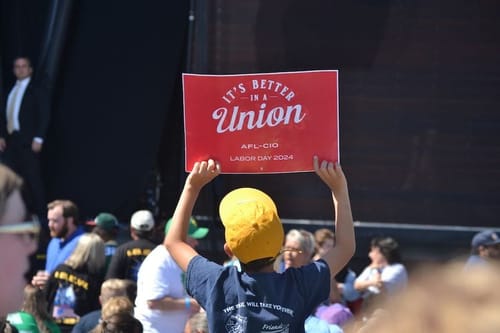
Finally, even in a sample where voters recall giving President Trump a ten-point margin, voters believe the decline in union membership has been bad for workers. This may give union organizers a better opportunity than in recent years to grow their ranks by persuading more workers that life is better in a union.
This story is republished from the Ohio Capital Journal. View the original article.