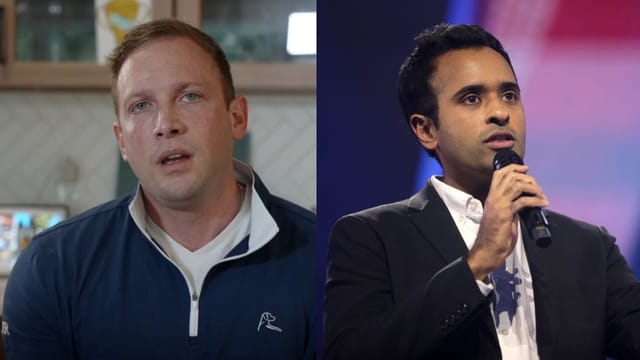
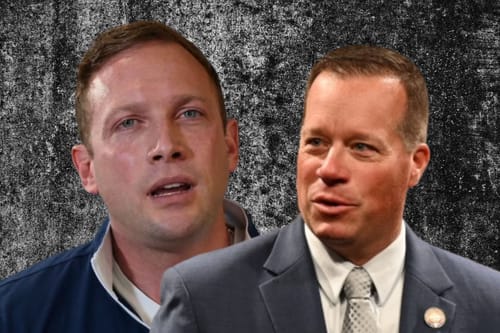
U.S. Sen. Bernie Moreno publicly turned against his former son-in-law Sunday, calling U.S. Rep. Max Miller “a danger” to his daughter, saying he needs “serious psychological help” and declaring him unfit for Congress — as the deadline approaches for Miller to withdraw and trigger Ohio’s process for naming a different Republican nominee.
“If there are any basic standards of character required to hold elected office, Max Miller fails them. He should not serve in the House of Representatives,” Moreno wrote on X, according to ABC News. He added that Miller “needs to seek professional help to end the clear pattern of abuse he has left in his wake” and “should not be free to continue endangering others until he does.” Moreno wrote that he had hoped to keep the matter private, but that Miller’s “increasingly erratic and dangerous behavior has made that impossible.”
Miller answered within hours. “If my daughter said the same thing to me, I personally wouldn’t wait two years before holding him accountable,” he wrote. “You know this isn’t true and the only reason you are speaking out now is to hide from your own media circus. This is all political.”
Miller, a Republican serving his second term in Ohio’s 7th Congressional District, has not been criminally charged in connection with the allegations. He denies all of them and is suing his ex-wife for defamation. In a roughly 17-minute livestream Sunday morning he went through the accusations one by one and said he is not leaving the race: “I’m not getting out of this race, and I’m winning in November.”
What Ohio law actually allows this week
That last point controls what can happen this week, because Ohio Republicans cannot resolve the nomination themselves.
Under section 3513.312 of the Ohio Revised Code, a vacancy in a party’s congressional nomination arises only if the nominee withdraws or dies before the 90th day preceding the general election. Party leaders have no power to install a replacement. Were Miller to withdraw in time, the law directs the county boards of elections within the district to hold a special election on a date set by the secretary of state. If only one candidate filed for it, no election would be held and the secretary of state would issue that person a certificate of nomination.
That cutoff is Wednesday, Aug. 5. The decision whether to withdraw is Miller’s alone; Republican leaders cannot take him off the ballot themselves, and he has said he will not go.
The allegations, and Miller’s answers
The accusations come from Emily Moreno, Miller’s ex-wife and the senator’s daughter. The two married in 2022 and had a daughter in 2023. Miller filed for divorce in August 2024, and the divorce was finalized in 2025. The custody fight has continued since.
In police reports obtained by ABC News, Emily Moreno told officers that Miller threw her against a wall during a February custody exchange, leaving a grab mark on her upper arm, and that he had previously held a gun to her head and thrown hot water on her. Court filings from her legal team place the hot-water incident in June 2024, after she told Miller she planned to leave him.
The same report says Emily Moreno told officers that after a stay at Miller’s home, the couple’s 2-year-old daughter said to her, “Daddy kill you.” When she emailed Miller asking about it, the report says, he denied that the child would have heard anything like that from him.
Miller rejects all of it and has given his own account of each episode. He told his livestream audience that the water incident was “horseplay” in their kitchen: “I sprayed water at her from the sprayer attached to our kitchen sink tap water, which does not reach boiling temperature or scalding,” he said, according to the Washington Examiner. He has also questioned his ex-wife’s mental health and cited it as part of his explanation for the allegations. He posted court records he says clear him to a public file-sharing folder, and his office pointed ABC News to a statement noting that the courts have continued to permit him joint custody, arguing credible evidence would have changed that.
Two facts weigh in Miller’s favor and belong high in any fair account. Prosecutors filed no criminal charges. And the Cuyahoga County Division of Children and Family Services did not substantiate allegations that he abused his daughter, according to records filed in court.
The February police investigation that produced those interviews began after the couple’s 2-year-old daughter was diagnosed with a fractured collarbone. Emily Moreno alleges Miller caused the injury. Miller denies it. The parents gave investigators conflicting accounts, prosecutors filed no charges, and child-welfare investigators did not substantiate the allegation. Mother Jones, which obtained roughly 2,000 pages of filings and police reports, first reported the competing explanations. CNN obtained recordings of Emily Moreno’s police interview through a public records request and published them in June; TiffinOhio.net reported on those recordings last week.
The litigation now runs in several directions. Emily Moreno has moved to dismiss Miller’s defamation suit under Ohio’s Uniform Public Expression Protection Act, commonly called an anti-SLAPP law, which creates an expedited process for challenging certain suits arising from protected speech on matters of public concern. Miller brought a separate case against her in February and voluntarily dropped it in May, saying he acted in the child’s best interests.
He has been accused once before. Former White House press secretary Stephanie Grisham wrote in her 2021 memoir, and in a Washington Post opinion piece, that a partner had physically abused her while she worked at the White House; she later identified Miller. Miller sued her for defamation in October 2021, then voluntarily dismissed the suit with prejudice in August 2023, weeks before it was set for trial, as part of a confidential settlement carrying non-disparagement terms. In July, Grisham sued him again, alleging he breached those terms while denying Emily Moreno’s allegations.
How Ohio Republicans responded in other cases
Sunday is notable less because one Ohio Republican criticized another than because the party’s recent record on these questions has run the other way.
In 2023, a minor relative accused state Rep. Rodney Creech (R-West Alexandria) of climbing into bed and under the covers with her while erect and wearing only his underwear, according to Ohio Bureau of Criminal Investigation documents obtained by the Statehouse News Bureau. Creech told investigators he had gotten into bed with the minor in his underwear but denied the sexual nature of the allegations, including that he touched her more than once. BCI did not open the case until late 2023, months after the alleged incident, because of conflicts of interest between Creech and several local sheriffs.
Clark County Prosecutor Daniel Driscoll declined in October 2024 to take it further, writing to BCI that Creech’s “behavior during the time of the investigation was concerning” but that he was closing the case. Creech was never charged and has called the claims “demonstrably false.”
When the allegations became public in May 2025, House Speaker Matt Huffman (R-Lima) stripped Creech of four committee assignments, removed him as chair of House Agriculture and asked him to consider resigning. “I told him that this, on its face, was very serious,” Huffman said.
Creech did not resign. Nine months later Huffman restored his committee seats, telling reporters that “none of that came to bear” and that no authorities had acted. The Ohio Republican Party endorsed him. He won his May 5 primary and is the party’s nominee in House District 40 on Nov. 3. TiffinOhio.net has tracked that reversal since February.
The local connection
That unresolved standard reaches into the campaign organization of Ohio’s other Republican senator. State Rep. Gary Click (R-Vickery), U.S. Sen. Jon Husted’s Sandusky County campaign chair, serves alongside Creech in the Ohio House. The two are cosponsors of House Bill 249, the Indecent Exposure Modernization Act, which House Republicans promoted as a measure protecting children from obscene adult performances and preserving privacy in restrooms and locker rooms.
The bill’s text is more specific than that description suggests. It rewrites Ohio’s definition of an “adult cabaret performance” to list, alongside topless dancers, go-go dancers, exotic dancers and strippers, “performers or entertainers who exhibit a gender identity that is different from the performer’s or entertainer’s biological sex using clothing, makeup, prosthetic or imitation genitals or breasts, or other physical markers.” It defines biological sex “without regard to an individual’s psychological, chosen, or subjective experience of gender.” Staging such a performance outside a licensed adult cabaret, where minors may be present and where the performance is found obscene or harmful to juveniles, would become a first-degree misdemeanor, or a felony if a court finds the performance obscene. News coverage and opponents have described the measure as a drag ban. The House passed it in March, and it is pending in the Ohio Senate.
Click has made children and families central to his own political identity, giving another measure he introduced with Rep. Josh Williams (R-Sylvania Twp.) the title Affirming Families First Act.
Huffman publicly asked Creech to consider resigning. A review of legislative records, campaign materials and public reporting found no public statement from Click joining that call, objecting when Creech’s committee assignments were restored, or saying whether Creech should remain on the November ballot. More than 14 months after the allegations became public, Click’s position remains publicly unknown.
One case moved differently. Andrew Havas, whom Husted’s campaign named its Franklin County chair in December, resigned in July after NBC News asked the campaign about a 2009 guilty plea in Mahoning County. Havas, then 22, was originally charged with sexual misconduct with a minor in a case involving a 15-year-old. That charge was reduced to a single count of misdemeanor assault, and it was to the assault count that he pleaded guilty, NBC reported. He served 90 days in jail. Husted spokesperson Amy Natoce said Havas had not disclosed the case and that the campaign accepted his resignation on learning of it. That resignation stood. Campaign-finance records reviewed by TiffinOhio.net show Havas gave $24,250.79 to Husted and DeWine committees since 2018.
What happens next
Ohio’s 7th District leans Republican, and Miller won it two years ago with just over 51 percent. He faces Democrat Brian Poindexter, a union ironworker and five-term local councilman, on Nov. 3. Democratic members of Congress have called for a House ethics investigation.
Republican leaders can pressure Miller to leave. They cannot remove him. Whether another Republican appears on the November ballot depends on a withdrawal he has publicly ruled out.
“I’m not getting out of this race,” he said Sunday.