
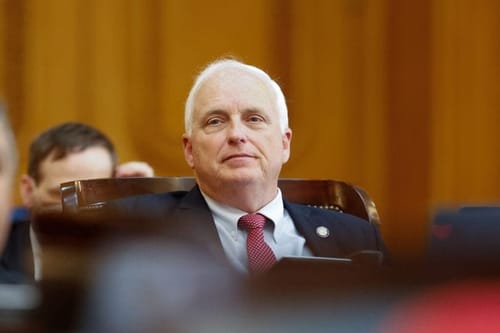

An Ohio senator wants to place new limits on the scope and duration of post-employment noncompete contracts for certain health care workers.
The agreements are commonplace in several industries, but state Sen. Terry Johnson, R-McDermott, says they can be particularly onerous in the health care field.
In January of 2023, the Federal Trade Commission introduced a proposed rule banning all noncompete contracts nationwide.
Commissioners issued the final rule in April last year and courts put it on hold that August.
Two months ago, the Trump administration Federal Trade Commission formally announced it was abandoning the rule.
In committee, Johnson explained he was working on a bill limiting noncompete contracts for physicians before the federal commission acted.
“It’s apparent to me that the only way to resolve the situation regarding our health care workers will not be from the federal government, but at the state level,” he said.
The proposal, Ohio Senate Bill 301, limits noncompete contracts to six months and 15 miles.
Those protections apply to physicians, physician assistants, and advanced practice registered nurses working at nonprofit hospitals.
“Noncompete agreements are inherently anti free-enterprise and impede an individual’s ability to earn a living as he or she so chooses,” Johnson said.
“In fact, it’s not uncommon for some of these restrictive employment clauses to stipulate a radius of up to 50 miles. The most onerous I’ve seen in the state of Ohio is 70 miles.”
Johnson’s bill also specifies that the 15-mile radius only applies to the physical location where a worker is employed.
“If you have a large health care organization that has places all over Ohio, well, every place they have, that restricted covenant applies to,” Johnson said. “So, you can’t practice in Ohio anymore.”
Johnson stressed that his proposal “strikes a fine middle ground” — maintaining hospitals’ ability to impose some staffing restrictions but placing limits on their extent.
Thirty-four other states, he noted, have approved some kind of noncompete limitation in their state laws.
Three neighboring states, Pennsylvania, Indiana, and Kentucky, have noncompete restrictions aimed specifically at the medical field.
State Sen. Bill DeMora, D-Columbus, welcomed the idea, but asked why Johnson didn’t go further.
Why not include all nurses or for-profit hospitals, he asked.
“Because I do agree with you,” DeMora said, “that especially in these rural communities, you get a noncompete, and you’d have to move all the way out of move out of town, 60 miles away, or you’re stuck working a job you don’t want to work at.”
Johnson agreed that noncompete agreements can create “a terrible situation” for workers who have to uproot their life to change jobs but didn’t embrace a more broadly written bill.
He explained the current bill is already an expansion on an earlier version that only applied to physicians.
“You know, certainly someone could come up with a bill like that,” he told DeMora, “and and I might even support it, but I’m limiting this to professionals.”
Someone could write a more expansive bill — DeMora himself, for instance.
Ohio Senate Bill 11, a measure he’s co-sponsoring with state Sen. Louis Blessing, R-Colerain Twp., would prohibit all noncompete contracts going forward.
That measure is currently stuck in the Senate Judiciary Committee and hasn’t had a hearing since March of this year.
Follow Ohio Capital Journal Reporter Nick Evans on X or on Bluesky.
This story is republished from the Ohio Capital Journal. View the original article.