
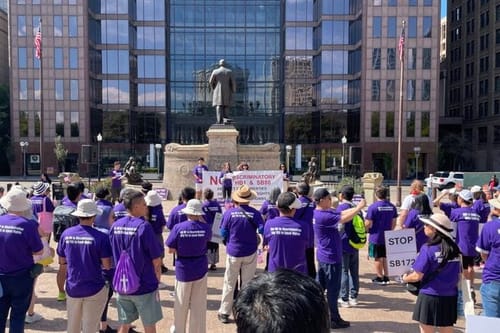

Ohio lawmakers introduced tweaks last month to a bill effectively prohibiting many immigrants from owning land in the state. Those changes include carveouts for green card holders and those who have served in the armed forces. But opponents don’t see the changes as much of an improvement.
The restrictions apply to people from countries designated as foreign adversaries. That list, compiled by the U.S. Secretary of Commerce, includes China, Cuba, Iran, North Korea, and Russia.
As part of Ohio’s 2023 state operating budget, Gov. DeWine allowed restrictions on foreign farmland ownership but refused to apply the same prohibitions to land within 25 miles of military installations. Ohio House Bill 1 revives those vetoed provisions and expands them to include critical infrastructure.
The sponsors’ stated concern is that allowing foreign governments, businesses, and agents to buy land nearby leaves the U.S. vulnerable to spying or sabotage.
“As legislators,” state Rep. Angie King, R-Celina, said when she introduced the bill, “we have a responsibility to protect Ohio from those who seek to undermine and destroy our American values and way of life.”
But critics, including civil rights groups and scores of immigrants from targeted countries, contend the bill is exceptionally harsh. The measure relies on a definition of critical infrastructure that includes large, discrete facilities like power plants, dams, and refineries, but it also extends to vast power and communication networks. For instance, every telephone and utility pole, the lines that run between them, and every cell tower fit squarely within that definition.
The changes
Barring ownership within 25 miles, as the original bill did, leaves little if any land in Ohio available. The amendment in the Ohio House reduced that limitation to 10 miles. But opponents say, with such an expansive list, even a one-mile ban “would render significant portions of Ohio inaccessible for families and businesses.”
In addition to reducing the radius of the bill’s exclusion zone, the amendment provides exemptions for legal permanent residents and people who have served or are serving in the military.
The changes also provide protection for property willed to someone, as well as property used to retire outstanding debts.
County prosecutors raised concerns early on about taking on potentially complex cases. “Without additional resources these cases will take time away from the core responsibilities of county prosecutors,” Ohio Prosecuting Attorneys Association Executive Director Lou Tobin said. The amendment includes a provision giving county prosecutors the ability to hand cases off to the state attorney general if they don’t have the resources to pursue them.
The bill grandfathers land already owned by individuals who would otherwise be prohibiting from ownership, but bars them from acquiring any other property. Should the measure take effect, anyone who becomes subject to the bill in the future would have to sell their property within two years.
In a joint statement, The Asian American Coalition of Ohio, Ohio Chinese American Association, and Justice for Ohio, acknowledged that narrowing the bill’s scope shows lawmakers are hearing them, but they insisted the changes don’t go nearly far enough.
The bill continues to discriminate against people in the U.S. lawfully, the groups said, based solely on their national origin — one of the seven protected characteristics laid out in the federal Fair Housing Act.
The bill also “conflicts directly with established U.S. and Ohio laws governing property ownership, due process and equal protection,” the groups added. Not only does the 14th Amendment of the U.S. Constitution require equal protection, but Article 1 Section 1 of the Ohio Constitution includes “acquiring, possessing, and protecting property” among all individuals’ inalienable rights.
The groups noted as well that the prohibitions would discourage legitimate investment in the state.
“At a moment when Ohio is striving to attract advanced manufacturing, strengthen its workforce, and deepen international partnerships, H.B. 1 sends a damaging and counterproductive message,” they wrote.
As for the newly proposed 10-mile exclusion radius, the groups said, “no evidence has been presented that these sweeping geographic bans improve national security or public safety.”
After the amendment was introduced, state Rep. Juanita Brent, D-Cleveland, pressed supporters to provide a map of the state showing what property is and isn’t excluded. The chair, state Rep. Cindy Abrams, R-Harrison, made no promises, but said she’d ask the sponsors if they have one.
Just before the committee adopted the amendment, state Rep. Cecil Thomas, D-Cincinnati, objected.
“Obviously, it’s discriminatory, in my opinion, on its face,” he said of the bill.
“In my opinion, this particular bill will weaken Ohio’s economy and competitiveness, basically creating an environment that certain individuals or businesses from certain origins of the world are not welcome,” he said. “This bill would clearly create a potential for racial profiling and create a question of equal protection under the law.”
Follow Ohio Capital Journal Reporter Nick Evans on X or on Bluesky.
This story is republished from the Ohio Capital Journal. View the original article.