
This story was originally published by Signal Ohio. Sign up for their free newsletters at SignalOhio.org/subscribe.
State agencies overseeing Ohio’s workers compensation program, fire marshal, state prisons and more have all contracted with Flock Safety, whose network of security cameras continuously use AI to track people’s whereabouts on the public roads.
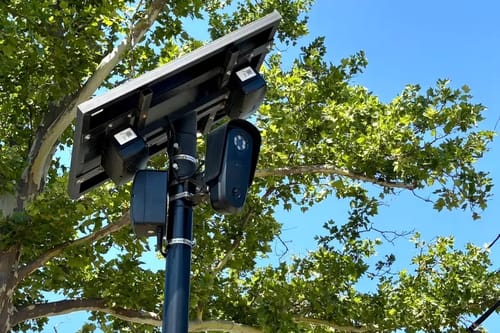
Law enforcement agencies have for years relied on the roadside, pole-mounted Flock cameras to track down suspected criminals or missing persons, emphasizing the boon to public safety when scrutinized over its privacy implications.
Flock owns what critics have estimated to be more than 90,000 “automated license plate readers” around the country that use machine learning, a subset of AI, to identify vehicles. The cameras power a database, searchable by license plate and other visual characteristics (think make, model, bumper stickers, dents and decals) as cars navigate the streets.
But it’s not just law enforcement adopting the new technology, public records show. State officials in Ohio with administrative or state level law enforcement job duties are increasingly tapping into Flock’s network over the past few years to monitor residents.
For instance, the Fire and Explosions Investigation Bureau of the state Fire Marshal’s office utilizes both the Flock network as well as five cameras to investigate fires and explosions, according to a Department of Commerce spokesperson. The state paid $21,000 to Flock last year for the data.
The state Bureau of Workers’ Compensation, which runs Ohio’s insurance program for people who get injured on the job, paid $24,000 to Flock last year to aid in fraud investigations, according to contract records and an agency spokesperson. The bureau paid the same amount to Flock in 2025, and $6,000 over each of the two prior years.
State officials declined to offer specifics about why they’re accessing Flock’s data, how it’s used, or where the cameras are placed.
Controversy around cameras has grown
The ACLU and others have criticized law enforcement’s use of Flock for tracking Americans, en masse, without a warrant. They’ve also highlighted findings from all over the country that the U.S. Immigration and Customs Enforcement has used the data to execute President Donald Trump’s mass deportation efforts.
The state is wading into its relationship with Flock while some Ohio cities, under pressure from residents, have sought to sever or unwind their police departments’ ties with the company.
This has included Dayton placing plastic bags over its Flock cameras to stop them from capturing license plate images; Kent preemptively voting to ban any future Flock contract with its police department; and Columbus promising reforms after an audit identified thousands of database searches on behalf of federal immigration officials. Cleveland recently delayed and then approved a contract extension with Flock but with a shorter term and with new limits on sharing its data.
What is Flock?
Flock Safety, an Atlanta-based company, makes a variety of sound and image capturing technology, including what it calls “advanced license plate readers.” Instead of continuous footage, they’re triggered by motion. The company says the readers can capture still images of license plates. Several of those images can effectively track movement, patterns, associations and others.
Law enforcement agencies can choose to upload their cameras’ feeds to a national database. But the company emphasizes that it’s the police offices and cities themselves that own the data that have say over who has access to the data.
“All of the people who use our services own that data,” said Joshua Thomas, a spokesperson for Flock, speaking at the Cleveland City Club earlier this month. “Locally. They decide who they share it with.”
Several state law enforcement agencies, including the authorities over adult and youth prisons, the Ohio Department of Public Safety, plus the Ohio attorney general’s office, all contract with Flock.
The Ohio attorney general’s office paid Flock $30,000 in 2023 and $75,000 in 2025, spending data shows. A spokesperson said the Ohio Organized Crime Investigations Commission uses the technology to investigate drug trafficking and human trafficking.
The ODRC uses the cameras as an investigatory tool to combat contraband conveyance efforts and other criminal activities at state correctional facilities, said spokesperson JoEllen Smith, who declined to answer further questions.
ODRC paid Flock $213,500 in 2026 and $171,000 in 2025.
And the Department of Youth Services, which runs Ohio’s juvenile prisons, uses Flock cameras to “investigate criminal activity and prevent contraband from getting into our correctional facilities.” It has paid the company about $50,000 over the past two years.
Cities consider cutting ties with Flock
The ACLU has waged an advocacy campaign, urging cities to nix their Flock contracts. Their basic argument is twofold: one, the network makes for a warrantless, mass surveillance state where police can track movements of the innocent; and two, that data flows to federal immigration officials, who use it in their deportation efforts.
They’ve had some success.
This spring, Dayton Police Chief Kamran Afzal announced that an internal review revealed that federal immigration officials accessed data from Flock’s 72 cameras on more than 7,100 instances, part of what he described as a user error in setting permissions. The city has since draped black plastic bags over the cameras, as they’re contractually prohibited from taking them down.
And last year, Kent City Council, in Portage County, preemptively voted to block its police department from entering a contract with Flock. At its meeting, council members expressed skepticism about police claims that federal immigration officials couldn’t access the data.
Elsewhere, there has been controversy but less clear a change.
Last week, Cleveland city council voted 9-6 to pass a six-month extension of its Flock contract spanning 100 cameras – a narrow slice of the whopping 1,700 cameras in Cuyahoga County. It came as something of a walkback after the council’s public safety committee voted to reject it last month.
“Our city is overrun with crime,” Ward 1 Council Member Joe Jones said. “We need to use every tool possible. This is a no-brainer for me. And if council members don’t want the [Flock] cameras and vote against it in their neighborhoods, Mr. Chairman, can you please put them over in my community?”
ACLU spokesman Sean McCann faulted the city for doubling down on “warrantless government spying” and mass surveillance.
“Residents have been clear that we cannot trust any company that sells this technology to protect our privacy rights,” he said.
And in Columbus, audit findings released earlier this month revealed that the city police department’s Flock network was searched for immigration related reasons on nearly 16,000 occasions, despite city policy prohibiting assistance to federal immigration authorities, according to The Columbus Dispatch.
Signal Ohio is a nonprofit news organization covering government, education, health, economy and public safety.