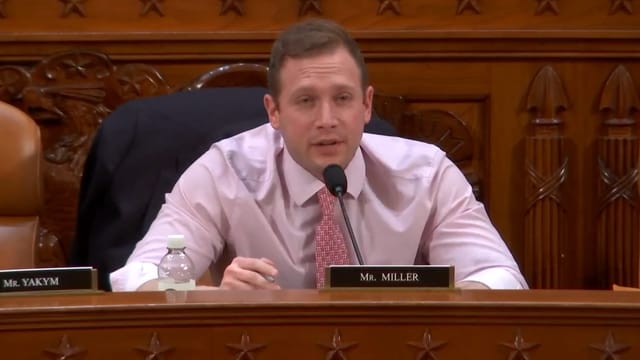
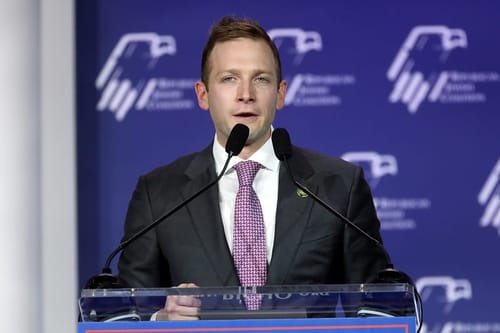

U.S. Rep. Max Miller, the Ohio Republican who represents the state’s 7th Congressional District in northeast Ohio, accepted $14,000 in March 2026 from two cryptocurrency executives whose companies have been the subject of federal court and regulatory action — the maximum amount each donor could legally give — as Miller has positioned himself as one of the industry’s most active allies in Congress.
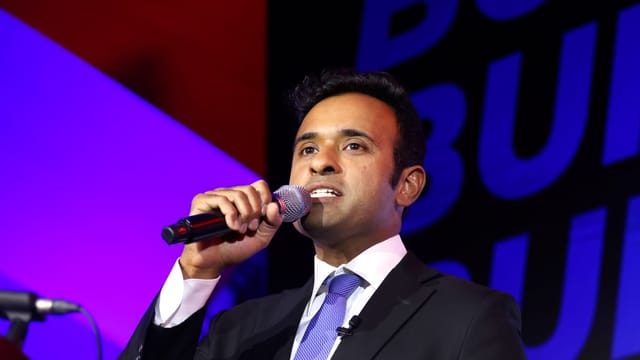
The contributions, which appear in campaign finance records filed with the Federal Election Commission, came from Anatoly Yakovenko, the CEO and co-founder of Solana Labs, and Donald R. Wilson Jr., the founder and CEO of the Chicago trading firm DRW. Federal records list both donations at the per-candidate maximum for the 2025–2026 cycle.
What the FEC records show
FEC data shows Yakovenko, of Boulder, Colorado, contributed $7,000 to Max Miller for Congress on March 31, 2026, and that the committee refunded an additional $3,500 contribution from him the same day. Wilson, of Chicago, made two $3,500 contributions on March 10, 2026, for a total of $7,000. Combined, the two executives gave $14,000 — the limit each individual could contribute across the primary and general elections.
The contributions are legal and were publicly disclosed. There is no indication in the records of any agreement or exchange tied to the donations.
Solana’s Yakovenko is a named defendant in a civil racketeering case
Yakovenko is among the defendants added to a class-action lawsuit over the Pump.fun memecoin platform. In a consolidated amended complaint filed in July 2025 in the U.S. District Court for the Southern District of New York, attorneys with Wolf Popper and Burwick Law expanded the case to name Solana Labs and its leadership, including Yakovenko, alleging violations of the federal Racketeer Influenced and Corrupt Organizations Act, or RICO.
The amended complaint also asserts securities claims and alleged violations of New York General Business Law sections 349 and 350, which address deceptive business practices and false advertising. The RICO allegations are predicated on claims of illegal gambling, wire fraud, intellectual property theft and unlicensed money transmission.
The allegations are unproven. The case, Aguilar v. Baton Corp., remains in litigation, and the defendants have signaled they intend to contest the claims through motions to dismiss. A judge granted plaintiffs leave to file a further amended complaint in December 2025.
Wilson’s firm faced an SEC suit that was dismissed under Trump
The Securities and Exchange Commission sued Cumberland DRW, the crypto trading arm of Wilson’s firm, in October 2024, accusing it of operating as an unregistered dealer in more than $2 billion of crypto assets the agency considered securities. Cumberland disputed the charge and said it had previously tried to register.
In March 2025, after President Donald Trump returned to office, the SEC dismissed the case with prejudice. In its litigation release, the agency said the decision rested on its effort to “reform and renew its regulatory approach to the crypto industry,” and “not on any assessment of the merits of the claims alleged in the action.” The dismissal was one of several crypto enforcement cases the SEC dropped during that period.
According to the Financial Times and public filings, DRW Investments, the firm Wilson founded and controls, invested $100 million in Trump Media & Technology Group — the company behind Truth Social and controlled by the president’s family — about nine weeks after the dismissal, as part of a funding round for the group’s purchase of more than $2 billion in cryptocurrency.
Miller’s record on crypto legislation
The donations arrived as Miller has compiled a consistent record favoring lighter regulation of digital assets. In July 2025, he voted for the CLARITY Act, the digital-asset market structure bill (H.R. 3633), which passed the House 294–134.
The watchdog group Americans for Financial Reform described the bill in a July 2025 fact sheet as “pitifully weak and loophole-ridden” legislation that “will expose crypto investors — and the financial system and real economy — to growing risk, rampant fraud, and money laundering.” The bill drew bipartisan support, with most Democrats who opposed it citing investor-protection concerns.
In December 2025, Miller and Rep. Steven Horsford, D-Nev., both members of the House Ways and Means Committee, unveiled a bipartisan discussion draft of the Digital Asset PARITY Act. The proposal would exempt routine consumer purchases of up to $200 made with regulated, dollar-pegged stablecoins from capital gains tax, among other changes to how digital assets are taxed. Miller has framed the measure as consumer protection, saying it “protects consumers making everyday purchases” and brings “clarity, parity, fairness, and common sense” to digital-asset taxation.
Miller credits the industry with making him ‘passionate’
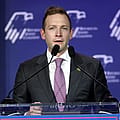
Speaking about the PARITY Act at the DC Blockchain Summit on March 18, 2026, Miller credited the cryptocurrency industry with shaping his views. “I came into Congress, you should probably looked at my background. I’m not a big crypto guy,” he said. “But it’s all of you who educated me to get to this point … It’s because of your industry and people like you as to why I’m up here passionate about cryptocurrency. So thank you for taking the time in your community to educate me as we continue to work on a piece of legislation, when you are the subject matter experts.”
At a Blockchain Association policy summit in December 2025, Miller singled out the previous administration as an obstacle to the industry, saying the “only one who is really hostile toward it” during his time as a member and as a congressional staffer “was really President Biden and his administration.”
Miller, a former senior aide in the first Trump administration, was first elected in 2022 and is running for reelection in 2026.