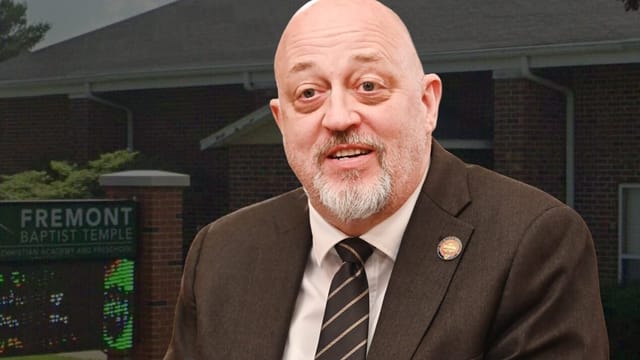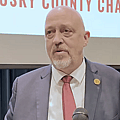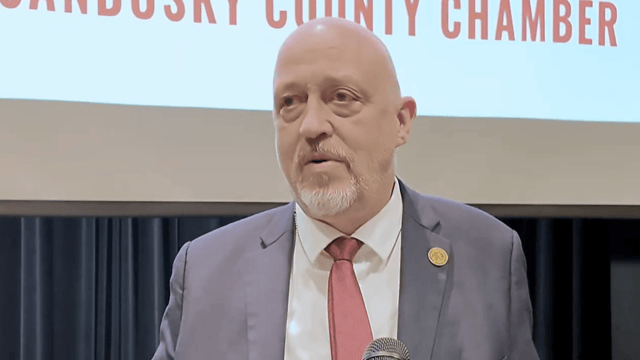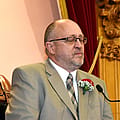
TIFFIN, Ohio — Rep. Gary Click (R-Vickery), a fundamentalist Baptist preacher and former community theater actor, has pursued a two-part approach to education funding: first authoring legislation to funnel public dollars to the type of private religious school operated by his own church, then cosponsoring a bill that is now costing Tiffin City Schools $1.2 million annually—with no state oversight of where the voucher money would go.
In late 2023, Click introduced legislation to create vouchers for nonchartered religious schools like Temple Christian Academy, the Baptist school run by Fremont Baptist Temple, where Click served as pastor for 19 years and currently holds the title of Pastor Emeritus. That voucher bill died three times, including a veto by Republican Governor Mike DeWine. Then in 2025, Click cosponsored a property tax cap that forced Tiffin City Schools to place its first operating levy on the ballot since 2012, asking the median household to pay approximately $408 per year to maintain basic classroom operations.
The property tax cap
Click is listed as a cosponsor of House Bill 186, branded “Stop the Spikes,” which caps school district property tax revenue growth at the rate of inflation. The Ohio House Republican Caucus estimated the bill would save property owners nearly $1.7 billion over three years—savings that come directly from school district revenue.
According to Tiffin City Schools Treasurer Anne Spence, HB 186 is one of two pieces of property tax legislation directly responsible for the district’s projected $1.2 million annual funding loss, which takes effect in March 2026. The Advertiser-Tribune reported Spence’s identification of the bill as a primary cause of the revenue shortfall.
The financial pressure has already forced significant changes in Tiffin. The district placed a 0.75% earned income tax levy on the ballot—its first operating levy since 2012. The levy generates approximately $3.2 million annually for day-to-day operations including salaries, benefits, utilities, and maintenance. Superintendent Jerry Nadeau called it necessary to “keep our doors open,” according to WTOL reporting.
The district has also sold off 82 acres of farmland it purchased in 2019 for nearly $1 million, originally intended for future expansion. Under financial pressure, the board voted to auction the property and redirect proceeds to maintaining existing buildings.
Superintendent Jerry Nadeau resigned in December 2025, marking the fourth superintendent change in recent years during a period of escalating fiscal challenges.
The voucher push came first
In November 2023, Click introduced House Bill 339, establishing what he called the “Nonchartered Educational Savings Account Program.” The bill would create a new funding unit within Ohio’s state foundation formula to funnel public education dollars to nonchartered nonpublic schools—private schools that have declined state oversight.
Each participating student would receive 90% of the statewide average base cost per pupil in public money. The bill had zero cosponsors from either Republicans or Democrats in the Ohio House.
HB 339 received two committee hearings but never received a vote. Click provided sponsor testimony at the first hearing on January 16, 2024. Proponent testimony was heard at a second hearing on February 13, 2024, including from representatives of the Buckeye Christian School Association. The bill died in committee at the end of the 135th General Assembly.
Click’s church connection
Click, originally from Indiana, accepted the position of pastor at Fremont Baptist Temple in 2006 and served through 2025. His official Ohio House biography states he “recently stepped down and assumed the honorary title of pastor Emeritus.” He remains listed on the church’s leadership page.
Fremont Baptist Temple operates Temple Christian Academy, a PreK-12 nonchartered Baptist school located at 1150 S. County Road 198 in Fremont—in Sandusky County, within Click’s own legislative district. According to National Center for Education Statistics data, Temple Christian Academy has approximately 40 students and a student-teacher ratio of 5:1. The school is affiliated with the American Association of Christian Schools.
The church’s leadership page lists “Pastor Gary Click” in the top leadership position. Multiple staff members serve dual roles at both the church and Temple Christian Academy, including teaching at the school while serving as church ministers.
Click has also publicly identified himself as a board member of the Buckeye Christian School Association (BCSA), which lobbies on behalf of nonchartered Christian schools in Ohio—the same schools HB 339 would fund.
In a post on the BCSA website, Click described how he “participated in several discussions” as a board member on lobbying the state. Click wrote about winning a “legislative victory” to exempt church-operated preschools from state licensing: “As a board member of the Buckeye Christian School Association, I participated in several discussions on this issue. Together we decided to lobby the state on this matter.”
BCSA representatives Keith Hamblen and Robert Kurtz, both identified as representing Buckeye Christian School, submitted proponent testimony for HB 339 at the February 13, 2024 hearing.
Click’s official Ohio House biography states he has spent over 30 years in ministry including “Christian education” and “lobbying Congress on behalf of churches and Christian schools.”
No state oversight
HB 339 explicitly blocked the state from overseeing schools receiving public money through the program. The bill declares nonchartered schools are “autonomous and not an agent of the state or federal governments.”
The Treasurer of State “shall not regulate the curriculum, instructional methods, or other aspects of a school’s educational program,” according to the bill text. The legislation states the program “does not expand the authority of the Treasurer of State to impose on nonchartered nonpublic schools any additional requirements beyond those expressly prescribed.”
Participating schools “shall be given maximum freedom to provide for the educational needs of their students,” the bill declares.
The legislation contains no requirements for teacher certification, curriculum standards, or academic performance benchmarks. The only substantive requirements are administering a standardized test chosen by parents, maintaining a physical location, and basic health, fire, and safety compliance.
Contradictions in testimony
In his written sponsor testimony, Click stated: “These are schools that, for religious reasons (i.e. separation of church and state,) choose not to receive direct funding nor accept direct regulation from the state.”
Click characterized HB 339 as funding families, not schools. In his testimony, Click wrote: “The Education Savings Accounts, however, funds the families, not the schools. Families may then direct those restricted resources to the school.”
However, the bill’s own text explicitly allows the Treasurer of State to “disburse funds directly to a participating school.” Section 3310.24(B)(1) provides for direct payment to schools as one of two disbursement methods—contradicting Click’s characterization that funds go to families rather than schools.
Click also described HB 339 as correcting an “oversight” in universal school choice, writing: “House Bill 339 corrects an oversight in the Universal School Choice program instituted in House Bill 33.” The exclusion of nonchartered schools from the voucher program was not an oversight—it reflected the longstanding arrangement in which these schools declined state funding in exchange for avoiding state regulation.
Three failed attempts
The nonchartered school voucher concept has failed three times:
Attempt 1: HB 339 died in committee with zero cosponsors in the 135th General Assembly.
Attempt 2: Sen. Mark Romanchuk introduced Senate Bill 68 on February 12, 2025, with the same concept. The bill would pay tuition up to 90% of the statewide average base cost per pupil, with a fiscal estimate of $51 million. Like HB 339, it has zero cosponsors and remains in committee.
William Phillis, executive director of the Ohio Coalition for Equity and Adequacy of School Funding, told NBC4 Columbus: “These schools that didn’t want to have any state regulations agreed not to take any state money. But now this clever device to give money to parents, and then they can give the money to the nonchartered, nonpublic schools, the totally unregulated schools.”
Attempt 3: The Ohio House inserted a nonchartered ESA program into the state budget (HB 96). The budget version capped the voucher at 75% of the EdChoice amount (up to $4,625 for K-8, $6,306 for 9-12), with an estimated cost of $35 million per year.
The Ohio Senate stripped the nonchartered ESA from its version of the budget. The Ohio School Boards Association’s summary of Senate changes confirmed: “Removes House language creating Educational Savings Accounts for nonchartered” schools.
The conference committee restored the ESA provision to the final budget, but Governor Mike DeWine vetoed it on June 30, 2025. DeWine cited the Bishop Sycamore scandal as evidence of the risks, stating: “Without proper accountability, this item would risk taxpayer dollars on programs that may have compromised educational quality or that could risk student safety.”
DeWine noted that nonchartered schools “are not chartered by the state” and “do not receive any state or federal funds” by their own choice. The veto was one of 67 line-item vetoes—the most of any budget in DeWine’s tenure. Lawmakers discussed an override session but did not have consensus to override the ESA veto specifically.
The accountability contrast
The contrast in accountability is stark. After his voucher bill failed repeatedly, Click cosponsored HB 186, which constrains how much revenue public schools can collect—schools that are subject to state curriculum standards, teacher certification requirements, public reporting, and voter-approved levies.
His earlier HB 339 would have created new public funding for schools that are explicitly exempted from state regulation of curriculum, instructional methods, and virtually all accountability measures.
The pattern is clear: Click first tried to create a new funding stream for schools like the one at his church—with no strings attached. When that failed, he cosponsored legislation that cut funding to his constituents’ public schools. Tiffin taxpayers are now paying $408 more per median household to keep their schools open.