
A Florida congressman said last month that forcing tens of thousands of Haitians to return to the violence-ravaged country will actually help it.
But a humanitarian worker on the ground in the nation’s capital said it will only make a dire situation much worse — in multiple, mutually reinforcing ways.
And that’s aside from what it will do to the children, women, and men who have spent years as part of communities in Ohio and other states.
More than 350,000 Haitians are waiting to be deported to their home country after the Trump administration terminated their temporary protected status. It officially ended on July 27 and a court lifted an injunction last week.
As many as 18,000 Haitian former-TPS holders are in Ohio, with many concentrated in Springfield. But many others are in the Columbus area and elsewhere, said Lynn Tramonte, founder of the Ohio Immigrant Alliance.
As yet, mass deportations haven’t begun, but they’re widely anticipated. Haitians who have lost protections are being fitted with ankle monitors when they report to required check-ins with U.S. Customs and Immigration Enforcement. Many already lost their jobs when they lost the legal right to work.
Dire situation
As they wait, Ohio’s Haitians face going back to a country that may be even more dangerous than the one they left after a devastating earthquake in 2010.
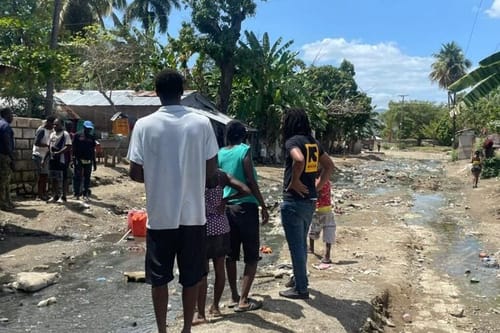
Gangs control about 90% of the capital, Port-au-Prince, and they’re spreading out into the rest of the country. As they do, they’re using rape, kidnapping, and violence to raise money and project power.
Rape is “being done by the gangs when they’re trying to take over a district,” Allie Pasieka, the International Rescue Committee’s Deputy Director of Programs in Haiti, said in a phone interview from Port-au-Prince last week. “It’s being used as a weapon… It’s being used to send messages.”
UNICEF, the United Nations Children’s Fund, reported a 1,000% increase in child rape in Haiti between 2024 and 2025. In a 2025 press briefing, spokesman James Elder said gangs had turned children’s “bodies into battlegrounds.”
Pasieka said the horror continues.
“We are seeing an enormous volume of sexual violence,” she said. “It’s used as a tool of fear and control in the parts of Port-au-Prince that are under gang control and the portions of Haiti that are increasingly under gang control.”
Among its other programs in Haiti, the International Rescue Committee provides support for victims of gender-based violence, operates health clinics, and tries to prevent the spread of diseases such as cholera.
To support the International Rescue Committee go to its webpage.
It also operates programs aimed at keeping kids out of gangs and helping them when they leave.
Focus on Springfield
Tramonte of the Ohio Immigrant Alliance said there are former holders of protected status all over Ohio, and Columbus and the central region of the state are home to the biggest populations of Haitian descendants generally.
But, she said, ICE’s biggest target right now seems to be those with some connection to Springfield.
Springfield, Ohio was the object of then-candidate Donald Trump and then-Ohio U.S. Sen. JD Vance’s racist lies in 2024 that Haitians were stealing and eating their neighbors’ pets.
“ICE is particularly focused on Springfield,” Tramonte said. “The call-in letters that people are getting to go to the field offices for check-ins, every single one of them has a nexus to Springfield. Even if people are being told to go to the Westerville office (in suburban Columbus), it’s all people who lived in Springfield at some point in time.”
When they’re forced back to Haiti, it will be to a place where kidnappings and other depredations are rampant.
Pasieka of the International Rescue Committee is reluctant to talk about the danger she faces.
While she is in a relatively secure section of Port-au-Prince, she has Haitian colleagues “who have children who go to school every day and they wonder if something’s going to happen to them,” she said.
“The threat of kidnapping is very, very real for them. They are on the front line of the aid and of the danger.”
The problem is so bad, the International Rescue Committee reports, that 60% of households keep their kids out of school from fear of kidnapping and other dangers.
Because of their connection to the United States, people who are deported from Ohio are likely to be targets of kidnappings in the gangs’ relentless quest for cash.
“When it comes to kidnapping, everyone is potentially a victim. There are different ways they approach it, but everyone could be kidnapped,” Pasieka said.
“But because kidnapping can be based on perceptions of wealth, then anything that would lead you to be perceived as wealthy or even somewhat wealthy would lead you to be a potential victim.”
Tramonte said Ohio Haitians who lost their protected status are well aware of the dangers they’ll face when they’re forced back to their troubled country.
“Absolutely,” she said. “They were there, first of all, so they saw these things up close and personal. They’ve had family members and friends killed, sometimes right in front of them. And they talk to people every day about what’s going on.”
Mass hunger
Beyond the profound trauma caused by all the violence, a related problem might cause even greater suffering: a humanitarian crisis afflicting nearly half of the nation’s people.
“Five million people at the moment can’t feed themselves,” Pasieka said. “They aren’t able to reach the volume of food the (World Health Organization) recommends for a person. That is just a fact — 5 million people. Whether that’s going to come up, we don’t know. But based on the indicators we’re seeing, it’s likely to rise further.”
While not yet technically a famine, people in Haiti are dying, said International Rescue Committee spokeswoman Sylvan Foley.
“Well before we get to famine, we’re already seeing people die from malnutrition, and we’re already seeing that on the ground in Haiti,” she said.
And, because the U.N. and non-governmental organizations like the International Rescue Committee are stretched to the limit, returnees from the United States can’t expect much help when they get to Haiti.
“The humanitarian funding is very insufficient for what we’re seeing in the country,” Pasieka said.
People who lost protected status in the United States “have a specific vulnerability, but they’re not being prioritized as if we were fully funded. The needs are just enormous, and they’re just spilling out everywhere. We’re just trying to keep a lid on basic food distribution and health protection and other areas for those who are the most in need.”
Creating TPS hurt Haiti? And ending it will help?
In spite of the dire situation, one congressman said deporting former TPS holders to Haiti will actually improve the situation.
House Foreign Affairs Committee Chairman Brian Mast, R-Fla., this year led a delegation there. In an interview with Fox News, Mast acknowledged the deep poverty and rampant violence, but he said he didn’t think there was much the United States could do to help.
However, he said, ending TPS would improve a security situation in Haiti that TPS had undermined.
“One of the big things would be to take the able-bodied males and put them into the police and military, which are actively recruiting, which were so decimated by the TPS taking place in the first place,” Fox quoted him as saying.
“All of these people took the chance to say ‘Okay, I’m leaving,’ and it left their forces that are supposed to protect the country essentially with no forces, which is one of the other parts of how the gangs came to be.”
There are 350,000 or fewer former Haitian TPS holders. While it’s unknown how many of them are males of an age appropriate for military or police work, it’s questionable that their departure gutted the potential security workforce in a nation of 12 million.
Mast’s office didn’t respond to a request for comment.
Double whammy
The International Rescue Committee staffers weren’t asked about Mast’s statements, but what they said about conditions in Haiti contradicted what the Florida congressman said.
Termination of TPS will result in a major loss of revenue flowing into the impoverished country, they said.
It’s unknown how much in such “remittances” to family and friends have been coming from TPS holders alone, but in 2024, the Miami Herald reported, the amount of all foreign remittances was greater than the Haitian government’s entire annual budget.
With the termination of TPS, a large chunk of that money is being wiped out.
At the same time, hundreds of thousands of returnees will only add to the humanitarian crisis in a country whose legitimate economy is on life support, the aid workers said.
“Haiti is not a safe place at the moment. We hope that it will be in the future,” Pasieka said. “But this is not a safe place to return to. Any way we can avoid adding people to the existing crisis can only be beneficial. So I believe ending TPS is not a good thing for the Haitians.”
Breaking faith
Tramonte of the Ohio Immigrant Alliance said that ending TPS not only breaks faith with Haitians, it also breaks faith with American ideals, she said.
“They saved their own lives,” Tramonte said. “They did the hard part. They escaped. They’ve established new lives here in Ohio. They’ve gotten jobs. They’ve taken care of themselves and they’ve taken care of people back home. They’ve sent money to their families and they’re often the only source of income for people in Haiti.
“To take that all away from them, from the people in Haiti, and to send them back into what Gov. (Mike) DeWine has called hell… If that’s what we’re going to do, then we are not who we say we are.”
This story is republished from the Ohio Capital Journal under a Creative Commons license. View the original article.