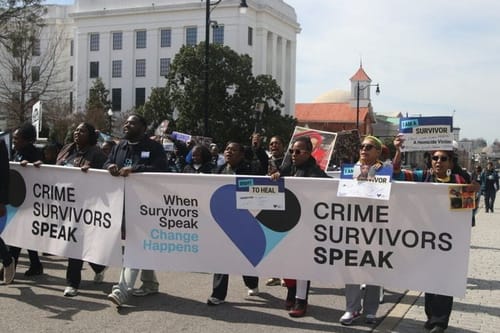
While federal efforts to strengthen victim compensation are underway, states play a critical role in determining whether survivors of gun violence can actually access that support, according to a new report from Everytown for Gun Safety, a nonprofit gun research and advocacy organization.
Access to victim compensation varies widely by state, with nearly 30% of applications denied nationwide in 2024, according to federal data from the Department of Justice’s Office of Victims of Crime. Incomplete paperwork is the most common reason, but strict eligibility rules, short filing deadlines and requirements that the crimes be reported to law enforcement also prevent many survivors from receiving aid, the report found.
Each year, tens of thousands of people survive shootings in the United States, often facing lasting injuries, trauma and financial strain. State-run crime victim compensation programs, which are primarily funded through the federal Victims of Crime Act, or VOCA, are designed to help cover costs such as medical care, lost wages and funeral expenses.
But the Everytown for Gun Safety report highlighted significant disparities in how those programs operate. Average payouts, denial rates and eligibility rules differ across states, shaping whether survivors can successfully access support.
In some states, claims can be denied based on a victim’s prior criminal record or their perceived role in the incident — practices the report says can disproportionately affect Black applicants and rely on subjective or biased judgments.
The analysis also pointed to administrative hurdles, including complex applications, limited staffing and slow processing times. A lack of awareness of these programs further limits access, especially for people who do not report crimes to police. Federal crime data suggests that nearly half of violent crimes are not reported to police.
New laws in New York, which went into effect late last year, made changes that the report’s authors cite as examples of how states can improve access. The laws expanded the time victims have to apply for assistance, increased reimbursement caps for funeral expenses and reduced reliance on police reports to verify claims.
Several states this year, including Alabama, California, Idaho and Minnesota, are considering legislation aimed at supporting crime victims. Some of the legislation would extend application deadlines and provide mental health services for young survivors of gun violence.
In 2024, victim compensation programs paid out about $405 million across nearly 219,000 claims nationwide, according to federal data cited in the report.
Funding for those programs has fluctuated over the past decade. The federal crime victims fund, which is financed through criminal fines and penalties imposed by the feds, dropped sharply from about $13 billion in 2017 to roughly $1 billion by 2023, leading to cuts to state programs and service providers. Congress has taken steps to stabilize funding in recent years, but funding has continued to fluctuate.
The Trump administration last year also froze or canceled hundreds of millions of dollars in grants from the federal Department of Justice, including an estimated $50 million for victim services.
Stateline reporter Amanda Watford can be reached at ahernandez@stateline.org.
This story was originally produced by Stateline, which is part of States Newsroom, a nonprofit news network which includes Ohio Capital Journal, and is supported by grants and a coalition of donors as a 501c(3) public charity.
This story is republished from the Ohio Capital Journal. View the original article.