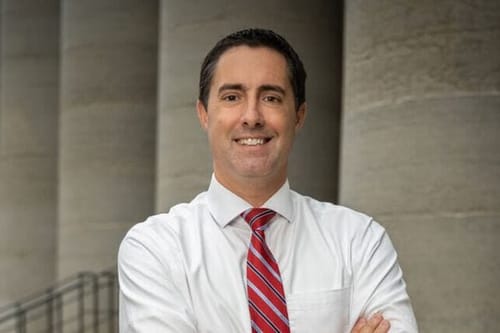

If you are one of Ohio’s nearly 8 million registered voters, your personally identifiable information like full name, address, date of birth, driver’s license and partial Social Security numbers may be compromised thanks to Ohio Secretary of State Frank LaRose.
He quietly shared the state’s complete voter registration list, with significant private data about each Ohioan in the file, to Trump’s Department of Justice last month without any certainty about how it will be used, shared, or protected.
And without any consent from voters.
Justice department officials say they have a statutory mandate to enforce federal voting laws — which is different than building a national database of every voter in the country for who knows what — something the federal government has never done before and lacks congressional authority to do.
Still, DOJ leaders trying to seize unredacted voter rolls in an unprecedented power grab over state sovereignty have the gall to insist that the president’s top priority is to ensure the voting public’s confidence in election integrity.
We are talking about the same convicted felon who conspired to overturn a free and fair election in 2020 and incited a violent insurrection on the U.S. Capitol, right?
The same guy who just declared the need to “nationalize” elections and urged the GOP to seize control of voting procedures in swing states such as Michigan, North Carolina and Arizona?
The attempted coup plotter who ordered FBI raids to confiscate state election ballots in Georgia to reseed invented conspiracies about a stolen election he lost?
Alarmed yet?
The justice department has pressured states to agree to a “confidential memorandum of understanding” and hand over their full voter files without redactions — or be sued.
LaRose capitulated on Feb. 13.
He sent an electronic copy of statewide voter data, including personal, sensitive information, to Trump’s DOJ “for purposes of enforcing” federal regulations with the “understanding that the Department of Justice will use the records only for legitimate governmental purposes and will not disclose any of the provided records to any entity except as authorized” — and that all federal data-privacy laws will be strictly followed.
But the DOJ agreement that compelled at least 12 states to release privileged information about their unsuspecting voters reveals plans to interfere with states’ authority to run elections and how dangerously insecure the sensitive data will be in the department’s hands.
The Trump regime has already asserted DOJ is sharing the voter registration data it collects with the Department of Homeland Security.
Most states have refused to turn over private voter registration databases to the DOJ and instead provided only publicly available voter information which omits driver’s licenses and Social Security numbers.
DOJ has sued over two dozen states to force compliance, but many have argued (successfully) that their obligations under federal law do not require the full, uncensored disclosure of sensitive voter information.
As Utah’s Republican chief election official put it, “Neither state nor federal law entitles the Department of Justice to collect private information on law-abiding American citizens.”
West Virginia, which supported Trump in 2016, 2020, and 2024, (like Ohio) was adamant that “the federal government is not going to get any personal information on West Virginia voters.”
Kentucky also gave Trump its support in those elections, but Republican Secretary of State Michael Adams said he would not give “Kentuckians’ personal data to the federal bureaucracy unless a court orders me to.”
And therein lies the rub.
The DOJ’s aggressive scheme to commandeer the complete voter rolls of states has been rejected by multiple courts who find zero legal justification for the department’s claimed entitlement.
Three federal courts in 2026 ruled that the Department of Justice had no right to unredacted copies of state voter registration lists.
One judge called the DOJ’s lawsuit for private voter roll data not just an overreach into state-run elections, but a threat to American democracy.
“The centralization of this information by the federal government would have a chilling effect on voter registration which would inevitably lead to decreasing voter turnout as voters fear that their information is being used for some inappropriate or unlawful purpose.”
Another federal judge, appointed by Trump, echoed that sentiment when he dismissed the DOJ’s attempt to obtain Michigan’s full voter registration list.
He reiterated the absence of any full disclosure requirements in federal statutes cited by the department — the National Voter Registration Act (NVRA), the Help America Vote Act (HAVA), and the Civil Rights Act of 1960 — and said interpreting those laws to require such disclosure would “contradict” their objective to increase voter participation “because the risk of having one’s personal information misused will deter people from registering to vote.”
Yet another judge ruled that the DOJ can “no longer” be trusted to be acting in good faith.
But in a recent interview, LaRose essentially accepted the DOJ’s refuted claims at face value.
He was confident the federal government would follow data privacy laws — despite a massive Social Security Administration data breach last year.
“It’s clear the DOJ knows how to handle sensitive information,” said LaRose glibly in the wake of its major privacy failures with the Epstein files.
If you’re one of Ohio’s nearly 8 million registered voters whose personal records are now property of Trump’s duplicitous Justice Department, are you reassured?
This story is republished from the Ohio Capital Journal. View the original article.