Miami-Dade prosecutors dropped kidnapping and aggravated-battery charges against former Ohio Republican legislative candidate Daniel Kalmbach after losing contact with the alleged victim for months, leaving them unable to prove their case when a judge refused to postpone his trial again.
In a November 16 internal memorandum obtained by TiffinOhio.net, Assistant State Attorney Janeen Zamora detailed months of unsuccessful efforts to locate the woman, including subpoenas, background searches and assistance from police in Pennsylvania. The prosecution had no video footage of the alleged assault and no other witness who had observed it.
“Because there was no other direct evidence to the criminal acts, the State announced a nolle prose as we could not prove the case at trial without the victim’s cooperation,” Zamora wrote.
The charges were dropped November 9, the day Kalmbach’s jury trial was scheduled to begin, ending a prosecution in which the 31-year-old former candidate faced a possible life sentence. Kalmbach had pleaded not guilty.
The prosecutor’s memorandum, obtained through a public-records request, also establishes that a separate domestic-violence case stemming from Kalmbach’s July arrest was never formally charged and was sealed in September. In that matter, the alleged victim explicitly told prosecutors on two occasions that she did not want the case to proceed.
Prosecutors searched for alleged victim for months
Zamora’s memorandum provides the first detailed public explanation of why the felony prosecution collapsed after nearly nine months of proceedings.
When Zamora was assigned to the case in July, she discovered prosecutors had lost contact with the alleged victim despite previous telephone calls and attempts to arrange her availability for court proceedings. Zamora personally called and emailed the contact information prosecutors had previously used to reach the woman, but received no response. Support staff likewise failed to arrange a deposition.
Subpoenas sent to the woman’s last known Miami-area address were returned unserved. In October, Zamora ordered additional efforts to locate her, including background searches and further subpoenas. Building management told investigators that the woman had moved out in June.
The search eventually extended to Pennsylvania, where prosecutors sought assistance from local police. Officers contacted the woman’s parents, who reported being estranged from her but provided a last-known telephone number. Subsequent calls to that number were unsuccessful.
Prosecution staff also searched additional telephone numbers, mailed letters to previous addresses and attempted to identify social media accounts that might provide contact information. The State Attorney’s Office escalated the search to its investigations unit, which was unable to develop additional leads that resulted in contact.
By November 9, prosecutors were facing their third scheduled trial date without contact with the alleged victim.
Zamora wrote that the only other listed witness had not observed any portion of the alleged criminal conduct. The witness became involved afterward, assisting Kalmbach and the woman in contacting police. Investigators also lacked video footage of the incident.
The prosecution requested another continuance, but Circuit Judge Carmen Cabarga denied it. With the alleged victim unavailable to testify and no other direct evidence of the reported offenses, prosecutors announced that they were abandoning both felony charges.
A separate disposition form signed by Zamora and approved by Jonathan Borst on November 16 confirms that prosecutors entered nolle prosequi before trial began. The court closed the case November 9, discharged Kalmbach’s bonds and terminated his pretrial-release conditions.
Charges escalated to kidnapping carrying possible life sentence
Kalmbach’s felony prosecution began with his February 23 arrest by Miami police following allegations of an assault inside a downtown apartment.
He initially faced third-degree felony charges of false imprisonment and domestic battery by strangulation. In April, prosecutors replaced those charges with more serious offenses: kidnapping with a weapon and aggravated battery causing great bodily harm with a deadly weapon.
The formal charging document alleged that Kalmbach confined the woman against her will between February 21 and February 23 while using or threatening to use scissors or a knife. Prosecutors further alleged that he cut her hair and cut her with a knife, causing injuries that left scars.
The kidnapping count was classified as a life felony under Florida law because of the alleged use of a weapon. The aggravated-battery charge was classified as a first-degree felony.
Kalmbach denied the charges and demanded a jury trial. The proceedings were repeatedly postponed, with trial dates initially scheduled for July before being moved into September and ultimately November.
Records separately obtained from the Miami-Dade Clerk document a September 10 hearing in which Cabarga found probable cause that Kalmbach had violated a stay-away order and committed a new law violation. The judge ordered him taken into custody in open court without bond. The supplied minutes do not establish how long he remained detained.
The felony prosecution ultimately ended without a verdict. The state’s closing memorandum attributes that outcome to the absence of the alleged victim’s participation and the lack of other direct evidence sufficient to prove the charges at trial.
Political connections reach incoming House Republican leader Jim Jordan
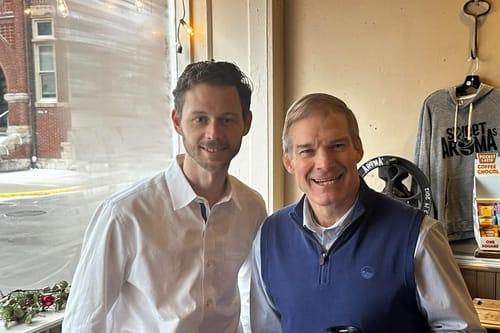
Kalmbach’s political connections extend into the upper ranks of the Republican Party, including U.S. Rep. Jim Jordan of Ohio, whom House Republicans elected November 10 to serve as their incoming minority leader when the new Congress convenes in January.
Jordan endorsed Kalmbach’s unsuccessful 2024 Republican primary campaign for Ohio House District 69, as did U.S. Rep. Bob Latta. Kalmbach also received backing from Americans for Prosperity and the Center for Christian Virtue, organizations that supported his challenge to incumbent state Rep. Kevin Miller.
Miller defeated Kalmbach in the March 2024 primary.
Kalmbach also maintained financial ties to Republican state lawmakers. State Rep. Gary Click, a Vickery Republican, contributed $1,000 to Kalmbach’s campaign in February 2024, according to campaign finance records previously reviewed by TiffinOhio.net. Kalmbach subsequently contributed $350 to Click’s campaign in May 2025.
The former candidate is the son of Paul Kalmbach, chief executive of Kalmbach Feeds, the family-owned animal-nutrition company headquartered in Upper Sandusky.
President Donald Trump nominated Paul Kalmbach on June 1 to serve as U.S. ambassador to Paraguay. The Senate Foreign Relations Committee advanced the nomination November 18, and it remains on the Senate’s executive calendar awaiting confirmation.
The elder Kalmbach has been a substantial financial supporter of Republican candidates and political organizations. Federal Election Commission records document a $250,000 contribution to the Trump 47 Committee, the joint fundraising organization supporting Trump’s 2024 campaign, on June 25, 2024.
A political contribution disclosure published in the Congressional Record as part of Paul Kalmbach’s ambassador nomination lists additional support for Republican organizations and candidates. Among the reported transactions were $25,000 to Make Liberty Win in January 2024 and $5,000 to Latta’s congressional campaign in August 2026, along with contributions involving the Republican National Committee, Bernie Moreno and other GOP committees.
Daniel Kalmbach drew renewed public attention in September when he appeared in a newly released episode of Lakefront Bargain Hunt Renovation, a former HGTV series now airing on Magnolia Network. The program followed Kalmbach and his partner as they renovated a waterfront home at Buckeye Lake.
TiffinOhio.net reported that the network began reviewing the episode after learning of his pending felony charges. The program had been filmed in 2025, before Kalmbach’s arrests.
Separate July domestic-violence allegations never formally prosecuted
The November 16 prosecution memorandum also settles a significant question surrounding Kalmbach’s second arrest, which occurred July 14 at the W South Beach hotel in Miami Beach.
Miami Beach police arrested Kalmbach on allegations of domestic-violence battery and violating a domestic-violence injunction involving the same woman from the February felony case.
According to the July arrest affidavit, hotel employees reported hearing the woman screaming and crying. Responding officers documented redness on her face and forearm, and a records check identified an existing protective injunction involving Kalmbach. He denied that an argument or physical contact had occurred, and the woman also told responding officers that no threats or harm had occurred, according to the affidavit.
Although the arrest led to initial misdemeanor court proceedings and restrictions on Kalmbach’s release, prosecutors ultimately declined to file formal charges.
Zamora’s memorandum identifies the July proceeding as the last documented direct contact between prosecutors and the alleged victim.
On the day of the July arrest, a prosecution paralegal contacted the woman, who said she did not want charges filed and declined to provide a statement. The woman later appeared at the misdemeanor prosecutor’s office without an appointment and repeated that she did not want the prosecution to proceed.
The telephone number used during those contacts was the same one felony prosecutors subsequently tried without success.
The State Attorney’s Office recorded a no-action disposition in the misdemeanor case around September 16, and the proceeding was sealed September 23, according to the memorandum.
The woman’s explicit refusal to pursue the July allegations concerned that misdemeanor matter. In the separate February felony prosecution, Zamora documented unsuccessful attempts to locate her and obtain testimony. The memorandum contains no statement from the woman withdrawing the February allegations.
TiffinOhio.net contacted Kalmbach’s defense attorneys, Howard Srebnick and Mark Shapiro, on November 11 seeking an explanation of the dismissal and an opportunity for Kalmbach to comment. Neither attorney responded by the November 12 deadline. The State Attorney’s Office subsequently supplied the internal case-closing memorandum and related prosecution records.
The memorandum establishes that the woman’s last documented direct communication with prosecutors occurred in connection with the July arrest, when she twice declined to pursue the misdemeanor allegations. Four months later, prosecutors were unable to locate her for the felony trial, and the judge’s refusal to grant another postponement brought the prosecution to an end.