We’re coming close to the point that I wouldn’t want my son to attend college in the United States.
Granted, he’s seven. We have 10 years to turn it around. It’s essential for the health of our nation that we do.
College is a time when you should be able to think big thoughts and explore challenging ideas.
As an English and government major, I took courses that may not have taught me how to code, but they did teach me how to think.
I believe that’s worth fighting for, which is why I’ve joined a growing movement of alumni that are calling on our alma maters to stand strong against ascendant fascism and the Trump regime.
To make a difference, we need to build a powerful coalition representing alumni from the Ivy Leagues, state schools, and community colleges.
Because the assaults on academic freedom are well underway within state capitals and inside university administrations, few institutions will be spared.
Lawmakers in 26 states have introduced more than 70 bills to censure state colleges and universities; 22 have become law in 16 states.
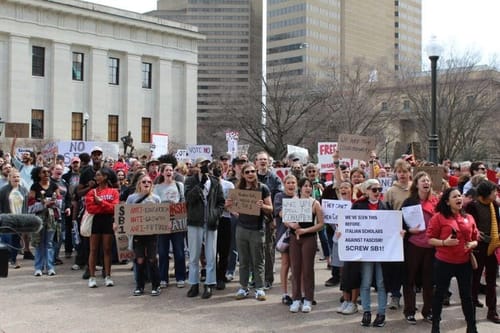
In Ohio, lawmakers passed Senate Bill 1 to root out “woke ideology” at state colleges and universities.
It ensures professors teach “both sides” of issues. It also contains provisions to weaken unions’ collective bargaining power.
Funny how those two things often seem to go together, isn’t it?
It’s troubling to consider how this law would have affected my studies at Cleveland State University’s Maxine Goodman Levin College of Urban Affairs where I received a Master of Public Administration.
We grappled with redlining, segregation, broken windows policing, welfare reform, and many other difficult topics.
What do these discussions look like under Senate Bill 1?
Meanwhile, one institution after another is giving in to Trump’s blackmail.
Northwestern agreed to a $75 million payoff and Brown forked over $50 million.
The University of Virginia and University of Pennsylvania made a host of concessions about student data and DEI to protect their federal research funding.
Columbia University was the first to fall with a $200 million payoff to atone for allegations of antisemitism within student Gaza protests.
Last month, my alma mater, Cornell University, agreed to pay the administration $60 million for similar reasons.
It agreed to hand over student demographic data to prove admissions aren’t being made based on race. But based on my experience (and the data), it seems legacy students and those from wealthy families are the ones with the real advantage.
Yet even before they gave Trump his kickback, Cornell discontinued cultural housing such as Ujamaa House for Black students.
Last year, the administration started cracking down on campus dissent.
They prohibit students from protesting during “business hours” or after 9 p.m. If a student is caught protesting outside that window, they can be temporarily suspended as they await investigations that may take as long as two semesters.
Meanwhile, they still owe tuition and must pay back financial aid.
That’s a costly proposition that seems especially designed to silence the very students most harmed by the Trump extortion deal: first-generation students who are most likely to be students of color or immigrants.
Combine these developments with the eye-popping cost of college and Trump’s further dismantling of our already flawed student loan program and I return to my original statement: If my son decides to go to college, I’m not sure he should stick around here.
Most alumni are busy working, raising families, enjoying retirement or panicking about the many other horrors President Trump is unleashing.
Many of us have been slow to comprehend what has happened on the campuses that shaped us. I’m paying attention now, and closely following the work of Students for a Democratic Cornell, who are leading the charge to give students a voice in the disciplinary process.
Students can vote for 36 hours starting December 12.
Back at home, we’re getting organized.
Groups like Crimson Courage, Stand Strong Brown, Longhorns for Liberty and Stand For Campus Freedom are coming together.
Members of Cornell Courage recently sent a letter to President Michael Kotlikoff and the Board of Trustees calling on them to take measures to increase transparency and protect student privacy.
Alumni like me are fighting back in part to protect the legacy of the institutions that we love.
After all, many of us studied authoritarianism in college.
We understand why Trump wants to destroy anyone or anything that encourages free thinking.
For that reason, the fight is about much more than our colleges’ good name: it’s about our future.
This story is republished from the Ohio Capital Journal. View the original article.